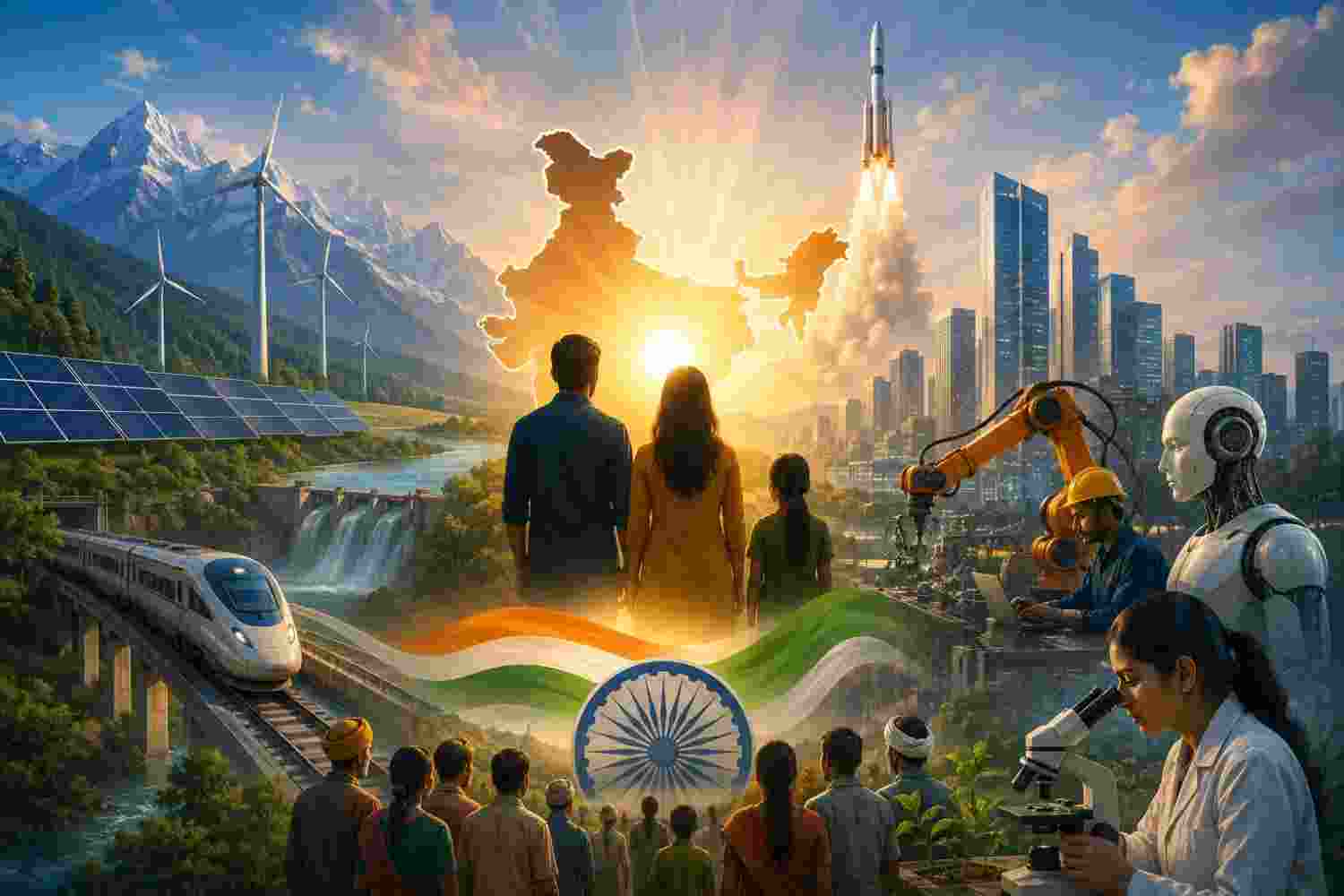
Bharat’s 80th Independence Day is a moment of both celebration and introspection. Since 1947, the country has evolved from a predominantly agrarian, resource-constrained economy to one of the world’s major economic and technological powers. Yet the journey towards Viksit Bharat@2047, the vision of transforming India into a developed nation by the centenary of Independence, demands a deeper understanding of what development should mean for a country as diverse and populous as India.
The next two decades will require more than faster economic growth. It requires stronger human capabilities, productive employment, technological leadership, environmental responsibility, institutional capacity and greater social inclusion. The challenge is to ensure that the India of 2047 is not simply larger and richer, but more prosperous, equitable, resilient and sustainable.
From Economic Growth to Broad-Based Prosperity
India’s economic transformation has created a substantially larger domestic market, expanded infrastructure and strengthened the country’s position in the global economy. However, the transition towards a developed economy requires sustained improvements in productivity and living standards.
The World Bank’s assessment of India’s development trajectory indicates that maintaining high, sustained growth will be essential for India to achieve high-income status by 2047. Growth, therefore, needs to be supported by structural transformation across agriculture, manufacturing and services, alongside improvements in productivity and human capital.
The quality of growth will matter as much as its pace. A developed India must ensure that rising national income translates into better housing, education, healthcare, nutrition, financial security and access to economic opportunities. This requires strengthening the economy’s foundations while ensuring that productivity gains are widely distributed.
The transition from an economy of scarcity to an economy of opportunity will ultimately depend on whether India’s growth becomes sufficiently broad-based to improve everyday economic security across regions and communities.
The Demographic Dividend and the Future of Work
The demographic structure India has provides an extraordinary opportunity for accelerated development, but demographic advantage becomes meaningful only when people can participate productively in the economy. With a large and relatively young working-age population, India has the potential to become a major source of labour, entrepreneurship, consumption and innovation for the global economy.
The World Bank has highlighted employment generation as central to India’s development ambitions, particularly given the scale of new entrants into the labour market. The nature of employment will be particularly important. India will need employment-intensive manufacturing, modern services, productive agriculture and a dynamic entrepreneurial ecosystem capable of absorbing workers with diverse levels of education and skills.
At the same time, artificial intelligence and automation are transforming occupational structures. India’s education and skilling systems will consequently have to become more adaptable, combining technical competencies with creativity, clear communication, analytical ability, and continuous learning.
The demographic dividend can become a powerful engine of Viksit Bharat only when India’s human capital is effectively connected to productive economic opportunities.
Women at the Centre of Economic Transformation
India’s development trajectory will also depend significantly on the extent to which women participate in and benefit from economic transformation. Women’s economic participation has implications that extend well beyond household incomes, influencing productivity, human capital formation, entrepreneurship, and intergenerational welfare. The World Bank’s India development framework recognises greater female labour-force participation as an important component of India’s long-term growth potential.
The next phase of development, therefore, requires an enabling ecosystem in which women can participate meaningfully across agriculture, manufacturing, services, entrepreneurship, research, and leadership. This involves improving access to education, skills, finance, property, digital technologies and formal employment while addressing the unpaid-care constraints that frequently limit economic participation.
Greater economic agency for women would not simply advance gender equality; it would also expand the productive capacity of the Indian economy and strengthen the foundations of inclusive development.
Technology, Artificial Intelligence and the New Digital Economy
India’s digital transformation has already changed the way citizens access payments, financial services, public services and markets. The next stage will be shaped by artificial intelligence, advanced computing, automation, digital public infrastructure and data-driven innovation. India’s experience with digital public infrastructure demonstrates how technological systems can expand access at enormous scale.
The NITI Aayog roadmap on Digital Public Infrastructure and Viksit Bharat places considerable emphasis on using digital capabilities to generate inclusive socio-economic transformation. However, technological progress must remain anchored in human welfare and institutional trust. AI adoption will require appropriate frameworks for privacy, accountability, cybersecurity, algorithmic transparency, and digital inclusion. India also has an opportunity to develop AI solutions suited to its own linguistic, economic and social diversity.
The objective should be to build technological capabilities that complement human skills, improve public service delivery, and generate new economic opportunities, while ensuring that technological advancement does not deepen existing inequalities.
Green Growth and Energy Security
India’s development ambitions will require enormous quantities of energy, infrastructure and natural resources. This makes the transition towards a cleaner and more resilient energy system central to Viksit Bharat. India has committed to achieving net-zero emissions by 2070, creating a long-term framework for transforming its energy and production systems. The Government of India’s net-zero framework highlights the scale and long-term nature of this transition.
The challenge is to reconcile development needs with environmental sustainability without compromising energy access and affordability. Renewable energy, green hydrogen, energy efficiency, electric mobility, sustainable industrialisation and circular-economy practices can increasingly become sources of both environmental and economic opportunity.
Green finance will also be crucial in mobilising the capital required for this transition. India’s development model can consequently evolve from one based heavily on resource-intensive expansion towards a model in which competitiveness increasingly derives from efficiency, innovation and low-carbon technologies.
Building Cities for a Billion-Plus Future
Urbanisation will be another defining feature of India’s journey towards 2047. India’s cities are already major centres of employment, innovation, education and investment, and their importance will increase as structural transformation continues. Yet rapid urban growth without adequate planning can generate congestion, pollution, housing shortages, infrastructure deficits and social exclusion.
The future of Indian urbanisation, therefore, requires a shift from fragmented infrastructure development to integrated urban planning. Affordable housing, mass public transport, efficient water and waste management, resilient infrastructure, clean energy and accessible public spaces will become essential components of liveable cities.
Well-designed urban systems can raise productivity while improving quality of life, making cities not merely centres of economic activity but platforms for social mobility and human development.
Reducing Regional and Social Gaps
India’s development is characterised by considerable diversity across states, districts and communities. Some regions have developed globally competitive industrial and service sectors, while others continue to face significant gaps in infrastructure, education, healthcare and employment opportunities. The World Bank’s recent assessment of India similarly identifies regional disparities and unequal access to quality services among important development challenges.
Also Read — ‘Dimagi Naxal’: PM Modi’s Warning On India’s Hidden Ideological Threat
Viksit Bharat will therefore require a stronger emphasis on spatially balanced development. Infrastructure connectivity, quality public services, digital access and investment in less-developed regions can help distribute the benefits of economic transformation more widely.
Rural India and smaller cities must increasingly be integrated into national and global value chains rather than treated merely as recipients of development expenditure. Greater regional convergence would strengthen domestic demand, reduce economic vulnerability and make India’s growth trajectory more resilient.
The Meaning of India@2047
The journey from the 80th Independence Day to 2047 will be defined by choices made today. Viksit Bharat is ultimately not a single economic target or a particular GDP ranking. It represents a broader developmental aspiration in which economic prosperity is combined with human capability, technological advancement, social inclusion, environmental sustainability and institutional strength.
India’s first eight decades established the foundations of a modern nation. The next two decades must consolidate those foundations while preparing for a world characterised by technological disruption, geopolitical uncertainty, climate change and changing patterns of global production.
The true measure of India at 100 will therefore lie not merely in how much the country produces, but in how widely prosperity is shared, how sustainably it is generated and how effectively human potential is converted into national capability. In addition, India’s global influence will consequently depend not only on the size of its economy, but also on the credibility of its institutions and the strength of its domestic development model.
The 80th Independence Day thus marks not simply another anniversary, but the beginning of a decisive phase in India’s journey towards Viksit Bharat@2047 — a journey in which growth, inclusion, innovation and sustainability must advance together.
Click here to join our WhatsApp Channel for real-time news updates and exclusive coverage.