
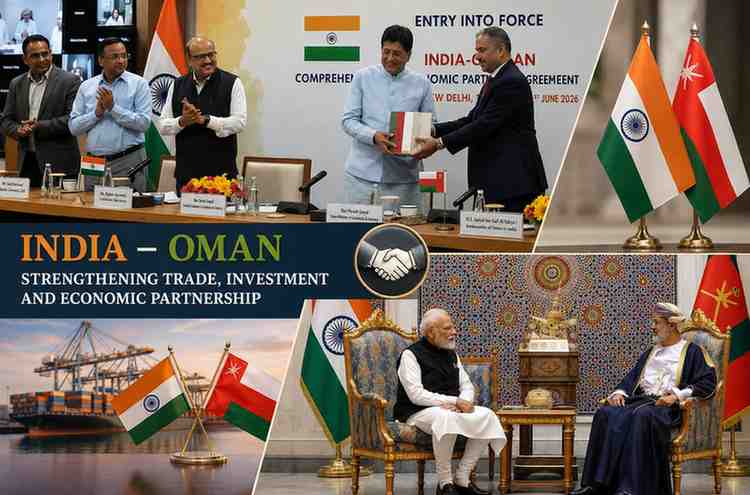
NEW DELHI: India and Oman have taken a major step towards deepening their economic relationship with the implementation of the Comprehensive Economic Partnership Agreement (CEPA), a landmark trade pact designed to boost bilateral trade, investments, services, and professional mobility. The agreement is expected to strengthen India’s commercial presence in the Gulf region while opening new opportunities for businesses, exporters, and service providers in both countries.
The CEPA officially came into force on June 1, 2026, following the completion of domestic approval procedures by both nations. The agreement is being viewed as one of India’s most significant trade initiatives in the Gulf region, reflecting New Delhi’s broader strategy of expanding economic partnerships with key Middle Eastern countries.
Trade between India and Oman has witnessed steady growth over the past few years. Bilateral trade reached more than USD 10 billion in recent years, highlighting the increasing importance of the partnership. Oman is India’s second-largest trading partner in the Gulf and serves as a crucial gateway to the wider Gulf Cooperation Council (GCC) market due to its strategic location and advanced port infrastructure.
One of the most significant gains for India under the agreement is enhanced market access. The CEPA provides Indian exports with duty-free access across more than 98 percent of Oman’s tariff lines, covering almost the entire value of India’s exports to the Gulf nation. This is expected to improve the competitiveness of Indian products and create fresh opportunities for exporters.
Several labour-intensive sectors are likely to benefit from the pact. Industries such as textiles, leather, footwear, engineering goods, pharmaceuticals, plastics, gems and jewellery, agricultural products, marine products, medical devices, furniture, and automobiles are expected to gain from lower trade barriers and preferential access to the Omani market. The agreement is also expected to support employment generation by expanding export opportunities for Indian manufacturers and small businesses.
Beyond merchandise trade, the CEPA covers services, investment, regulatory cooperation, and professional mobility. Oman has opened a large number of service sectors to Indian companies, including information technology, business services, education, healthcare, research and development, and professional services. The agreement is expected to create new opportunities for Indian professionals and companies seeking to expand their footprint in the Gulf region.
The services sector is considered one of the key growth areas under the agreement. Indian firms are expected to benefit from improved market access and reduced regulatory barriers, while provisions related to temporary movement of professionals are likely to facilitate greater mobility for skilled workers and service providers.
Investment is another important pillar of the trade pact. The CEPA aims to encourage greater capital flows between the two countries by providing a more predictable and transparent framework for businesses. Policymakers in both nations expect the agreement to stimulate investments in manufacturing, logistics, infrastructure, technology, and energy-related sectors.
The agreement also holds strategic significance. Oman occupies a key position near major international shipping routes and serves as an important economic and logistical hub in the region. Strengthened economic cooperation with Oman aligns with India’s efforts to diversify trade partnerships, secure supply chains, and expand its economic engagement across West Asia.
With the CEPA now operational, both countries are expected to witness stronger trade flows, increased investments, and deeper business collaboration. As India continues to strengthen its economic ties with Gulf partners, the India-Oman trade agreement is set to play a pivotal role in shaping the next phase of bilateral economic cooperation and regional connectivity.