
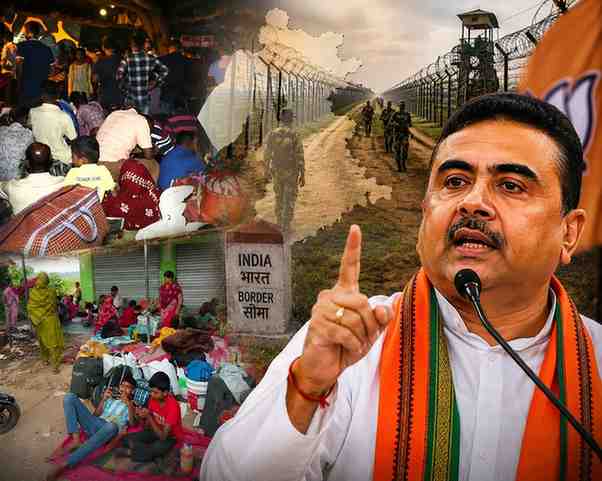
West Bengal has long occupied a unique place in India’s political, cultural, and geographical landscape. Sharing a long and porous international border with Bangladesh, the state has historically experienced cross-border movement of people, goods, and cultures. However, in recent years, concerns regarding demographic changes in several border districts have become a subject of intense political and public debate.
The issue is no longer confined to electoral rhetoric. Questions surrounding migration, border security, citizenship documentation, and the social impact of population shifts have emerged as matters of national importance. The challenge for policymakers is to separate facts from political narratives and ensure that public confidence is maintained through transparency and accountability.
Several analysts and political observers have pointed to noticeable demographic changes in districts such as Murshidabad, Malda, North Dinajpur, South Dinajpur, Nadia, North 24 Parganas, and Cooch Behar. Census data over multiple decades indicates changing population patterns in many of these areas. While demographic change can result from various factors—including birth rates, economic migration, urbanization, and internal population movements—the question of illegal cross-border migration remains central to the debate.
The Trinamool Congress (TMC) government under former Chief Minister Mamata Banerjee failed to adequately address concerns related to illegal immigration from Bangladesh. They contend that electoral considerations may have influenced the state’s approach to migration-related issues. According to this view, insufficient scrutiny of identity documentation and welfare enrollment mechanisms may have enabled undocumented individuals to access public services.
Supporters of the TMC Party, however, reject such allegations and argue that migration-related challenges are primarily the responsibility of central agencies tasked with border management and citizenship verification. They also caution against drawing sweeping conclusions without conclusive evidence and stress that demographic shifts can occur due to a variety of social and economic reasons.
Regardless of political positions, one fact remains clear: the issue deserves rigorous examination based on data rather than assumptions. A democracy functions best when contentious questions are addressed through evidence-based inquiry rather than partisan accusations.
The demographic transformation of border regions carries implications that extend beyond electoral politics. Population changes can affect infrastructure planning, employment opportunities, educational resources, healthcare systems, and local governance. They can also influence social cohesion and public perceptions of security. Consequently, both the state and central governments share a responsibility to ensure that accurate records are maintained and that immigration laws are enforced fairly and consistently.
The debate has also raised broader concerns about national security. Critics argue that if illegal immigration has occurred on a significant scale, there is a need to determine whether administrative lapses, organized networks, or institutional weaknesses facilitated such movement. These concerns become particularly significant in a border state where issues of identity verification and security are closely linked.
In this context, demands for investigation by agencies such as the National Investigation Agency (NIA) and the Intelligence Bureau (IB) have gained attention in political discourse. Advocates of such inquiries believe that a comprehensive assessment could help establish facts regarding illegal migration, document verification processes, and any potential threats to national security. At the same time, any investigation must remain impartial, evidence-driven, and free from political influence.
India’s democratic institutions are strongest when they operate transparently and independently. If concerns regarding illegal immigration, document fraud, or security vulnerabilities exist, they should be examined thoroughly by competent authorities. Equally important, if allegations are found to be exaggerated or unsupported, the public deserves clarity on that as well.
The broader challenge facing West Bengal is not merely demographic change but public trust. Citizens need confidence that borders are secure, welfare benefits reach eligible beneficiaries, and government systems operate without discrimination or political favoritism. Achieving this requires cooperation between state authorities, central agencies, security institutions, and civil society.
As West Bengal moves forward, the conversation must shift from political accusation to institutional accountability. Demographic trends should be studied scientifically, migration concerns should be addressed legally, and security issues should be investigated professionally. Only through transparency and adherence to the rule of law can the state and the nation ensure that legitimate concerns are resolved while preserving social harmony and democratic values.
The debate over demographic change in West Bengal is ultimately about governance, security, and public confidence. It is a matter that deserves careful scrutiny, honest discussion, and above all, a commitment to facts rather than rhetoric.
Suvendu Adhikari led bjp Government Intensifies Crackdown on Illegal Immigration in West Bengal
The BJP government, led by Chief Minister Suvendu Adhikari has placed border security and illegal immigration at the center of its governance agenda in West Bengal. In this scenario, the BJP government led by Suvendu Adhikari has placed border security and illegal immigration at the center of its governance agenda. Reports indicate that the government has adopted a “detect, delete, and deport” strategy aimed at addressing illegal immigration through legal and administrative mechanisms.
The state government has also directed district administrations to establish holding centres for foreign nationals awaiting deportation or repatriation after due legal procedures. Officials have described the move as part of a broader effort to strengthen compliance with immigration laws and improve coordination with central authorities.
In addition, the government has announced measures to enhance border management. Recent decisions include facilitating land transfer for border fencing projects and increasing cooperation with security agencies to prevent unauthorized cross-border movement. Supporters argue that stronger border infrastructure is essential for national security and for preventing document fraud and illegal entry.
The West Bengal government has also emphasized verification of welfare databases and public records. According to government statements, large-scale reviews of beneficiary lists are being conducted to identify irregularities and ensure that public resources are directed toward eligible recipients.
Supporters view these policies as a necessary step toward restoring administrative accountability and strengthening border security. Critics, however, stress that any enforcement measures must strictly follow constitutional protections, legal due process, and safeguards against wrongful identification.
As the debate continues, the government’s approach is likely to remain one of the most closely watched aspects of West Bengal’s political and administrative landscape.