
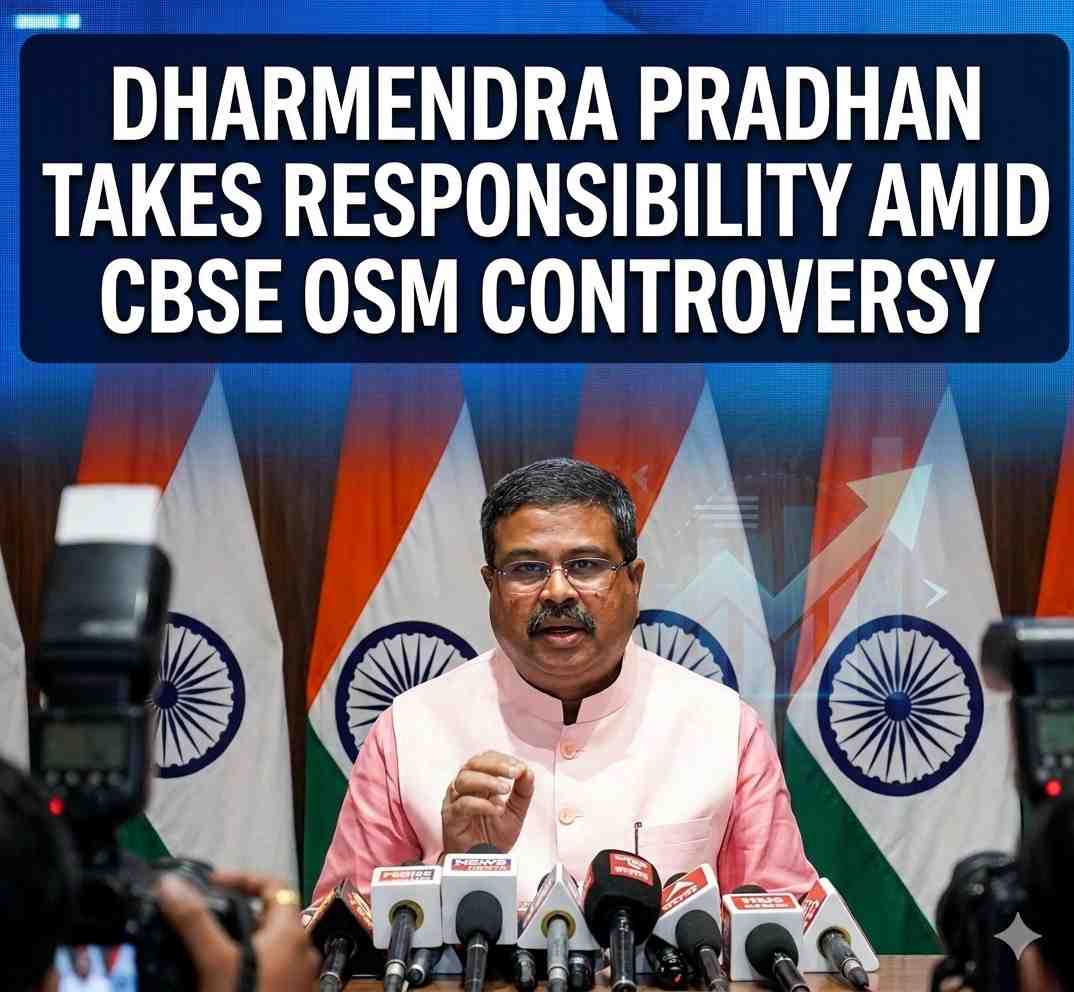
Union Education Minister Dharmendra Pradhan has finally addressed the growing controversy surrounding the Central Board of Secondary Education’s (CBSE) new On-Screen Marking (OSM) system. As criticism intensified from students, parents, and political leaders, the minister publicly accepted responsibility for the difficulties faced during the post-result evaluation process and assured strict action if any irregularities are confirmed.
Speaking after a meeting with CBSE officials in Delhi, Pradhan said that solutions were being worked out and promised that students would receive fair treatment. His statement comes at a time when thousands of Class 12 students across India have complained about blurred answer sheets, missing pages, unchecked answers, payment failures, and technical glitches while accessing scanned copies of their evaluated answer books.
What Is CBSE’s On-Screen Marking System and Why Was It Introduced
The OSM system was introduced this year as part of CBSE’s digital evaluation reform for Class 12 board examinations. Under this system, answer sheets are scanned and uploaded online for teachers to evaluate digitally instead of checking physical copies manually.
According to CBSE officials, over 98 lakh answer books belonging to nearly 18 lakh students were processed digitally this year. Each answer book contains approximately 40 pages, resulting in nearly 40 crore scanned pages being handled through the system.
The Board claimed that the system was designed to improve transparency, eliminate totalling mistakes, and make evaluation more standardised across regions. Since the answer sheets are coded digitally, copies can be checked by evaluators from different parts of the country, reducing regional bias and ensuring more consistent marking.
Pradhan defended the OSM model by calling it a “progressive instrument” already being adopted internationally. He said the system was introduced with the intention of helping students receive accurate and transparent information regarding their marks.
Technical Glitches and Blurred Copies Trigger Student Outrage Nationwide
Despite the Board’s claims, the implementation of the system has faced severe criticism. Students who applied for scanned copies of their answer sheets reported several major problems.
Many students alleged that the copies they received were blurred, incomplete, or difficult to read. Some claimed that certain answers appeared unchecked, while others reportedly received answer books belonging to different students altogether. In addition to these issues, the online payment portal also experienced repeated crashes and technical failures during peak traffic hours.
Several parents complained that payments were deducted multiple times, while some applications were left incomplete due to system errors. The increasing number of complaints created widespread anxiety among students already worried about verification and re-evaluation procedures.
The controversy became even more serious after reports showed a noticeable decline in overall Class 12 results this year. The pass percentage reportedly dropped from 88.39 percent last year to 85.29 percent, marking one of the lowest performances since the Covid-19 period. The number of students scoring above 90 percent also declined significantly.
As concerns grew, many students linked the lower scores to possible flaws in the new digital evaluation system.
CBSE Extends Deadlines and Reduces Fees After Public Pressure Builds
Facing mounting criticism, CBSE introduced several corrective measures. The Board reduced the cost of obtaining scanned answer sheets from Rs 700 to Rs 100 and lowered verification charges from Rs 500 to Rs 100. Re-evaluation fees were also reduced from Rs 100 per question to Rs 25 per question.
The Board further announced that students would receive refunds if re-evaluation resulted in increased marks. This move was seen as an attempt to restore public confidence in the process.
Due to heavy traffic and technical disruptions, the deadline for applying for scanned copies was extended multiple times. CBSE admitted that the portal faced “unprecedented traffic” and also warned about attempts of “unauthorised interference” affecting the system.
Officials stated that nearly 2.94 lakh applications requesting over 8.5 lakh answer book copies had already been received, more than double last year’s numbers. This surge reflected the growing mistrust and concern among students and parents regarding the evaluation process.
Political Debate Intensifies as Opposition Demands Accountability From CBSE
The issue has now turned into a political controversy as Leader of Opposition Rahul Gandhi questioned the handling of the matter and demanded accountability from the government and CBSE.
Responding to criticism, Pradhan maintained that the evaluation process followed proper government procurement rules and assured that no wrongdoing would be ignored. He stressed that “no one will be spared” if any irregularities are discovered during investigations.
At the same time, the minister urged political leaders and the public not to make statements that could increase stress among students. He emphasised that protecting students’ mental well-being should remain the top priority during the ongoing controversy.
Questions Remain Over Transparency and Digital Infrastructure in Education
While CBSE continues defending the On-Screen Marking system as a modern and transparent method, the controversy has raised larger questions about India’s digital education infrastructure and preparedness for large-scale reforms.
Experts believe that although digital evaluation may improve efficiency in the long run, stronger technical systems, better testing, and proper grievance redressal mechanisms are necessary before implementing such changes nationwide.
For now, students and parents continue waiting for clarity, corrections, and reassurance that evaluation errors, if any, will be addressed fairly and transparently.