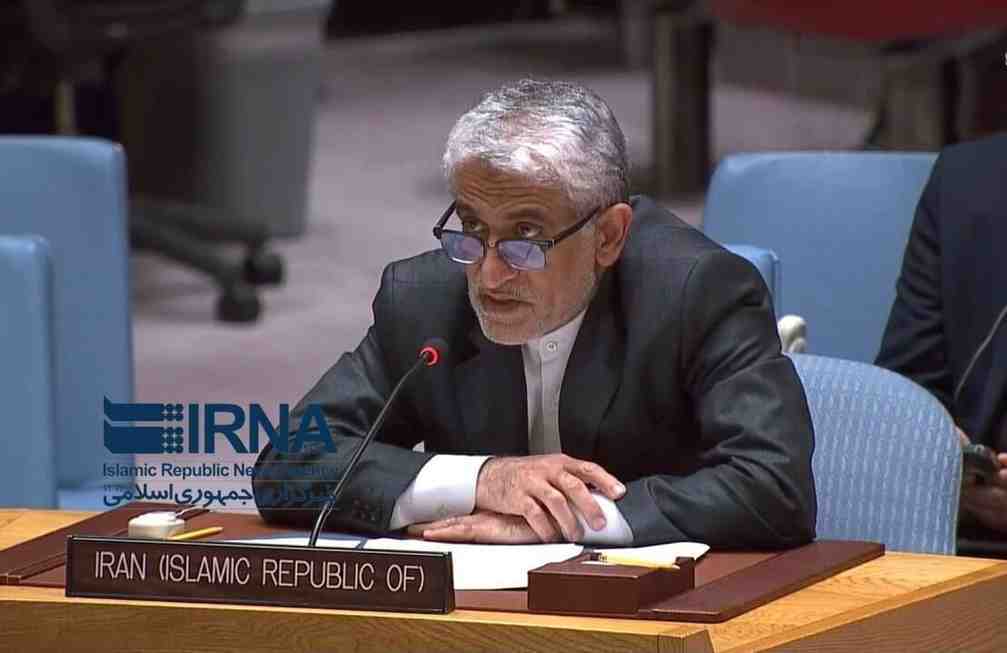
New York: Iran’s Ambassador and Permanent Representative to the United Nations, Amir Saeid Iravani, has defended Tehran’s actions in the Strait of Hormuz, describing them as lawful and fully consistent with international law during a high-level debate at the United Nations Security Council (UNSC).
Speaking at the UNSC session titled “Upholding the Purposes and Principles of the UN Charter and Strengthening the UN-Centered International System,” Iravani said Iran would not allow the strategic waterway to be used for hostile military operations against its sovereignty and national interests.
The Iranian envoy stated that the United Nations was founded to prevent war and establish a global legal order based on the UN Charter. Referring to Article 2(4) of the Charter, he emphasized that the prohibition of the threat or use of force remains one of the fundamental principles of international law.
Iravani accused certain countries, particularly the United States, of undermining international law through unilateral actions, coercive policies, and double standards. He alleged that recent US measures against countries including Iran, Venezuela, and Cuba reflected a broader pattern of interference in the affairs of sovereign states.
The ambassador also referred to the ongoing tensions surrounding the Strait of Hormuz, one of the world’s most important maritime trade routes. He said Iran’s actions in the region were aimed at safeguarding security and preventing the misuse of the waterway for military aggression.
According to Iravani, Tehran’s measures are based on its rights and obligations under international maritime law and are intended to balance regional security concerns with the continued movement of vessels through the Strait.
During his address, the Iranian envoy strongly criticized the United States and Israel over what he called “unlawful acts of aggression” against Iran in June 2025 and again on February 28, 2026. He alleged that the attacks violated the UN Charter and international humanitarian law, claiming that civilian infrastructure, including a girls’ school in Minab, had been targeted.
Iravani claimed that the strikes caused civilian casualties, including the deaths of students and teachers, and accused the Security Council of remaining silent over the incidents.
He further stressed that aggression and violations of international humanitarian law must be condemned irrespective of the country responsible. According to him, the Security Council should not be used to protect certain states from accountability or advance political interests.
The remarks come amid growing international concern over maritime security in the Strait of Hormuz, a crucial global energy corridor through which a large portion of the world’s oil and gas supplies passes. In recent months, several countries, including the United States and Gulf allies, have pushed for UN resolutions demanding unrestricted navigation in the region, while Iran has maintained that its actions are defensive and lawful.