
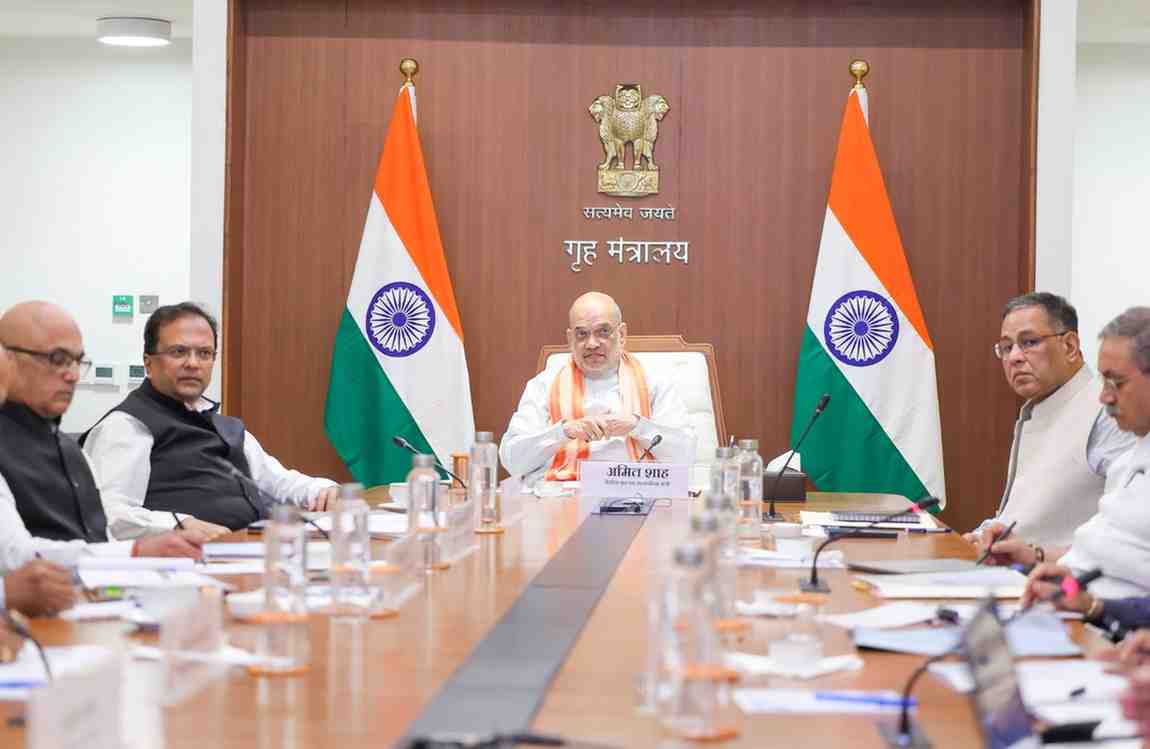
NEW DELHI: Union Home Minister and Minister of Cooperation Shri Amit Shah on Tuesday reviewed the functioning of the National Cyber Crime Helpline 1930 during a high-level meeting in New Delhi and directed officials to modernise the system using advanced technologies, including Artificial Intelligence (AI), to make it faster, more efficient and citizen-friendly.
The review meeting focused on strengthening mechanisms designed to provide immediate assistance to victims of cyber crimes, particularly those affected by online financial frauds. Shah emphasised that every citizen approaching the helpline must receive timely support and no complaint should remain unattended.
Focus on Faster and Smarter Cyber Crime Response
During the meeting, the Home Minister said the National Cyber Crime Helpline 1930 has emerged as a crucial platform that allows citizens to report cyber crimes quickly and conveniently, especially cases involving financial fraud.
He stressed the need to further improve the system so that victims can receive immediate assistance without delays. According to Shah, technological advancements must be integrated into the existing framework to enhance response capabilities and overall service delivery.
He directed officials to comprehensively modernise the helpline by incorporating AI-driven solutions that can facilitate quicker complaint registration, intelligent call routing and efficient grievance management.
Citizen-Centric Approach to Cyber Security
Reaffirming the government’s commitment to cyber safety, Shah said the Modi government is dedicated to building a secure, technology-driven and citizen-centric cyber crime prevention and response mechanism across the country.
He instructed that the 1930 call centres operating in all States and Union Territories be further strengthened with improved technology and upgraded infrastructure.
Under the proposed plan, the Ministry of Home Affairs will extend financial and technological support for hardware upgrades, while State governments and Union Territories will be responsible for ensuring adequate manpower at these centres.
The objective is to ensure that complaints are processed quickly and victims receive timely resolutions.
IVR Systems to Improve Call Management
One of the key decisions taken during the meeting was the upgradation of all State-level 1930 call centres with robust Interactive Voice Response (IVR) systems.
The IVR mechanism will streamline call handling, reduce delays and ensure calls are seamlessly forwarded to the appropriate departments and authorities for quicker action. Officials believe this enhancement will significantly improve the overall efficiency of the helpline and reduce the burden on operators during periods of high call volumes.
National-Level 1930 Call Centre to Be Established
In a major move to strengthen the national cyber crime response framework, Shah directed the establishment of a National-Level 1930 Call Centre equipped with sufficient manpower and advanced call handling capabilities. The proposed national centre will act as a backup mechanism and take over calls that remain unanswered at the state level.
The initiative aims to ensure that no victim seeking assistance is left without support and that every complaint is promptly registered. Officials said this additional layer of support will create a more robust nationwide safety net against cyber crimes.
Review of Financial Fraud Management System
The meeting also reviewed the performance of the Citizen Financial Cyber Fraud Reporting and Management System (CFCFRMS), an important initiative launched by the Ministry of Home Affairs to combat cyber-enabled financial fraud.
The system enables authorities to quickly block suspicious transactions through the banking network, increasing the chances of recovering and restoring money to victims. The Home Minister highlighted the importance of strengthening this mechanism further, considering the rapid rise in online financial scams across the country.
SOP for Faster Return of Victims’ Money
Shah also referred to the Standard Operating Procedure (SOP) issued by the Ministry of Home Affairs in January 2026 for the speedy resolution of cyber financial fraud cases.
The SOP establishes coordinated action among banks, financial institutions, law enforcement agencies and other stakeholders to ensure blocked funds are returned to victims at the earliest possible stage.
He noted that the Supreme Court has directed all High Courts across the country to ensure effective implementation of the SOP. The move is expected to create greater uniformity and efficiency in handling cyber fraud cases nationwide.
Regular Monitoring of Money Restoration Mechanism
The Home Minister directed authorities to regularly review the Money Restoration Module (MRM) and the Grievance Redressal Module (GRM) developed under the CFCFRMS platform.
He emphasised that state governments should also actively monitor these systems to ensure timely complaint resolution and speedy restoration of funds to victims.
Shah further instructed officials to take swift action in cases involving unnecessarily frozen bank accounts and said accountability must be fixed wherever delays or errors occur.
According to officials, around one lakh citizens have already benefited from the Money Restoration and Grievance Redressal mechanisms.
Massive Database Created for Fund Recovery
During the meeting, officials informed the Home Minister that approximately 94 lakh bank accounts from which funds could potentially be restored have been uploaded under the Money Restoration and Grievance Redressal framework.
This large database is expected to strengthen efforts aimed at tracing fraudulent transactions and expediting financial recovery for victims.
Authorities believe the initiative will become one of the key pillars of India’s cyber security architecture in the coming years.
Focus on Tackling Mule Bank Accounts
Shah also highlighted the growing challenge posed by mule bank accounts, which are frequently used by cyber criminals to move and hide illegally obtained funds.
He called for stronger coordination among the Indian Cyber Crime Coordination Centre (I4C), state governments, law enforcement agencies, banks and financial institutions to identify and eliminate such networks.
The Home Minister said a collaborative approach among all stakeholders is essential to build a stronger cyber security ecosystem and provide effective support to citizens affected by cyber crimes.
He reiterated that protecting citizens in the digital age remains a top priority for the government and that technological innovation will continue to play a central role in India’s cyber security strategy.