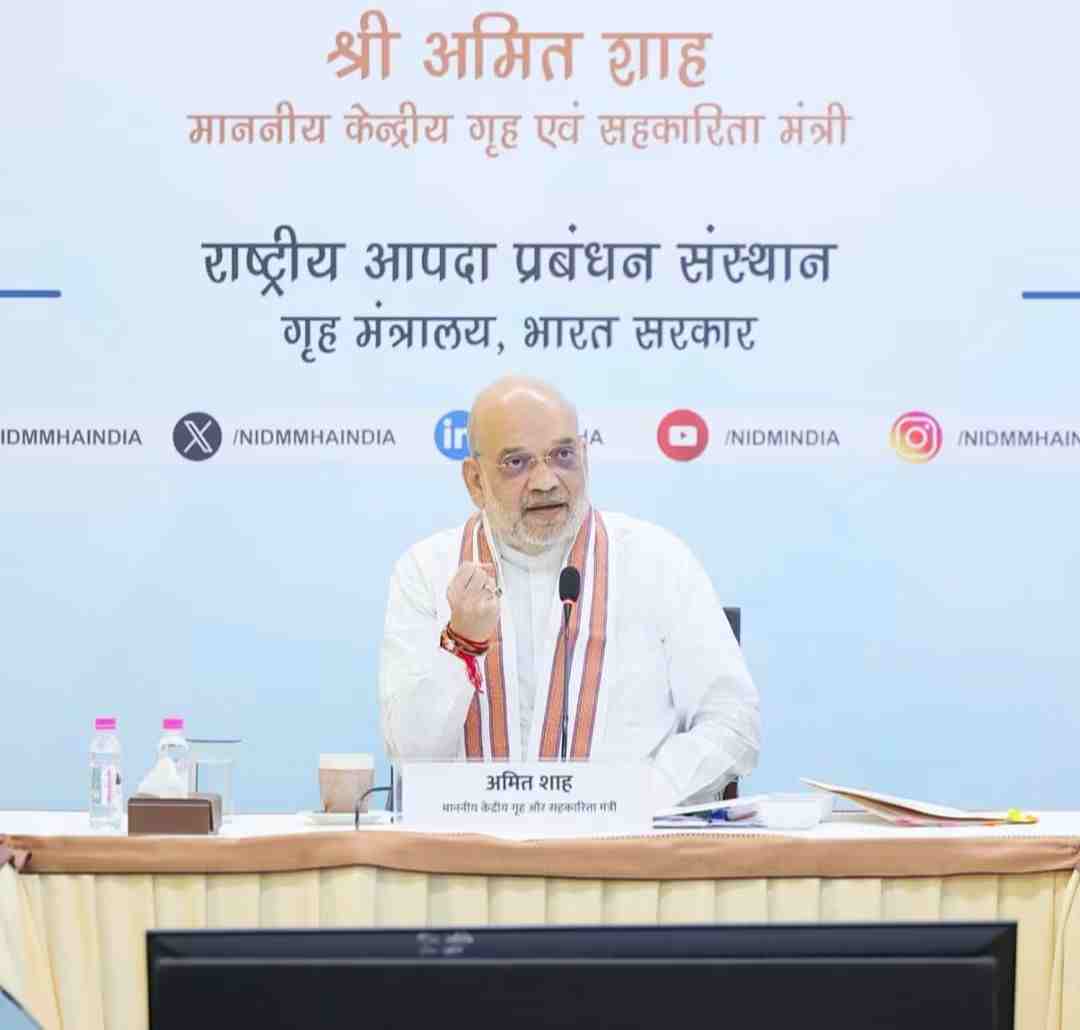
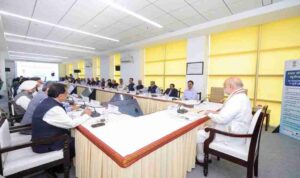
The Union Home Minister and Minister of Cooperation Amit Shah chaired the third meeting of the Governing Body of the National Institute of Disaster Management (NIDM) in New Delhi, stressing the need for stronger preparedness, advanced research, coordinated action and a sustained focus on the government’s ‘Zero Casualty’ objective.
The meeting was attended by senior officials from the Union Home Ministry, National Disaster Management Authority (NDMA), National Disaster Response Force (NDRF), India Meteorological Department (IMD), Department of Agriculture and Farmers Welfare, Delhi University, Lal Bahadur Shastri National Academy of Administration (LBSNAA), NIDM and other Central Ministries and State Governments.
From Relief to Risk Reduction and Zero Casualty
Amit Shah said India’s disaster management system has undergone a fundamental transformation during the past 12 years under Prime Minister Narendra Modi.
He said the country has moved away from a conventional approach focused mainly on relief and rehabilitation and is increasingly concentrating on risk reduction, early warning systems and preventing loss of life.
According to Shah, several disasters have already been managed with zero casualties, demonstrating the progress made in preparedness and response mechanisms.
He highlighted the growing importance of a ‘Whole of Government’ approach, under which different government departments work together whenever a disaster occurs. He called for this coordination to be strengthened through continuous monitoring, research and faster implementation.
Environmental Protection as a Disaster-Prevention Tool
Shah said disaster management cannot be separated from environmental protection, stressing that preventing environmental degradation can significantly reduce disaster risks.
He pointed to initiatives such as Mission LiFE, Pro-Planet People and the International Solar Alliance as part of India’s broader efforts towards sustainability and resilience.
The Home Minister said the ‘Zero Casualty’ approach should not be limited to saving lives after a disaster has already struck. The larger objective should be to reduce vulnerabilities and prevent disasters or minimise their impact wherever possible.
He said India’s focus on environmental protection, resilience and risk reduction could help the country emerge as a global model in disaster management.
NIDM and NDMA Told to Drive Research and Preparedness
The Home Minister reviewed the evolution of NIDM and said its predecessor, the National Centre for Disaster Management, was revived in 2003 following a decision taken during the tenure of former Prime Minister Atal Bihari Vajpayee.
He said the institution was brought under the Ministry of Home Affairs because disaster management requires coordination across multiple agencies and sectors. Under the Modi Government, NIDM has developed into a national institution focused on research, innovation, policy support and training.
Shah directed NIDM and NDMA to study international research and successful disaster-management practices and assess how they can be adapted to India’s local conditions.
He also instructed different departments to establish dedicated cells for implementing the meeting’s decisions. Departmental heads have been asked to review the functioning of these cells at least once every three months.
National Guidelines and Joint Disaster Assessments
Shah called for NIDM and NDMA to jointly prepare nationwide guidelines for different categories of disasters. The guidelines should clearly explain the appropriate actions, precautions and response mechanisms for each type of emergency.
NIDM will focus on the training component, while the NDRF, State Disaster Response Forces (SDRFs) and other concerned agencies will work together to implement the measures on the ground.
The Home Minister also stressed the need for systematic research into the causes of disasters and the damage they cause.
He proposed that after every disaster, a joint team comprising representatives of NDMA, NIDM, NDRF and SDRFs should examine the reasons behind the damage and prepare a detailed assessment report.
Shah also directed the Department of Agriculture and Farmers Welfare to maintain long-term preparedness against locust swarms originating from Pakistan and examine international best practices for tackling such threats.
He emphasised that disaster-management training should be treated as a serious responsibility and that priority should be given to personnel genuinely committed to the field.
₹2.5 Lakh Crore Spending and a Push for Disaster-Resilient India
Shah highlighted the financial and institutional reforms undertaken in disaster management. He said allocations under the State Disaster Response Fund (SDRF) have increased nearly fourfold, while the National Disaster Response Fund (NDRF) allocation has risen nearly threefold.
Around ₹2.5 lakh crore has been spent in the disaster-management sector over the past 11 years, he said.
BRICS 2026: Xi Jinping To Visit India, Raising Hopes For Major Diplomatic Breakthrough
The Disaster Management Act was amended after 20 years, while Urban Disaster Management Authorities have been introduced. Work has also begun on digital disaster databases at national and state levels. The National Crisis Management Committee (NCMC) has additionally been given statutory status.
Shah said the 16th Finance Commission has provided for ₹2 lakh crore for the period concerned, further strengthening the financial framework for disaster management.
He called for wider promotion of the disaster-management mobile application through primary, secondary and higher education institutions. He also said four acres of land had recently been allocated to strengthen NIDM’s infrastructure.
The Home Minister said NIDM should develop into a world-class institution while keeping India’s five lakh villages and urban centres at the centre of its priorities. International cooperation, he said, should complement rather than replace the focus on building resilience within India.
Shah called for at least one high-level NIDM meeting every year to ensure that decisions remain meaningful, outcome-oriented and effectively implemented.
He said India’s disaster-management mission must transform knowledge into capacity, capacity into preparedness and preparedness into results, with the ultimate objective of creating disaster-resilient villages and cities and achieving the ‘Zero Casualty’ goal.
Click here to join our WhatsApp Channel for real-time news updates and exclusive coverage.