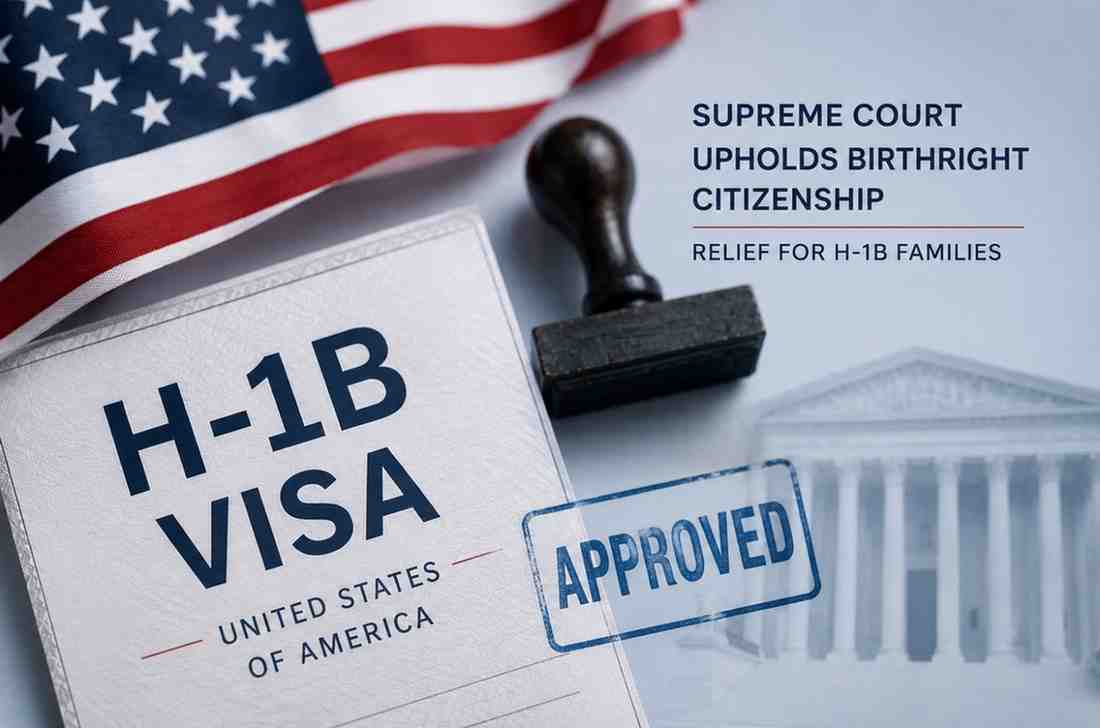
The United States Supreme Court has reaffirmed the constitutional guarantee of birthright citizenship, delivering a landmark judgment that preserves automatic American citizenship for children born on U.S. soil. The decision comes as a major relief for thousands of Indian families living in the United States on temporary work visas, particularly H-1B visa holders, who had been facing uncertainty over the future citizenship status of their children.
The court, in a 6-3 majority verdict, ruled that attempts to restrict birthright citizenship through executive action were inconsistent with the Citizenship Clause of the 14th Amendment of the U.S. Constitution. The ruling effectively blocks efforts to deny citizenship to children born in the country to parents who are in the U.S. on temporary visas or who do not yet hold permanent resident status.
Major Relief for Indian Professionals
The judgment has been welcomed by Indian professionals employed across the American technology, healthcare, finance and research sectors. A significant number of Indians work in the U.S. under the H-1B visa programme, and many have been concerned that changes to birthright citizenship rules could affect the legal status and future opportunities of their U.S.-born children.
Legal experts believe the verdict restores certainty for immigrant families who had delayed important personal and financial decisions due to fears surrounding possible policy changes. The ruling ensures that children born in the United States continue to receive citizenship at birth, irrespective of their parents’ temporary immigration status.
Court Reaffirms the 14th Amendment
The Supreme Court based its decision on the Citizenship Clause of the 14th Amendment, which declares that all persons born or naturalised in the United States, and subject to its jurisdiction, are citizens of the country.
The majority opinion reaffirmed long-established constitutional interpretation and upheld more than a century of legal precedent. The judgment also reinforced the historic 1898 Supreme Court decision in United States v. Wong Kim Ark, which established that children born in the United States are entitled to citizenship regardless of their parents’ nationality or immigration status.
Setback for Trump’s Immigration Agenda
The ruling marks a significant legal setback for President Donald Trump’s immigration agenda. His administration had argued that birthright citizenship should not automatically extend to children born to temporary visa holders or undocumented immigrants and had sought to implement changes through executive action.
However, the Supreme Court concluded that such a fundamental constitutional protection cannot be altered through an executive order. Any change to birthright citizenship would require constitutional or legislative action rather than unilateral executive measures.
Impact Beyond Indian Families
Although Indian H-1B workers stand among the biggest beneficiaries, the ruling has implications for immigrant communities from many countries. Thousands of families living in the United States on employment, student and other temporary visas now have renewed legal certainty regarding the citizenship rights of their American-born children.
Immigration attorneys say the decision removes immediate concerns about children potentially being left without automatic U.S. citizenship, preventing complicated legal and residency issues for future generations.
Strong Reactions Across the Political Spectrum
Civil rights organisations welcomed the judgment, calling it a reaffirmation of constitutional values and equal protection under the law. Immigration advocates described the ruling as a victory for families, while supporters of stricter immigration policies expressed disappointment and argued that Congress should revisit citizenship laws.
President Trump criticised the decision and urged lawmakers to pursue legislative reforms if they wish to modify birthright citizenship provisions. However, legal experts note that changing such a long-established constitutional principle would face significant political and legal challenges.
Long-Term Significance
The Supreme Court’s decision is expected to influence U.S. immigration law for years to come. By reaffirming birthright citizenship, the court has preserved one of the country’s foundational constitutional principles and provided clarity to millions of immigrant families planning their future in America.
For Indian professionals waiting for permanent residency while working under long visa backlogs, the verdict removes one of the biggest uncertainties surrounding their children’s legal status. It also reinforces the long-standing interpretation that citizenship acquired by birth on American soil remains protected under the Constitution unless amended through the appropriate constitutional process.