
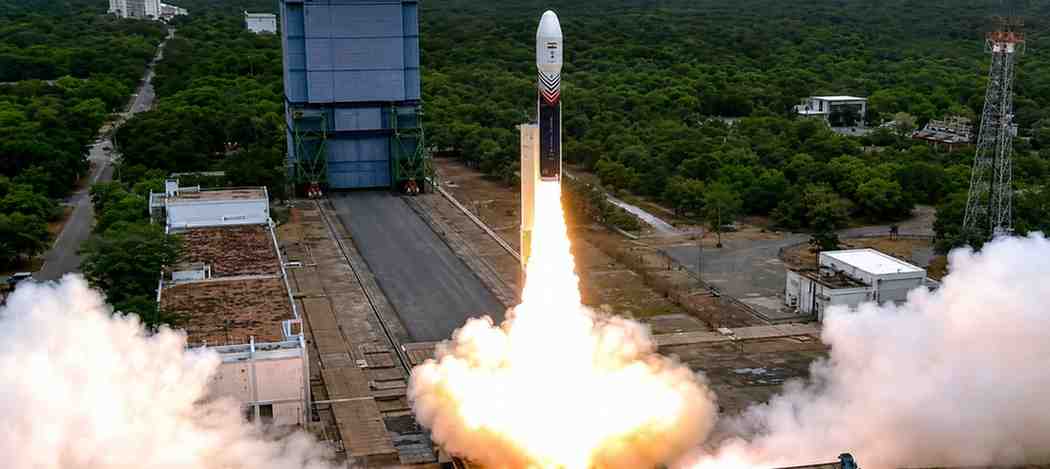
India marked a defining moment in its space journey on Saturday as Hyderabad-based Skyroot Aerospace successfully launched Vikram-1, the country’s first privately developed orbital-class rocket, from the Satish Dhawan Space Centre in Sriharikota. The successful mission places India among a select group of nations with privately built rockets capable of reaching orbit and signals the rapid growth of the country’s commercial space sector.
The launch, named Mission Aagaman, represents years of research, engineering, and collaboration between country’s private space industry and national space agencies. The mission also reflects the government’s push to encourage private participation in advanced space technologies following the opening of the space sector to private companies.
Vikram-1 Opens a New Chapter
Vikram-1 is a three-stage solid-fuel launch vehicle designed to place small satellites into Low Earth Orbit (LEO). Built entirely by Skyroot Aerospace, the rocket is capable of carrying payloads weighing up to around 350 kilograms to a 450-kilometre orbit, making it suitable for commercial satellite launches and technology demonstration missions.
The successful orbital mission follows Skyroot’s earlier achievement in 2022 when it launched Vikram-S, Bharat’s first privately built sub-orbital rocket. With Vikram-1, the company has now taken a major leap toward becoming a commercial launch service provider for domestic and international satellite operators.
Mission Aagaman Demonstrates Indigenous Capability
Mission Aagaman carried multiple technology demonstration payloads from Bharat and international customers into orbit. The launch served not only as a commercial mission but also as a comprehensive test of Vikram-1’s propulsion systems, stage separation, avionics, navigation, and flight control technologies.

The successful completion of these mission objectives validates the rocket’s design and strengthens confidence in the nation’s ability to develop competitive commercial launch vehicles outside the traditional government-led space programme.
Experts believe the achievement could pave the way for more frequent launches, greater investment in Indian space startups, and expanded participation in the rapidly growing global small satellite launch market.
Major Boost for Private Space Industry
The launch is being viewed as a watershed moment for Bharat’s private space ecosystem. Since the Indian government introduced reforms allowing greater private participation, several startups have emerged in launch services, satellite manufacturing, and space technology.
Skyroot Aerospace has become one of the leading names in this transformation by developing indigenous launch vehicles using advanced manufacturing techniques, including 3D-printed rocket components and innovative propulsion technologies.
Industry observers say Vikram-1’s success demonstrates that Indian startups can now build sophisticated launch systems capable of serving international customers while complementing the Indian Space Research Organisation’s (ISRO) capabilities.
PM Modi Congratulates the Team
Prime Minister Narendra Modi congratulated the Skyroot Aerospace team after the successful mission, describing the achievement as the beginning of a new era in Bharat’s space journey. Earlier, before the launch, he had called Vikram-1 a “historic new frontier” that showcased the innovation and talent of India’s youth.
Also Read: Priyanka Chopra’s Fierce ‘Mandakini’ Ignites Global Buzz For SS Rajamouli’s Epic Varanasi
The mission also carried a handwritten postcard bearing the Prime Minister’s patriotic message, “Vande Mataram,” symbolising India’s growing ambitions in space exploration.
A New Commercial Future for India
The success of Vikram-1 is expected to strengthen India’s position in the global commercial launch market, where demand for launching small satellites continues to rise rapidly.
Private launch providers are increasingly becoming important players worldwide by offering flexible, cost-effective launch solutions for communication, Earth observation, scientific research, and defence applications.
For India, the mission highlights how government reforms, startup innovation, and technical expertise can combine to create globally competitive space capabilities. Analysts believe successful missions like Vikram-1 will encourage further investment, international partnerships, and new business opportunities for Indian aerospace companies.
As India’s private space ecosystem continues to expand, Vikram-1 stands as a landmark achievement that demonstrates the country’s growing technological maturity and ambition to become a major player in the global space economy.
Click here to join our WhatsApp Channel for real-time news updates and exclusive coverage.