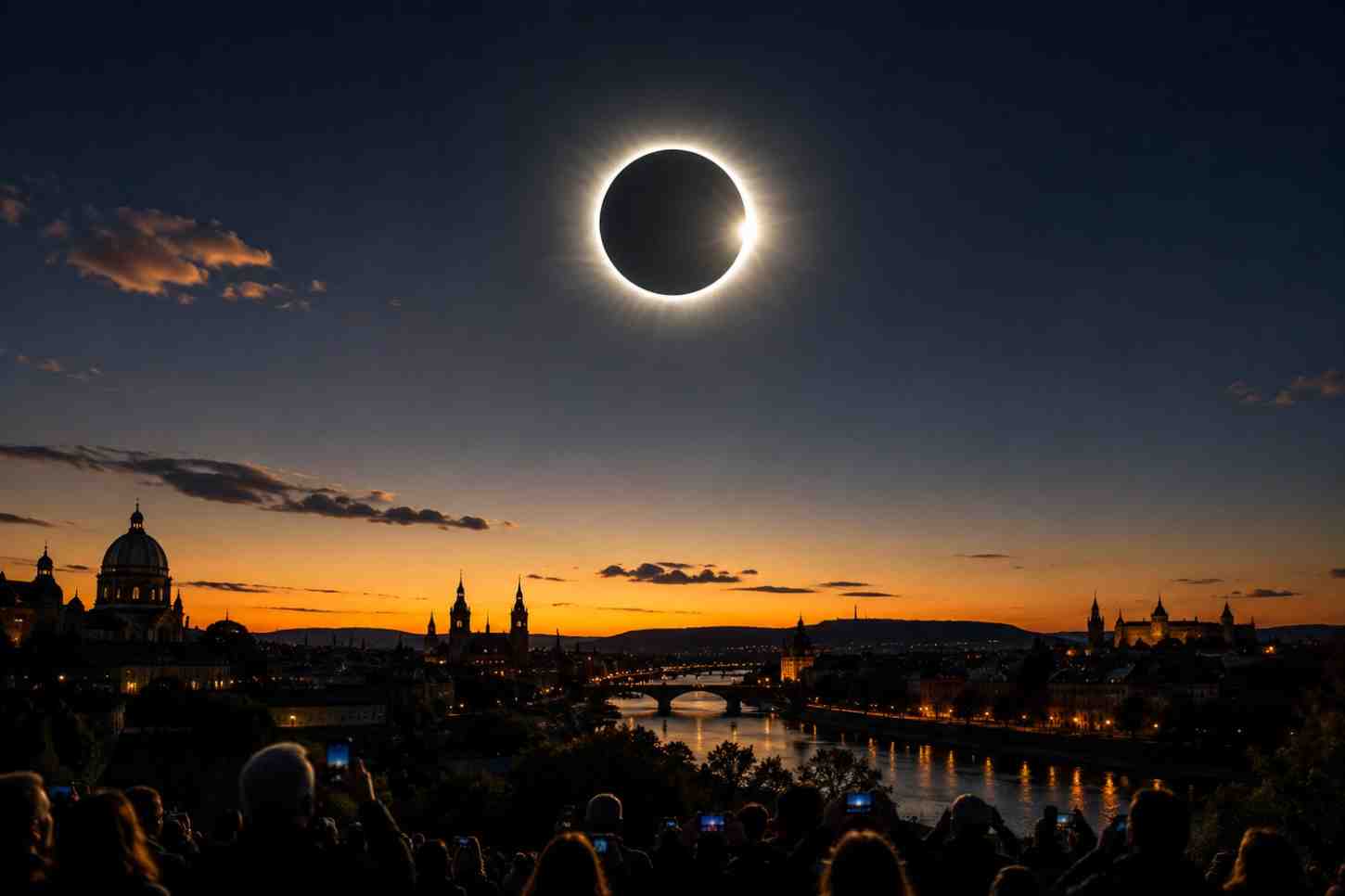
A breathtaking celestial spectacle is set to unfold over Europe on August 12, 2026, when a total solar eclipse will briefly transform daylight into darkness across parts of the continent. The rare astronomical event is expected to attract millions of skywatchers as the Moon passes directly between the Earth and the Sun, completely blocking the Sun’s visible disk.
For observers positioned along the eclipse’s path, daytime will suddenly give way to an eerie twilight. In some locations, the period of complete darkness will last for just over one minute, creating a dramatic scene in which the sky can become dark enough for bright stars and planets to appear.
According to the latest report, the event could be witnessed by more than a billion people, although only those within the narrow path of totality will experience the full effect of the eclipse. People outside that zone will see a partial solar eclipse, with only a portion of the Sun covered by the Moon.
What happens during a total solar eclipse?
A total solar eclipse occurs when the Moon moves directly between the Sun and Earth and its apparent size becomes large enough to cover the Sun completely. This alignment can happen only around the time of a new Moon, when the three celestial bodies are positioned almost in a straight line.
The phenomenon is possible because of an extraordinary coincidence in the Earth-Moon system. Although the Sun is roughly 400 times wider than the Moon, it is also approximately 400 times farther away from Earth. As a result, the Sun and Moon appear nearly the same size in the sky when viewed from Earth.
That apparent similarity allows the Moon to completely hide the bright solar disk during totality.
Europe will experience a dramatic shift from daylight to darkness
The eclipse will not begin with an instant blackout. Observers will initially see the Moon gradually moving across the Sun, producing a partial eclipse. As more of the Sun becomes covered, daylight will begin to fade.
When totality arrives, the transformation can happen remarkably quickly. The surroundings may take on an unusual twilight-like appearance, while the temperature can temporarily fall as sunlight is blocked.
The sudden darkness can also affect wildlife. Birds may behave as though evening has arrived, while some nocturnal animals can briefly become active because of the abrupt change in light conditions.
However, the period of complete darkness will be restricted to a relatively narrow geographical corridor known as the path of totality. This zone is typically around 100 to 200 kilometres wide. People outside it will experience only a partial eclipse and will not see the Sun disappear completely.
Why the August 12 eclipse is scientifically important
The eclipse is more than an extraordinary visual event. Total solar eclipses provide scientists with an opportunity to study the Sun’s outer atmosphere, known as the corona.
Normally, the intense brightness of the Sun makes the corona extremely difficult to observe directly. During totality, however, the Moon blocks the Sun’s brilliant surface and allows the faint outer atmosphere to become visible.
Also Read: Meta Faces $567 Million Blow Over Child Safety And Mental Health Crisis
The corona extends millions of kilometres into space and remains an important subject of solar research. Scientists are particularly interested in understanding why the corona is dramatically hotter than the Sun’s visible surface and how activity in this region contributes to the solar wind.
Solar wind can influence conditions in space around Earth, making observations of the Sun’s atmosphere valuable for understanding space weather and its potential effects on satellites and technological systems.
A spectacular event that requires careful viewing
Despite the excitement surrounding the eclipse, experts stress that watching a solar eclipse requires proper eye protection. Looking directly at the Sun during the partial phases can cause serious and permanent eye damage.
Certified eclipse-viewing glasses or appropriate solar filters should be used when observing the Sun. Ordinary sunglasses do not provide adequate protection.
There is one important exception: during the brief period of totality, when the Moon completely covers the Sun’s bright disk, observers can look at the eclipse without eye protection. However, protection must be put back on immediately before totality ends and the Sun’s bright surface becomes visible again.
Daylight darkness will create a rare cosmic spectacle
The August 12 total solar eclipse is expected to become one of the most striking astronomical events of 2026. For people fortunate enough to stand within the path of totality, the experience will be unlike an ordinary sunset or nightfall.
In a matter of moments, familiar daylight can fade, the sky can darken, temperatures may dip and celestial objects can become visible in the daytime. Above it all, the Sun’s delicate corona will appear around the Moon’s dark silhouette.
The event offers both a spectacular experience for the public and a valuable opportunity for scientists to study the complex relationship between the Sun, Moon and Earth.
As millions prepare to look toward the sky on August 12, Europe is set for a remarkable moment when nature will seemingly switch off the daylight — if only for a little over a minute in some locations.
Click here to join our WhatsApp Channel for real-time news updates and exclusive coverage.