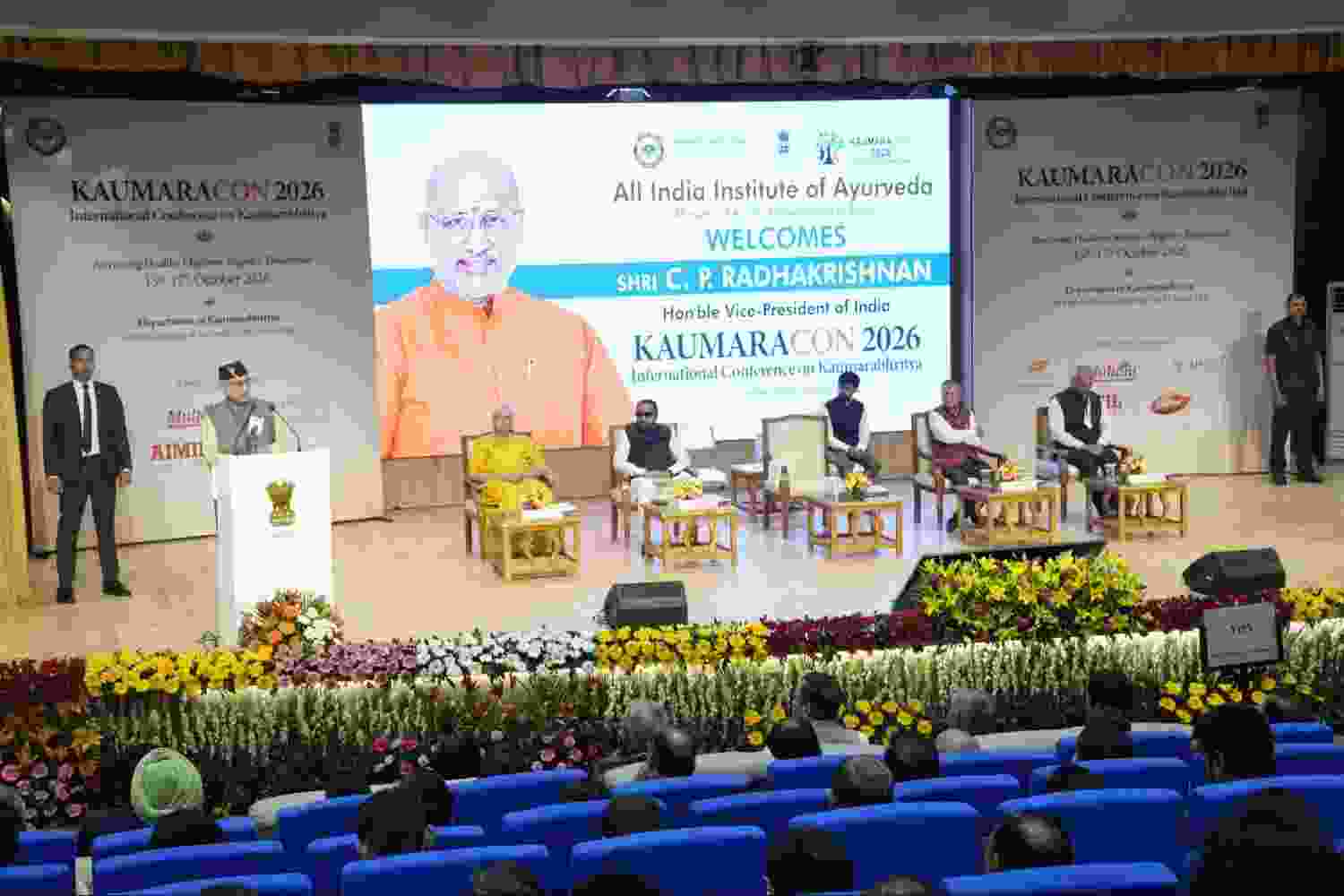
Vice-President of India C. P. Radhakrishnan has expressed confidence in the growing role of the All India Institute of Ayurveda (AIIA), New Delhi, stating that Prime Minister Narendra Modi’s vision of developing the institute on a par with the All India Institute of Medical Sciences (AIIMS) is taking shape. He made the remarks while inaugurating KAUMARACON-2026, an international conference dedicated to Ayurvedic paediatrics, on Thursday.
The Vice-President emphasised that scientific research, innovation and academic excellence would be crucial to strengthening Ayurveda’s credibility and expanding its acceptance worldwide. He also called for traditional medical knowledge to be supported by scientific evidence to improve patient confidence and healthcare outcomes.
The event coincided with AIIA’s 10th Foundation Day and featured the launch of several digital platforms and technology-driven initiatives aimed at advancing Ayurveda, encouraging entrepreneurship and strengthening healthcare services.
VP Calls for Scientific Validation of Ayurveda
Addressing healthcare professionals, researchers, academics and students, Radhakrishnan stressed the importance of establishing the scientific basis of traditional healthcare practices.
He said India’s centuries-old medical knowledge represents a valuable civilisational legacy, but its wider acceptance depends on research that can demonstrate the effectiveness of traditional treatments and practices.
The Vice-President encouraged researchers to combine traditional wisdom with contemporary scientific methods. Such an approach, he indicated, could help build greater confidence among patients and healthcare professionals while creating opportunities for traditional medicine to contribute to modern healthcare.
He also highlighted the importance of sustained research and collaboration between different medical disciplines to improve clinical practices and strengthen the evidence supporting Ayurveda.
AIIA Advances Towards the AIIMS Benchmark
Referring to the Prime Minister’s vision for AIIA, the Vice-President said the institution was progressing towards becoming a leading centre for Ayurvedic education, research and patient care.
Congratulating the institute on completing ten years, he underlined the need to maintain high academic standards, encourage innovation and expand research capabilities.
The comparison with AIIMS reflected the broader ambition to strengthen AIIA’s institutional capacity and establish it as a prominent centre for traditional medicine. Continued investment in scientific investigation, clinical services and education would be important in advancing this objective.
The institute’s anniversary also provided an opportunity to highlight its contribution to public healthcare and the development of Ayurveda as an organised system of medical education and research.
Child Healthcare at the Heart of KAUMARACON-2026
The international conference was organised around the theme, “Shaping the Future of Child Health: Global Perspectives, Research Innovations, and Clinical Frontiers in Kaumarabhritya.”

Kaumarabhritya is the branch of Ayurveda concerned with paediatrics and child healthcare.
Radhakrishnan emphasised that children’s health must remain central to India’s healthcare priorities. He highlighted the importance of nutrition, physical growth, developmental needs, disease prevention and emotional well-being in ensuring that children have a healthy start in life.
He urged healthcare professionals and researchers to give sustained attention to the specific needs of children and work towards creating conditions that support their overall development.
Connecting child health with the national goal of Viksit Bharat by 2047, the Vice-President stressed that a developed nation requires a healthy population and strong human capital. Ensuring children’s well-being today, he indicated, would contribute to India’s long-term social and economic progress.
Also Read | “A New Chapter In Ladakh’s Development”: PM Modi Unveils Major Projects To Accelerate Regional Growth
The conference brought the focus of Ayurvedic paediatrics to an international platform, encouraging discussion on research, clinical practices and emerging approaches to child healthcare.
Government Strengthens Traditional Medicine Research
The Vice-President highlighted the establishment of a separate Ministry of AYUSH in 2014 as an important development in the promotion of India’s traditional healthcare systems.
He referred to the ministry’s efforts to strengthen education, expand healthcare delivery and encourage scientific research. He also pointed to collaborations involving the Ministry of AYUSH and institutions such as the Indian Council of Medical Research (ICMR), the Council of Scientific and Industrial Research (CSIR), the Department of Biotechnology (DBT), the Department of Science and Technology (DST) and AIIMS.
Such interdisciplinary engagement can help facilitate knowledge-sharing between traditional and modern medical systems, supporting research and the development of better healthcare approaches.
Radhakrishnan also highlighted the international recognition of Yoga and the establishment of the World Health Organization’s Global Centre for Traditional Medicine in Jamnagar as important milestones in taking India’s traditional knowledge to a global audience.
He called for continued efforts to preserve this heritage while strengthening it through scientific assessment and innovation.
AIIA Launches Five Digital Initiatives
A key highlight of the programme was the inauguration and launch of five digital initiatives designed to support innovation and development in the Ayurveda sector.
The Vice-President inaugurated the AYUSH Start-up Portal, the AIIA–iCAINE website and the Ayurveda Digital Innovation and Venture Acceleration Facility (AyuDIVA). He also launched the Vamana App and the Panchakarma Assessment App.
The initiatives underscore the growing emphasis on digital technology, entrepreneurship and innovation in the traditional healthcare ecosystem. They are intended to support the wider development of Ayurveda through digital platforms and innovation-focused activities.
An international Memorandum of Understanding between Maharishi International University (MIU), United States, and AIIA, New Delhi, was also exchanged in the Vice-President’s presence, strengthening the focus on international academic engagement.
Vice-President Visits AIIA Hospital and Dhanwantari Vatika
Earlier, Radhakrishnan visited the hospital facilities at AIIA and Dhanwantari Vatika, where he received a briefing on the institute’s contributions to public healthcare.
He was also informed about the Ayurvedic significance of the medicinal plants, herbs and rocks displayed at the Vatika, reflecting the traditional knowledge associated with natural resources and their role in Ayurveda.
Senior AYUSH Officials Attend the Event
The programme was attended by Prataprao Jadhav, Minister of State for AYUSH and Health and Family Welfare; Vaidya Rajesh Kotecha, Secretary, Ministry of AYUSH; Dr. Maneesha Upendra, Chairperson of the National Commission for Indian System of Medicine; and Professor P. K. Prajapati, Director of AIIA, New Delhi.
Researchers, faculty members, students and other dignitaries were also present.
KAUMARACON-2026 highlighted the growing emphasis on scientific research, digital innovation and international collaboration in traditional medicine. The Vice-President’s address reinforced the need to combine Ayurveda’s established knowledge traditions with scientific validation while ensuring that child healthcare remains a priority.
As AIIA enters its second decade, the emphasis on research, innovation and academic excellence is expected to remain central to its efforts to strengthen Ayurveda’s role in India’s healthcare system and broaden its global recognition.
Click here to join our WhatsApp Channel for real-time news updates and exclusive coverage.