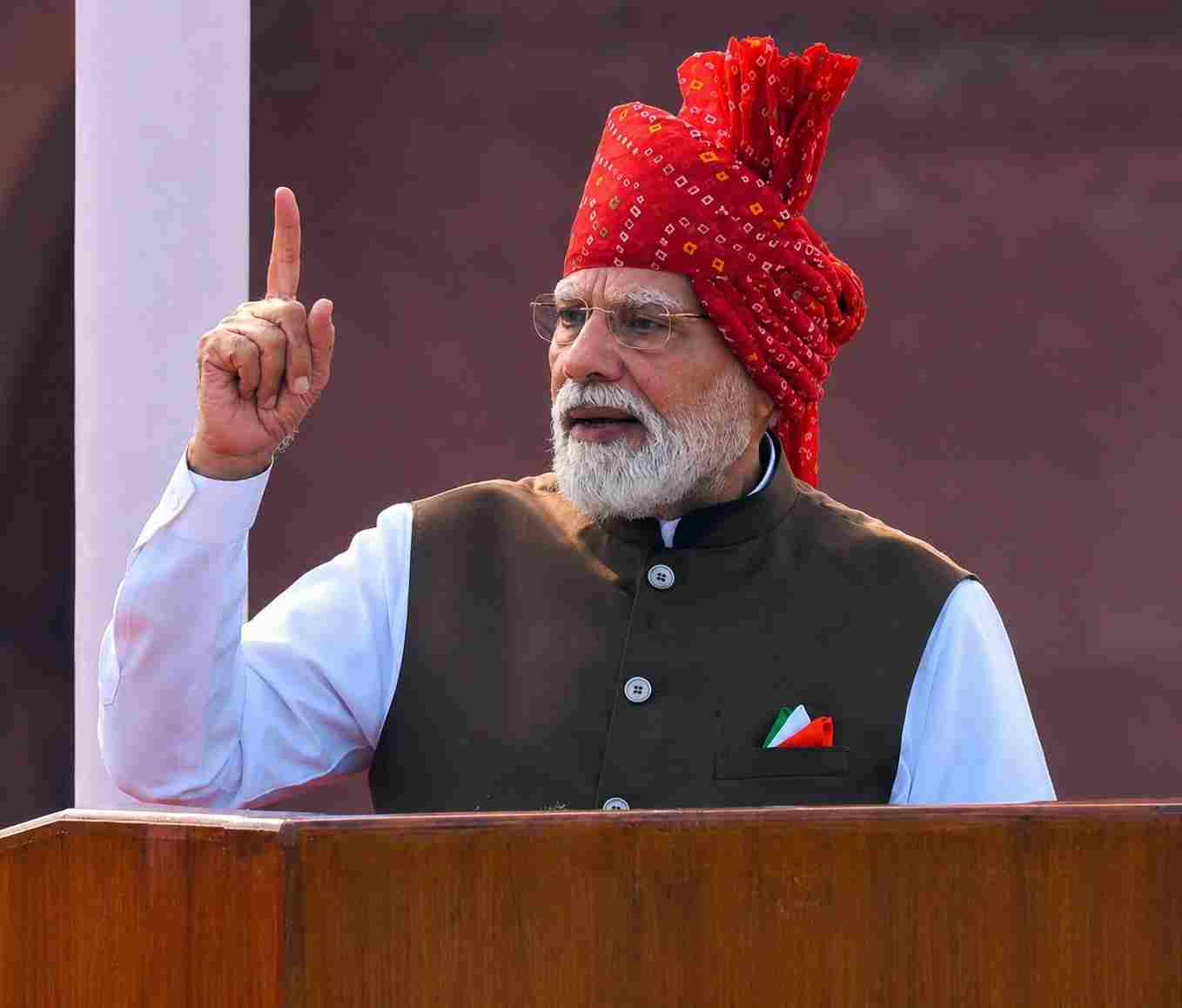
Prime Minister Narendra Modi used his Independence Day address from the Red Fort to present an ambitious roadmap for India’s journey towards a developed nation by 2047, placing young people, technological self-reliance, economic strength and national security at the heart of his message.
Delivering his 13th consecutive Independence Day speech, Modi spoke for around 75 minutes and addressed a wide range of issues, from employment and artificial intelligence to women’s representation, energy security, semiconductors and the continuing ideological challenge posed by Naxalism.
The speech came against the backdrop of growing attention on India’s Gen Z population following recent student protests over examination paper leaks and unemployment. Modi made youth empowerment one of the most prominent themes of his address, signalling a stronger focus on skills, opportunities and participation in nation-building.
Gen Z and Youth at the Heart of Modi’s Independence Day Message
A major announcement was a plan to train one crore young Indians in artificial intelligence skills. The Prime Minister also announced free online coaching for competitive examinations, particularly aimed at reducing the financial pressure on aspirants from poor and middle-class families.
The initiatives reflect the growing importance of technology and employability in India’s young workforce. With a large share of the country’s population below the age of 35, youth are expected to play a decisive role in shaping India’s economic and political future.
Modi stressed that the aspirations and energy of young Indians would be critical to achieving the vision of Viksit Bharat by 2047.
‘Shakti Ki Saptadhara’ Sets Seven-Part Development Vision
Another major highlight was the unveiling of ‘Shakti Ki Saptadhara’, a seven-stream development framework intended to strengthen India’s growth and self-reliance.
The roadmap places manufacturing, agriculture and food processing, technology and innovation, infrastructure and connectivity, defence, the green and blue economy, and India’s creative and cultural sectors among the key engines of future development.
Manufacturing was presented as a crucial foundation for India’s economic expansion, with emphasis on producing both components and finished products domestically. Agriculture, meanwhile, was linked with food processing, exports and global markets, particularly for Indian products such as millets, spices, fruits and vegetables.
Technology emerged as another major pillar, with the Prime Minister highlighting data centres, robotics, emerging technologies and the ambition to take Made-in-India 6G solutions to the global market.
Infrastructure, Defence and Green Economy Get Major Push
Infrastructure and connectivity formed another important part of the roadmap. High-speed rail, expressways, ports and integrated logistics were highlighted as essential to improving the movement of people and goods while creating employment across multiple sectors.
Defence self-reliance was also given prominence. Modi stressed the importance of developing indigenous defence capabilities, including drones and counter-drone technologies, with India aspiring to become a global supplier rather than remaining dependent on imports.
The green and blue economy also featured prominently. Green hydrogen, renewable energy and energy storage were identified as areas with significant future potential, while fisheries, coastal tourism and ocean-related technologies were presented as opportunities within the blue economy.
Semiconductors and Energy Security Central to Atmanirbhar Bharat
Modi also reinforced his Atmanirbhar Bharat agenda by highlighting semiconductors, critical minerals and energy security.
In a major technology push, the government is targeting the establishment of seven to eight semiconductor plants over the next one to two years. The Prime Minister also set an ambitious target of taking India’s nuclear energy capacity to 100 GW by 2047.
These priorities underline the government’s effort to reduce dependence on global supply chains in strategically important sectors while building domestic capabilities in advanced technology and energy.
Warning Against ‘Dimaagi Naxals’
National security was another strong element of the Independence Day speech. Modi said armed Naxalism had been substantially weakened but warned about what he described as “dimaagi Naxals”, referring to people he believes continue to promote Maoist ideology.
He argued that the ideological challenge must also be confronted after the decline of armed insurgency and called for such elements to be identified and isolated. Modi also recalled the sacrifices of security personnel during years of anti-Naxal operations.
Strong Push for Women’s Political Representation
Women’s representation in politics also featured prominently. Modi appealed to political parties to support the implementation of 33 per cent reservation for women in Parliament and state assemblies.
Also Read: Toxic Gas Tragedy In Gaya: 4 Die Inside Bihar Well, Father-Son Among Victims
He pointed to the growing contribution of women representatives in panchayats, municipalities and other local bodies, arguing that greater participation in policymaking would strengthen India’s democratic institutions.
Creative Economy and India’s Global Soft Power
The Prime Minister’s seven-part vision also extended beyond traditional economic sectors. Yoga, handicrafts, films, animation, gaming and digital content were identified as areas through which India could expand its global soft power.
The focus reflects the changing nature of employment, where creativity, technology and cultural influence increasingly overlap. India’s large digital and creative workforce could potentially turn these sectors into major contributors to economic growth and international influence.
A Roadmap Towards Viksit Bharat 2047
Overall, Modi’s 2026 Independence Day address combined political messaging with a broad economic and developmental roadmap. Youth empowerment, AI skills, free competitive-exam coaching, semiconductor manufacturing, energy security, defence production, women’s representation and the Saptdhara framework formed some of the speech’s most significant themes.
The message from the Red Fort was clear: India’s next phase of growth, according to the Prime Minister, will depend on combining technological capability, economic self-reliance, national security and the energy of its young population.
As India moves towards the centenary of independence in 2047, the government’s challenge will now be to translate these ambitious announcements into measurable opportunities, jobs and sustained development for citizens across the country.
Click here to join our WhatsApp Channel for real-time news updates and exclusive coverage.