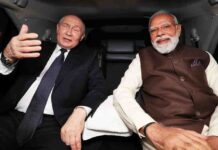
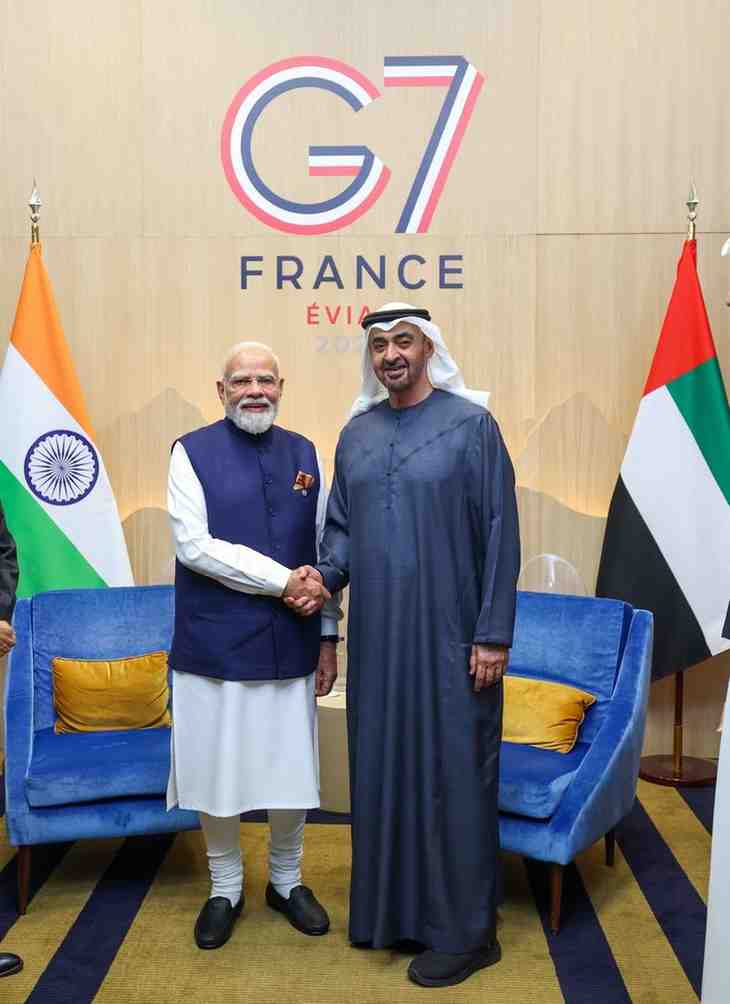
Prime Minister Narendra Modi invited United Arab Emirates President Sheikh Mohamed bin Zayed Al Nahyan to attend the BRICS Summit, which India will host later this year, during a bilateral meeting held on the sidelines of the G7 Summit in Évian, France. The invitation highlighted India’s intention to further strengthen engagement with one of its closest partners in West Asia and deepen cooperation within emerging global platforms.
The meeting reflected the strong and evolving relationship between India and the UAE, with both leaders reviewing progress across several sectors and discussing regional as well as global developments of mutual interest. The two countries have steadily elevated their ties over the past decade into a Comprehensive Strategic Partnership built on economic cooperation, energy security and geopolitical coordination.
PM Modi’s Earlier Visit
Prime Minister Modi and Sheikh Mohamed bin Zayed expressed satisfaction over the pace of bilateral engagement in 2026. Their discussions covered the outcomes and follow-up actions arising from the UAE President’s visit to India in January and Prime Minister Modi’s visit to the UAE in May this year. These exchanges have accelerated cooperation across numerous sectors and created fresh opportunities for long-term collaboration.
A major focus of the meeting was expanding cooperation in technology, trade, investment, energy and defence. Both sides acknowledged the growing momentum in economic relations, particularly after the implementation of various bilateral initiatives aimed at facilitating investment flows and enhancing strategic connectivity between the two economies.
West Asia Conflict
The leaders also exchanged views on the rapidly changing security environment in West Asia. Amid ongoing tensions in the region, Prime Minister Modi reiterated India’s longstanding position that dialogue and diplomacy remain the most effective tools for achieving sustainable peace. He stressed that respect for international law, sovereignty and territorial integrity should remain at the centre of all efforts aimed at resolving conflicts.
Both leaders agreed that preserving peace and stability in West Asia is not only a regional necessity but also a global imperative. Given the region’s importance to international trade and energy supplies, any disruption has worldwide implications. They therefore emphasized the need for coordinated efforts to reduce tensions and prevent further escalation.
Maritime Security
Another important issue discussed during the meeting was maritime security. India and the UAE jointly called for ensuring free, safe and uninterrupted navigation through the Strait of Hormuz, one of the world’s most critical energy corridors. Both nations underscored the importance of keeping trade and commerce flowing without disruptions, particularly at a time of heightened geopolitical uncertainty.
The meeting once again demonstrated the increasingly strategic nature of India-UAE relations. What began decades ago as an energy-focused partnership has now transformed into a broad and multidimensional relationship covering trade, infrastructure, renewable energy, advanced technology, food security, logistics and defence cooperation.
The strong personal rapport between Prime Minister Modi and Sheikh Mohamed bin Zayed has also become a significant pillar of bilateral ties. Frequent high-level interactions have enabled faster decision-making and stronger institutional coordination between New Delhi and Abu Dhabi. Both leaders have consistently prioritized practical outcomes over symbolic diplomacy, resulting in several major initiatives over recent years.
India also values the role played by the large Indian diaspora living in the UAE. The community continues to act as an important bridge between the two countries by contributing to economic growth, cultural exchanges and people-to-people connections.
The bilateral meeting took place amid Prime Minister Modi’s active diplomatic engagements during the G7 Summit, where he held discussions with several world leaders on issues ranging from trade and energy security to global conflicts and international cooperation. India’s participation at the summit reflects its growing role in shaping discussions beyond traditional multilateral institutions.
The invitation extended to the UAE President to attend the upcoming BRICS Summit is also significant because the UAE has become an increasingly important member of the grouping. India’s BRICS presidency later this year is expected to focus on strengthening economic resilience, South-South cooperation and reforming global governance structures.
As global geopolitical dynamics continue to evolve, India and the UAE appear determined to deepen their strategic partnership further. The meeting at the G7 Summit reinforced a shared vision centred on economic growth, regional stability, secure trade routes and stronger international cooperation.
Both leaders concluded their interaction by reaffirming their commitment to work together in advancing peace, prosperity and sustainable development, while ensuring that the India-UAE partnership remains one of the most dynamic and trusted relationships in the contemporary global landscape.