
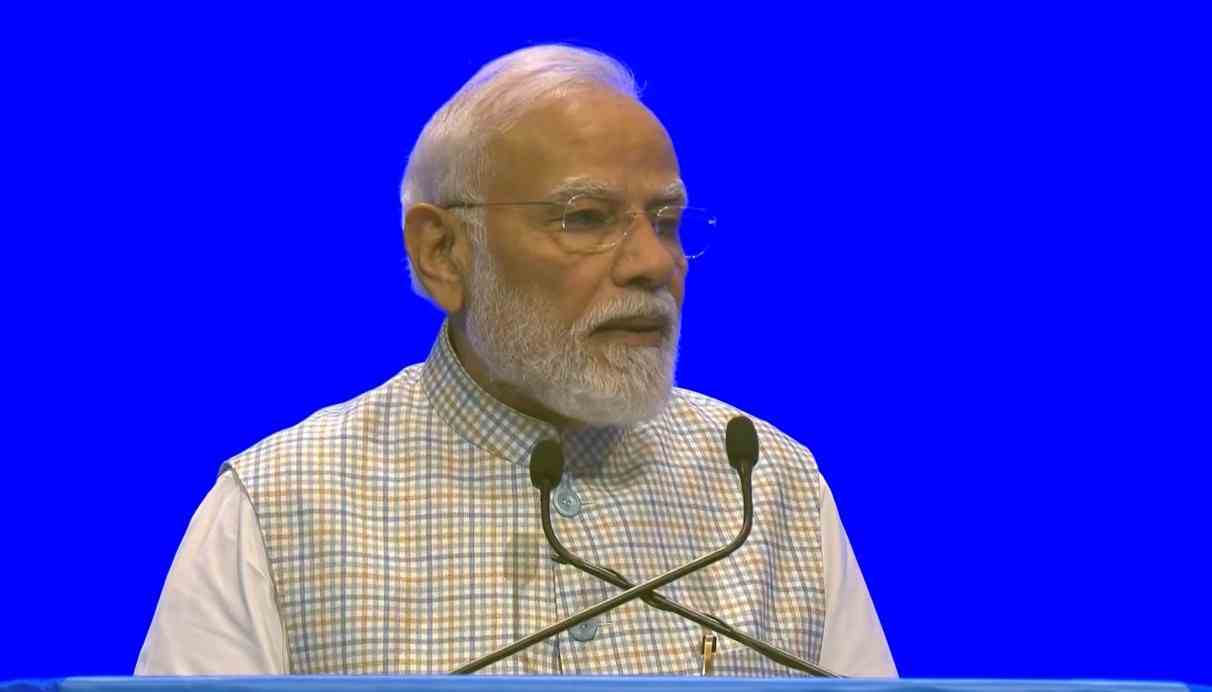
Prime Minister Narendra Modi on Thursday highlighted India’s rapid digital transformation, saying mobile technology and nationwide connectivity have fundamentally changed the way citizens access services, interact with government and participate in the digital economy.
Addressing the 10th edition of the India Mobile Congress 2026 at Yashobhoomi in New Delhi, PM Modi underlined the expanding reach of 5G and India’s growing digital infrastructure. The Prime Minister said the country’s technological progress is increasingly reaching people across geographical and social boundaries.
5G Connectivity Reaches Every District
A key highlight of Modi’s address was India’s nationwide 5G expansion. He said 5G connectivity has now reached every district, marking a significant milestone in the country’s telecommunications journey.
The expansion represents a major shift from earlier generations of mobile connectivity, with high-speed networks increasingly becoming part of everyday life for citizens, businesses and public institutions.
Modi presented the growth of mobile connectivity not simply as a technological achievement but as an important enabler of development. With smartphones and digital networks becoming increasingly accessible, citizens can obtain information, access services and conduct transactions without depending entirely on physical infrastructure.
Mobile Phones Transform Everyday Governance
The Prime Minister also emphasized how mobile phones have evolved far beyond being communication devices.
According to Modi, mobile technology has helped reduce the need for physical travel, shortened waiting periods and lowered costs for citizens. In this sense, digital connectivity has created what he described as a major “citizen dividend” of technology.
The transformation is particularly significant for government services. Digital platforms allow citizens to access a growing range of services through smartphones and online systems, making governance more accessible and convenient.
India’s broader Digital India programme has focused on strengthening digital infrastructure, expanding broadband connectivity and delivering government services electronically, including in rural and remote regions.
Digital Public Infrastructure Drives Inclusion
India’s digital transformation has also been supported by large-scale Digital Public Infrastructure (DPI).
Government data indicates that the country has built an extensive digital ecosystem involving Aadhaar, UPI, DigiLocker, BharatNet and Common Service Centres. These platforms are designed to deliver services at population scale and improve access to financial, administrative and citizen services.
The expansion of digital infrastructure is particularly important for bridging the urban-rural divide. Broadband connectivity and Common Service Centres have enabled people in smaller towns and villages to access services that previously required travelling to administrative or commercial centres.
AI and Next-Generation Networks Take Centre Stage
The Prime Minister’s remarks came as IMC 2026 placed a strong emphasis on the technologies expected to shape the next phase of India’s digital economy.
This year’s India Mobile Congress is being held under the theme “Scale Without Boundaries” and features discussions around 5G, 6G, artificial intelligence-powered networks, semiconductors, cybersecurity, quantum communication and enterprise transformation.
Also Read | India Rejects Elon Musk’s Starlink ‘Oligarchs’ Claim, Calls Delay Allegation Baseless And Misconceived
The event has also expanded into emerging areas such as smart mobility, industrial robotics, stadium technology and transport technology, reflecting the increasingly broad role of telecommunications in the wider economy.
India Positions Itself as a Global Digital Power
Modi’s address also reinforced India’s ambition to become a major force in global digital innovation.
The government has increasingly promoted India’s digital public infrastructure as a model that can support inclusive development at population scale. The approach combines connectivity, digital identity, payments and online service delivery to create an interconnected digital ecosystem.
With representatives from more than 100 countries expected at IMC 2026, the event provides India with a platform to showcase its technological capabilities and engage with international companies, policymakers, investors and innovators.
From Connectivity to Empowerment
The Prime Minister’s message at IMC 2026 reflected a broader shift in India’s technology narrative—from expanding connectivity to using that connectivity as a tool for empowerment.
The rapid spread of 5G, combined with digital public infrastructure and mobile-enabled services, is changing how citizens interact with businesses and government. For millions of people, the smartphone has increasingly become a gateway to payments, documents, public services, education and information.
As India prepares for the next stage of 6G, AI and advanced digital networks, the government is seeking to ensure that technological progress remains inclusive and accessible.
The milestone of 5G reaching every district, Modi suggested, is therefore not merely about faster internet. It represents a larger transformation in which technology is becoming deeply embedded in everyday governance and the lives of ordinary citizens.
Click here to join our WhatsApp Channel for real-time news updates and exclusive coverage.