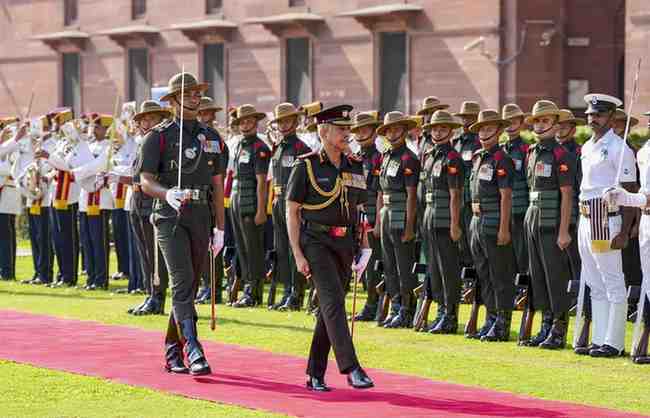
India has entered a new chapter in its military leadership with General N.S. Raja Subramani officially assuming charge as the country’s Chief of Defence Staff (CDS), succeeding General Anil Chauhan. The appointment places one of the Indian Army’s most experienced officers at the helm of the nation’s defence establishment at a time when major structural and strategic reforms are underway.
General Subramani, widely regarded as an expert on India’s security challenges involving both Pakistan and China, takes over the country’s highest military post with a mandate to strengthen coordination among the Army, Navy, and Air Force while accelerating long-pending defence transformation projects.
Soon after taking charge, the new CDS emphasized the importance of modernisation, innovation, and deeper integration across the armed forces. He stated that enhancing joint military capabilities and speeding up organisational reforms would remain among his top priorities. He also highlighted the need to promote indigenous defence manufacturing and ensure greater integration of homegrown weapon systems into the armed forces.
One of the biggest responsibilities before General Subramani will be the implementation of the theatre command model, a landmark reform aimed at integrating the operational capabilities of the Army, Navy, and Air Force under unified commands. Defence experts consider the project crucial for improving military efficiency and preparedness in future conflicts.
Before becoming CDS, General Subramani served as Military Adviser at the National Security Council Secretariat. He had earlier held several key appointments, including Vice Chief of Army Staff and General Officer Commanding-in-Chief of the Central Command. His elevation reflects decades of operational experience and leadership across some of India’s most sensitive military zones.
A graduate of the National Defence Academy and the Indian Military Academy, General Subramani was commissioned into the 8th Battalion of the Garhwal Rifles in December 1985. Over a military career spanning more than four decades, he has commanded infantry units in counter-insurgency operations, led formations in Jammu and Kashmir, and held major operational commands along strategic frontiers.
His career also includes international and strategic assignments such as Defence Attaché in Kazakhstan, senior intelligence roles, and instructional appointments at premier military institutions. He has attended the Joint Services Command and Staff College in the United Kingdom and the National Defence College in New Delhi, further strengthening his strategic credentials.
For his distinguished service, General Subramani has been awarded the Param Vishisht Seva Medal (PVSM), Ati Vishisht Seva Medal (AVSM), Sena Medal (SM), and Vishisht Seva Medal (VSM), reflecting his contributions to national security and military leadership.
His appointment comes at a critical period for India’s defence establishment, with growing emphasis on military self-reliance, integrated warfare capabilities, cyber preparedness, and joint operational planning. As the country continues to strengthen its security architecture, General Subramani’s leadership is expected to play a central role in shaping the future direction of India’s armed forces.