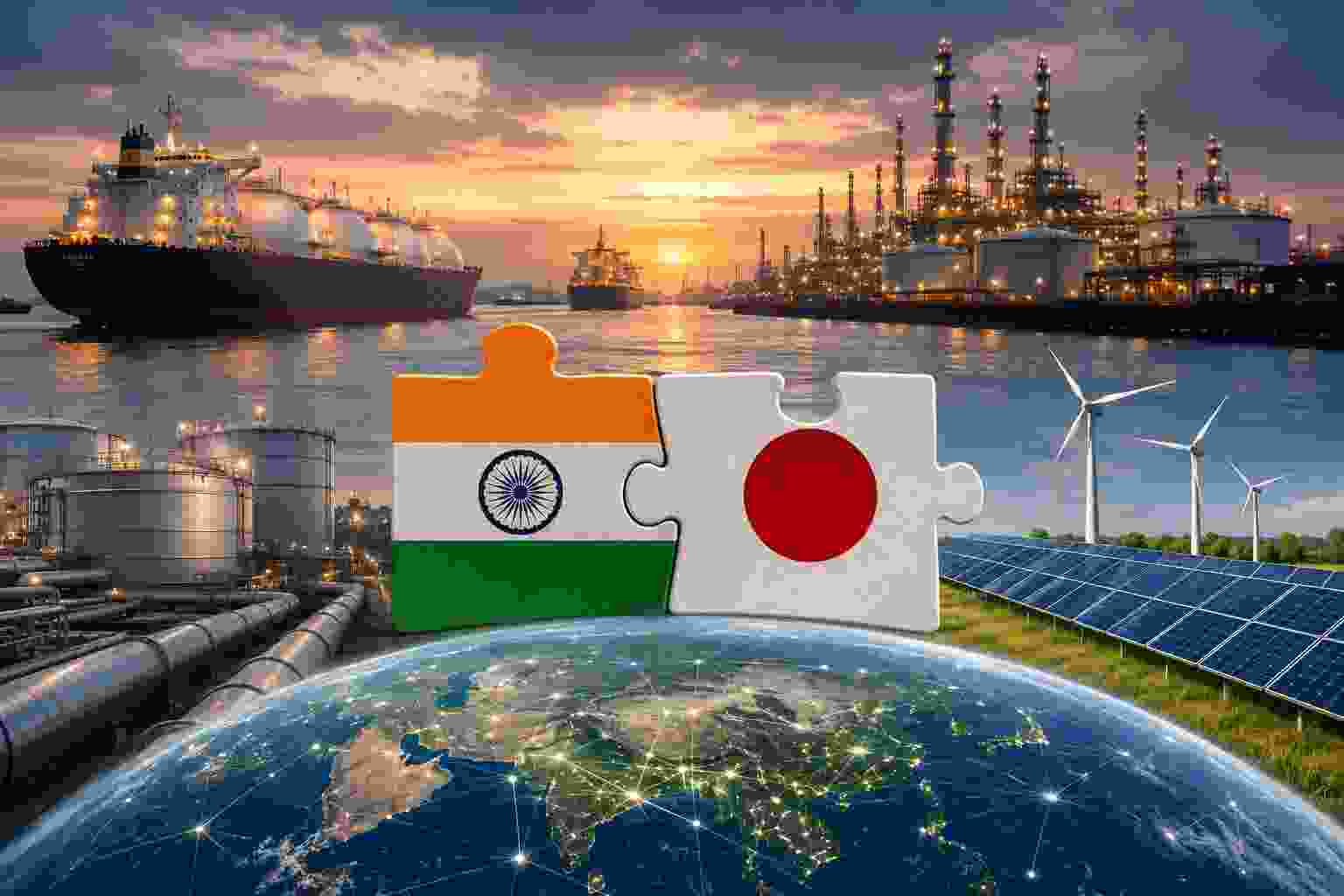
The global energy landscape in 2026 has been defined by unprecedented volatility, exposing the fragile nature of international supply chains. As conflicts in West Asia escalated and disruptions such as the temporary closure of the Strait of Hormuz rippled through global markets, major energy-consuming nations faced severe tests of their economic stability. For India and Japan, two heavily import-dependent economies, these global shocks have catalysed a profound strategic convergence.
The resulting Joint Statement on Energy Resilience, articulated during the sixteenth India-Japan Annual Summit, marks a definitive shift in bilateral relations, moving beyond traditional trade and infrastructure assistance to embed energy resilience at the core of national security.
A Strategic Shift in India-Japan Relations
Historically, bilateral engagements between New Delhi and Tokyo prioritised developmental finance, high-speed rail networks, and manufacturing partnerships. The contemporary geopolitical environment, characterised by the Russia-Ukraine conflict, instability involving Iran, and subsequent global supply bottlenecks, has dictated a reorientation of priorities. Both nations are profoundly vulnerable to fluctuations in the maritime transport of hydrocarbons.
When the Strait of Hormuz faced closure, India experienced a sharp surge in its crude basket prices, threatening domestic inflation and consumer stability. Japan, similarly reliant on West Asian liquefied natural gas, recognised the unsustainable nature of current supply models. This shared vulnerability forms the empirical foundation for a strategic alignment that treats energy transition as an urgent economic imperative.
Strategic Petroleum Reserves and Emergency Preparedness
The Joint Statement on Energy Resilience explicitly links energy security to broader economic stability. Central to this agreement is the decision to coordinate closely on strategic petroleum reserves. The respective petroleum and economy ministries will share technical expertise on national stockpiling systems and coordinate emergency response mechanisms to mitigate market volatility.
Also Read: Delhi Waterlogged; 3000 LPG Cylinders Swept Away In Maharashtra Rains
India’s crude stockpiles cover barely ten days of consumption, with no dedicated reserve system for liquefied petroleum gas, a buffer that is thin by any comparative standard, which is precisely why Japan’s experience in maintaining extensive national stockpiles offers such significant technical value.
Strengthening Maritime Energy Supply Chains
Beyond emergency stockpiling, the partnership emphasises the maritime energy transport value chain. Exploring joint investments across regional shipping corridors reduces dependence on singular, high-risk geographic chokepoints. By pooling logistical capabilities and sharing market intelligence, India and Japan aim to shield their domestic populations from the price manipulation and supply squeezes that have become common instruments of geopolitical coercion.
This bilateral initiative also serves a wider regional function, complementing minilateral frameworks like the Quad Initiative on Indo-Pacific Energy Security. While minilateral dialogues provide a broad umbrella for regional stability, the highly specific, capital-intensive nature of energy infrastructure requires deep bilateral trust to execute. The India-Japan bilateral alignment effectively acts as the primary engine for the Quad’s economic security agenda, proving that focused, state-to-state agreements can deliver material outcomes that larger, more unwieldy forums struggle to finalise.
Advancing Clean Energy Cooperation
The energy shock of 2026 has simultaneously accelerated mutual investments in next-generation clean energy technologies. The summit advanced concrete initiatives in green hydrogen, clean ammonia, and solar photovoltaics, illustrating a shift from policy dialogue to ground-level industrial execution.
For policymakers, the India-Japan alignment offers a masterclass in adapting to structural deficits. Neither nation possesses the domestic fossil fuel reserves necessary to insulate themselves unilaterally. By treating energy resilience as a form of shared security, they are attempting to build trusted alternatives to highly concentrated global supply chains, aiming to protect critical industrial sectors from arbitrary export restrictions.
The Way Forward: Building Long-Term Energy Security
Looking towards the way forward, the immediate crisis management demonstrated during the Hormuz closure must transition into permanent structural reforms. The lessons of 2026 dictate a comprehensive strategic response across multiple domestic and international vectors. The acceleration of the renewable energy transition remains paramount.
Every megawatt of clean energy generated domestically actively reduces exposure to volatile imported fossil fuels, structurally improving the balance of payments. Deepening the India-Japan Biogas Initiative and expanding joint research into battery storage will be essential to manage the intermittency of renewable sources, particularly as both nations expand their solar photovoltaic capacities.
Boosting Domestic Exploration and Energy Independence
Domestic oil and gas exploration requires renewed capital and technological injection. India’s sedimentary basins possess significant untapped potential, and the government’s recent approval of large-scale seismic surveys and artificial intelligence-enabled exploration is a step in the right direction.
Whether Japanese technological expertise could be drawn into this effort remains an open question worth pursuing, though no such arrangement has yet been formally announced. Maximising domestic resource utilisation through import-substituting technologies, such as coal gasification and advanced biofuels, will also lower dependence on imported transport fuels and fertilisers while supporting domestic industrial growth. The transition from legacy fossil fuels is a multi-decade process; managing the interim period requires extracting maximum utility from domestic reserves to avoid the fiscal drain of elevated global energy prices.
Expanding Strategic Energy Reserves
The physical expansion of strategic reserves must proceed with absolute urgency. India must move beyond its current capacity constraints to establish dedicated, long-term reserves for crude, liquefied natural gas, and liquefied petroleum gas.
The ongoing dialogue with Japan provides the technical blueprint for a hybrid stockpiling model that integrates state-owned strategic reserves with mandated industry stockpiles. However, the physical infrastructure requires rapid domestic capital allocation. Larger strategic buffers provide the necessary time-delay mechanism to absorb the initial shock of any future geopolitical crisis, allowing diplomatic and economic responses to be formulated without the pressure of immediate domestic shortages.
Diversifying Supply Sources for Future Resilience
The diversification of supply sources must be institutionalised through long-term procurement partnerships. Reliance on volatile spot markets has proven excessively costly. India and Japan should leverage their combined purchasing power to secure long-term contracts across varied geographic regions, reducing exposure to singular geopolitical theatres.
Expanding imports from producers in North America, West Africa, and Northern Europe, while maintaining stable relations with traditional partners, ensures that temporary regional conflicts do not result in national economic paralysis. By fusing their respective strengths, Japan’s advanced technological and capital resources with India’s immense scale and strategic geographic positioning, the two nations are actively shaping the regional energy architecture, ensuring that the next global shock is met with coordinated resilience rather than isolated vulnerability.
Click here to join our WhatsApp Channel for real-time news updates and exclusive coverage.