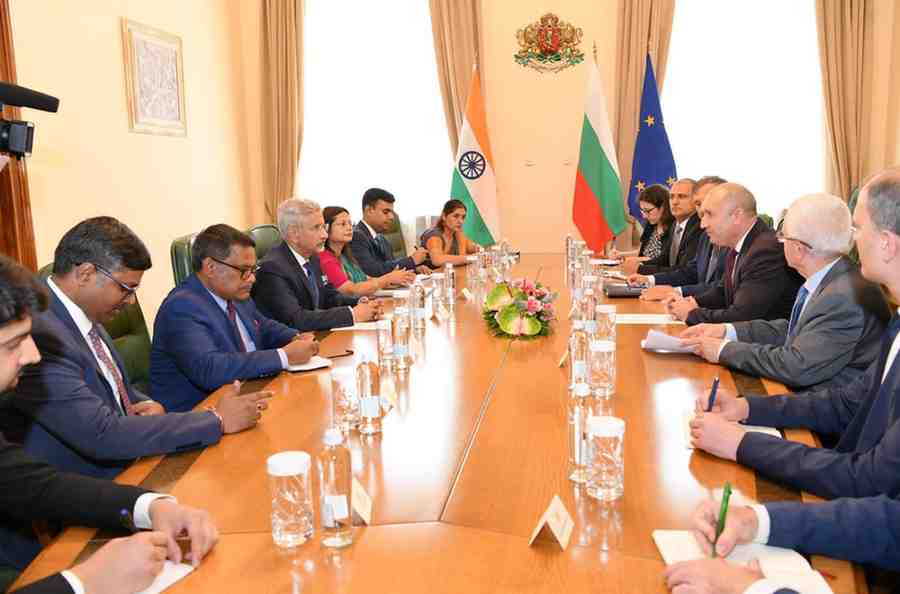
External Affairs Minister Dr. S. Jaishankar held a series of high-level meetings in Bulgaria on Wednesday, emphasizing the growing importance of India-Bulgaria relations amid shifting global economic and geopolitical dynamics. During his visit, Jaishankar met Bulgarian President Rumen Radev and Foreign Minister Velislava Petrova-Chamova, discussing ways to deepen cooperation across a broad range of sectors, including trade, investment, artificial intelligence, semiconductors, pharmaceuticals, defence, space, mobility, tourism, and culture.
Sharing details of his meeting with President Radev, EAM Jaishankar said it was “a pleasure” to meet the Bulgarian leader and conveyed the greetings of Prime Minister Narendra Modi to the government and people of Bulgaria. The discussions highlighted the strong foundation of bilateral ties and the opportunities emerging from the strengthening India-European Union strategic partnership.
In a strong signal of future intent, EAM Jaishankar also said that “India and Bulgaria are committed to transforming our longstanding friendship into a contemporary and forward-looking partnership.”
Jaishankar stressed the need for closer cooperation between India and Bulgaria in an increasingly uncertain global environment. He noted that both countries have a shared interest in strengthening supply chains, diversifying economic partnerships, and reducing vulnerabilities created by geopolitical disruptions.
“Highlighted our robust bilateral ties, recent opportunities created by the strengthening India-EU Strategic Partnership, and the imperative for closer India-Bulgaria cooperation to de-risk and diversify in an increasingly volatile world,” Jaishankar said.
The reference to “de-risk and diversify” reflects a growing international trend where countries seek to reduce excessive dependence on a limited number of suppliers or markets. For India and Bulgaria, this could translate into stronger collaboration in critical sectors such as semiconductors, pharmaceuticals, advanced manufacturing, and digital technologies, helping both nations build resilient economic partnerships.
The two sides also discussed expanding cooperation in trade and investment, with a particular focus on emerging technologies. Artificial intelligence and semiconductor manufacturing featured prominently in the talks, reflecting their strategic importance in the global economy. Discussions also covered space cooperation, defence partnerships, mobility initiatives, tourism promotion, and collaboration in the creative entertainment industry.
Beyond bilateral issues, the leaders exchanged views on regional and international developments of mutual concern, underscoring the growing convergence between India and European partners on global challenges.
Later in the day, Jaishankar met Bulgarian Foreign Minister Velislava Petrova-Chamova, where the two leaders reviewed the entire spectrum of India-Bulgaria relations and explored new opportunities for cooperation.
According to Jaishankar, the discussions took place in the context of ongoing India-EU Free Trade Agreement negotiations, efforts to strengthen strategic and defence ties, and the Comprehensive Mobility Cooperation Framework. These initiatives are expected to create new pathways for economic engagement, investment flows, skilled workforce mobility, and technological collaboration.
“Reviewed the full spectrum of India-Bulgaria relations and explored new avenues for cooperation,” Jaishankar stated, adding that both sides focused on expanding economic engagement and strengthening partnerships in science and technology, artificial intelligence, pharmaceuticals, defence, connectivity, education, culture, and people-to-people exchanges.
The emphasis on mobility and people-to-people contacts is particularly significant, as both countries seek to facilitate greater movement of students, professionals, researchers, and entrepreneurs. Such exchanges are expected to contribute to stronger economic and cultural ties while creating new opportunities for collaboration in innovation and education.
The ministers also discussed increasing the frequency of political engagements, reflecting a mutual desire to maintain regular dialogue and elevate bilateral relations to a higher level.
The statement highlights the evolving nature of India-Bulgaria ties, which are increasingly moving beyond traditional diplomatic engagement toward cooperation in advanced technologies, strategic industries, defence, and human connectivity. As India deepens its engagement with Europe and Bulgaria seeks to diversify its international partnerships, both countries appear determined to build a modern relationship capable of addressing the challenges and opportunities of the 21st century.
The meetings in Sofia are expected to provide fresh momentum to bilateral cooperation and reinforce India’s broader strategic engagement with Europe at a time of significant global economic and geopolitical change.