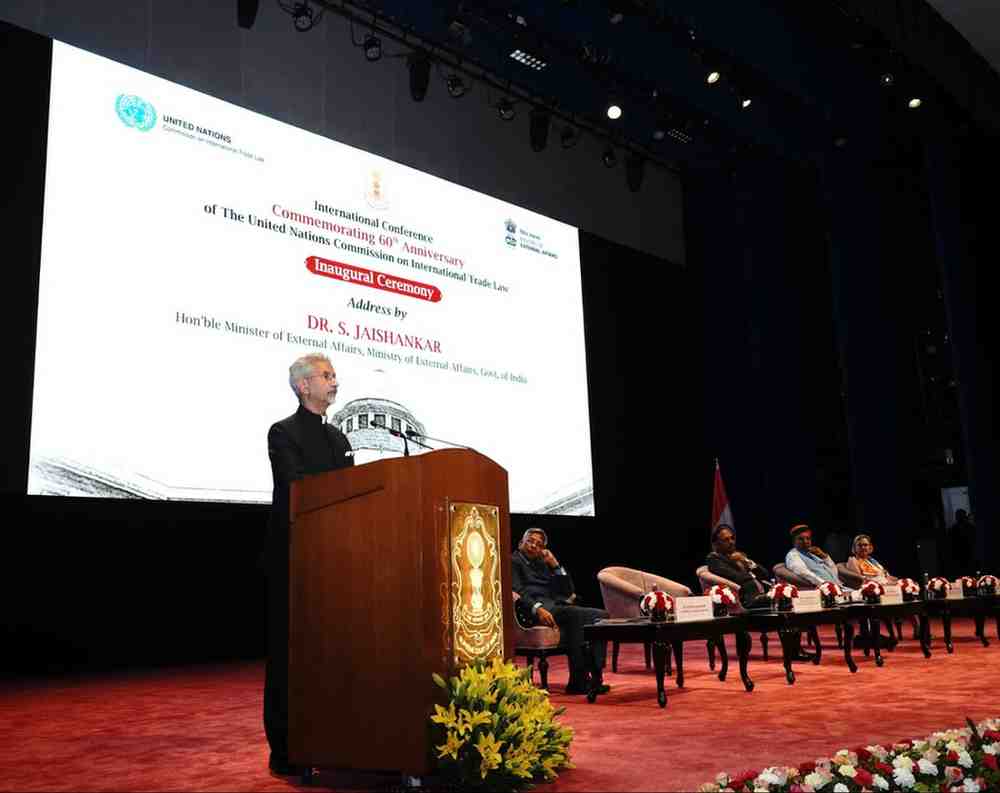
External Affairs Minister Dr. S. Jaishankar on Saturday stressed the need for modern, transparent and internationally compatible legal frameworks to keep pace with the rapidly evolving global economy while addressing the inaugural session of an international conference marking the 60th anniversary of the United Nations Commission on International Trade Law (UNCITRAL).
Speaking at the event, Jaishankar highlighted the significant role played by UNCITRAL in shaping international trade law over the past six decades. He said the commission has made substantial contributions to the harmonisation, modernisation and progressive development of legal systems governing international trade, enabling greater confidence in cross-border commercial activities.
UNCITRAL’s Six-Decade Contribution Recognised
The External Affairs Minister acknowledged UNCITRAL’s efforts in creating legal standards that have facilitated international trade and investment across countries. He noted that its work has helped establish greater consistency in legal principles, making international business transactions more predictable and efficient.
According to Jaishankar, the global trading system has witnessed remarkable changes over the years, and institutions like UNCITRAL have remained central to strengthening international commercial law. He said these legal frameworks have supported economic cooperation while reducing uncertainties in cross-border business operations.
He observed that a stable and harmonised legal environment is essential for sustaining international trade and encouraging long-term investments.
Rapid Global Changes Reshaping Trade
Highlighting the changing nature of the global economy, Jaishankar said profound transformations are taking place due to technological innovation, the rapid expansion of digital commerce, evolving global supply chains and new investment patterns.
He noted that these developments are significantly changing how goods, services, capital and data move across international borders. As digital technologies continue to reshape business models, governments and international institutions must ensure that legal systems remain relevant and responsive.
The minister pointed out that international trade today extends beyond the traditional movement of goods and increasingly involves digital transactions, data flows and emerging technologies. This changing landscape, he said, requires updated legal frameworks capable of addressing new commercial realities.
Importance of Predictable Legal Systems
Jaishankar emphasised the importance of predictable and harmonised legal frameworks in supporting global commerce. He said businesses require legal certainty to confidently engage in international transactions and investments.
He underlined the need for efficient dispute-resolution mechanisms that can resolve commercial disagreements fairly and quickly. Such systems, he said, help build trust among trading partners and reduce risks associated with cross-border business activities.
According to the minister, greater legal certainty benefits governments, businesses and investors alike by promoting smoother international trade and encouraging economic growth.
He added that strengthening international legal cooperation remains essential in ensuring stability in an increasingly interconnected global economy.
Global South Must Have a Strong Voice
A major focus of Jaishankar’s address was the importance of ensuring that developing countries have an active role in shaping international trade law.
He said the Global South has significant stakes in the future evolution of global commercial regulations. As economies across Asia, Africa and Latin America continue to expand, their developmental priorities and practical realities must be adequately reflected in international legal frameworks.
Jaishankar stressed that trade laws should be inclusive and responsive to the needs of developing economies rather than being designed solely around the interests of advanced nations.
Also Read: PM Modi Thanks Youngsters For Overwhelming Response To Midnight Video On Exam Reforms
He noted that balanced legal standards would contribute to more equitable global economic growth while strengthening international cooperation.
India’s Commitment to Legal Reforms
The External Affairs Minister reaffirmed India’s commitment to creating a modern, transparent and internationally compatible legal environment that supports trade, investment and economic development.
He said India has consistently pursued reforms aimed at improving the ease of doing business, strengthening commercial regulations and aligning domestic legal systems with global best practices.
These efforts, he noted, are intended to enhance investor confidence while promoting sustainable economic growth and greater integration with the global economy.
Jaishankar reiterated that India remains committed to supporting international cooperation in the development of fair and effective trade laws that benefit all countries.
Strengthening Rules-Based International Trade
Concluding his address, Jaishankar underscored that international trade continues to serve as a key driver of global economic prosperity. He said maintaining a predictable, transparent and rules-based trading system is essential for ensuring long-term growth and stability.
He observed that the legal architecture governing international commerce must continue evolving to meet emerging challenges while remaining inclusive and responsive to changing global realities.
As UNCITRAL marks its 60th anniversary, India reaffirmed its support for strengthening international legal cooperation and promoting frameworks that facilitate fair, transparent and efficient global trade. The conference served as an opportunity for policymakers, legal experts and international stakeholders to reflect on the future direction of international trade law amid a rapidly transforming global economy.
Click here to join our WhatsApp Channel for real-time news updates and exclusive coverage.