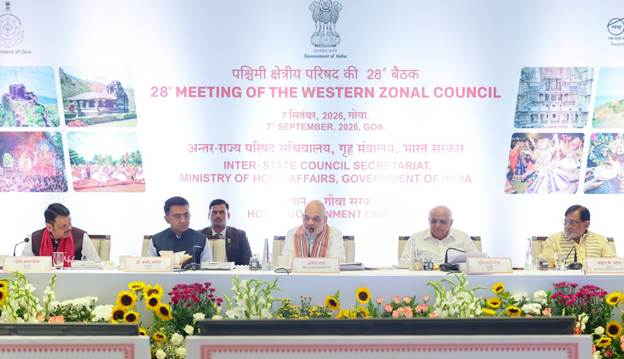
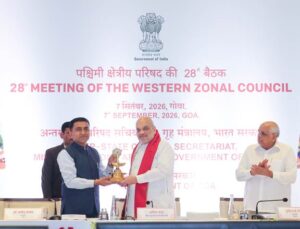
The Union Home Minister and Minister of Cooperation Amit Shah on Monday chaired the 28th meeting of the Western Zonal Council in Panaji, Goa, highlighting the region’s growing contribution to India’s economy, infrastructure, tourism, technology and financial sectors.
The meeting was attended by Goa Chief Minister Pramod Sawant, Gujarat Chief Minister Bhupendra Patel, Maharashtra Chief Minister Devendra Fadnavis and Administrator of Dadra and Nagar Haveli and Daman and Diu Praful K. Patel. Senior officials from the Centre, participating states and the Union Territory were also present.
Western Region Driving India’s Economic Growth
Addressing the meeting, Amit Shah said the Western Region has emerged as a critical pillar of India’s economic progress and described it as the country’s “WEST Engine” of economic growth.
He explained that the term WEST represents four major strengths of the region. “W” signifies wealth and finance, “E” stands for exports and ports, “S” represents start-ups and semiconductors, while “T” reflects tourism and the blue economy.
Shah said the region has made a substantial contribution to India’s economic performance, particularly as the country recorded a growth rate of 7.8 per cent in the first quarter of financial year 2026–27. He described the growth achieved amid global economic uncertainty as a matter of pride.
According to Shah, the Western Region has a particularly important role because it represents India’s largest economic, industrial and financial centre.
Goa, Maharashtra and Gujarat Strengthen WEST Engine
Shah highlighted Goa’s contribution to the economy, noting that the state’s economic importance goes beyond its geographical size. He attributed this strength to tourism, high per capita income and mining activities.
More than one crore tourists visit Goa annually, including around five lakh foreign visitors. Tourism contributes approximately 16 per cent to the state’s Gross State Domestic Product.
Maharashtra, meanwhile, has emerged as a major start-up centre, with 33,872 start-ups, the highest number among states, according to Shah. He also pointed to Mumbai’s position as India’s financial capital and its growing importance as a destination for global capital.
In Gujarat, Dholera has developed as an important semiconductor hub, while Mundra Port has emerged as a major cargo-handling facility. Shah also highlighted Deendayal Port for its significant cargo-handling capacity.
He said the three states and the Union Territory of Dadra and Nagar Haveli and Daman and Diu have played an important role in strengthening the Western Region’s contribution to the national economy.
Zonal Councils Strengthening Cooperative Federalism
The Union Home Minister said the Zonal Councils have gained greater importance under Prime Minister Narendra Modi, particularly in promoting cooperative federalism and improving coordination between the Centre and states.
Shah noted that between 2004 and 2014, only 25 meetings of the Zonal Councils and their Standing Committees were held. Since 2014, however, 71 such meetings have taken place, representing an increase of nearly three times.
He said these meetings have provided an effective platform for resolving issues and monitoring development-related matters. A total of 1,893 issues have been discussed through these meetings, with 1,445 already resolved.
Shah said the progress demonstrated the effectiveness of the Team India approach and credited state governments, Union Territories, central ministries and departments, as well as the Inter-State Council Secretariat, for the results.
He added that Zonal Councils have increasingly moved beyond their traditional role of dispute resolution and are now being used to monitor the implementation of welfare and development programmes.
Focus on Drugs, Cybercrime and Coastal Security
The meeting also focused on several areas linked to public welfare and national security. Shah called on the Western Region to take a leading role in implementing the new criminal laws and strengthening the country’s campaign against drugs.
Also Read — FSIE 2026: Maharashtra Leaders Call For Stronger Fire Safety To Build Safer India
He highlighted progress in computerisation of Primary Agricultural Credit Societies, with Maharashtra achieving 98 per cent coverage and Gujarat reaching 92 per cent. He also encouraged states to adopt the Gobardhan model developed by Banas Dairy.
On cybercrime, Shah said Prime Minister Narendra Modi is continuously monitoring the national strategy through PRAGATI. He stressed the need to connect Urban Cooperative Banks with the FCFRS and encouraged cooperative banks to integrate with MuleHunter AI.
He also emphasised the importance of connecting cooperative banks with the Indian Cyber Crime Coordination Centre (I4C). Shah said the Ministry of Home Affairs would intensify efforts to strengthen coastal security over the next two years.
The Union Home Minister further noted that all four members of the Western Zonal Council are performing strongly in the green-energy sector. He urged states to take maximum advantage of the Centre’s policy framework for data centres.
Key Issues Discussed at Western Zonal Council
The 28th meeting considered several issues affecting the member states and the Union Territory, along with matters of wider national importance.
Discussions included the implementation of Fast Track Special Courts to ensure quicker investigation and disposal of rape cases involving women and children. Matters concerning the Emergency Response Support System, ERSS-112, food safety standards and the Ayushman Bharat–Pradhan Mantri Jan Arogya Yojana were also reviewed.
The council discussed the need to provide brick-and-mortar banking facilities within the prescribed radius of villages, along with railway development projects and environmental clearance-related matters.
Other key areas included urban master planning, electricity supply, strengthening PACSs, tackling child malnutrition through the Poshan Abhiyaan and reducing school dropout rates.
The participation of public hospitals in the Ayushman Bharat scheme was also examined, alongside issues concerning cybercrime and digital infrastructure.
Shah said the Zonal Councils under Prime Minister Modi’s leadership are increasingly becoming platforms for coordinated development and public welfare. He stressed that the Western Region, with its strong economic, industrial, financial, technological and tourism base, has a central role to play in sustaining India’s growth momentum.
Click here to join our WhatsApp Channel for real-time news updates and exclusive coverage.