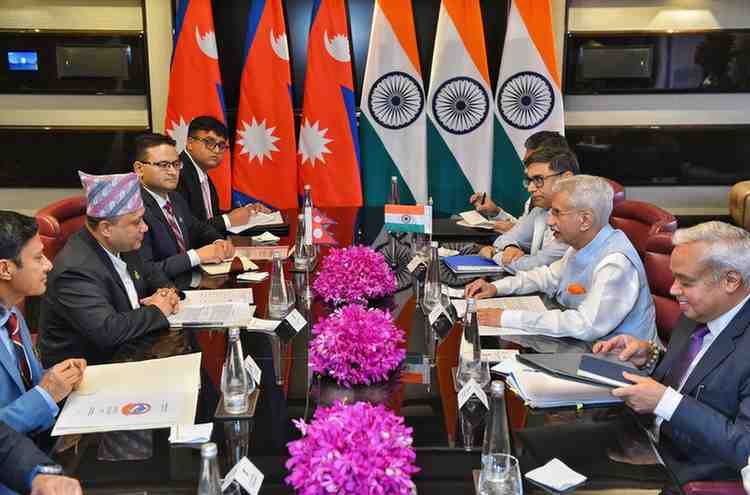
NEW DELHI: India and Nepal have reiterated their commitment to strengthening cooperation on border security and enhancing their long-standing bilateral partnership during high-level discussions held in New Delhi. External Affairs Minister Dr. S. Jaishankar and Nepal’s Foreign Minister Shishir Khanal reviewed the full spectrum of India-Nepal relations, with a particular focus on security coordination along the open border shared by the two neighboring countries.
The meeting comes at a significant time as both nations seek to deepen engagement across multiple sectors, including trade, connectivity, infrastructure development, energy cooperation, and border management. Nepal’s foreign minister is on a three-day official visit to India, marking the first ministerial-level engagement from Kathmandu since the formation of Nepal’s new government earlier this year.
During the talks, both sides highlighted the importance of maintaining peace and stability along the India-Nepal border, one of the most unique international boundaries in the world due to its open nature and extensive people-to-people interactions. The ministers acknowledged that effective border management requires close coordination between security agencies and administrative authorities on both sides.
India and Nepal have historically worked together to address challenges such as cross-border crime, smuggling, human trafficking, and other security concerns. Existing mechanisms involving security agencies and border management authorities have helped strengthen cooperation and facilitate information sharing. Recent bilateral engagements have also focused on improving surveillance, enhancing infrastructure, and promoting coordinated responses to emerging security challenges.
The discussions also underscored the importance of development partnerships that have become a cornerstone of India-Nepal relations. India continues to support various infrastructure, education, healthcare, and connectivity projects in Nepal, contributing to the Himalayan nation’s socio-economic development. Both countries expressed satisfaction with the progress made under ongoing projects and agreed to expedite implementation wherever necessary.
Connectivity remained another key area of focus. The two sides reviewed initiatives aimed at improving road, rail, and energy links between the countries. Enhanced connectivity is expected to boost trade, tourism, and investment while further strengthening people-to-people ties. Over the years, India and Nepal have expanded cross-border railway links, integrated check posts, petroleum pipelines, and power transmission networks, creating new opportunities for economic growth and regional integration.
Energy cooperation also featured prominently in the discussions. India and Nepal have emerged as important partners in the power sector, particularly in hydropower development and electricity trade. Nepal’s growing energy exports to India have opened new avenues for economic collaboration and contributed to regional energy security. Both nations reiterated their commitment to expanding cooperation in renewable energy and power transmission infrastructure.
The ministers further emphasized the cultural and civilizational bonds that connect the two countries. India and Nepal share centuries-old historical, religious, and social linkages, reflected in the movement of people, pilgrimage routes, educational exchanges, and family ties across the border. These unique connections continue to serve as a strong foundation for bilateral relations.
The meeting also took place against the backdrop of recent discussions concerning border-related issues. India has consistently maintained that any outstanding boundary matters should be addressed through bilateral dialogue and existing diplomatic mechanisms. New Delhi has reiterated its position that such issues are best resolved directly between the two countries through mutual understanding and cooperation.
Both leaders expressed confidence that regular dialogue and sustained engagement would help address challenges while unlocking new opportunities for collaboration. They agreed to maintain close consultations and continue working together on issues of mutual interest.
The visit reflects the priority both governments place on maintaining a strong and constructive partnership. As neighboring countries linked by geography, history, and culture, India and Nepal continue to view each other as important partners in ensuring regional stability, economic development, and shared prosperity.
The discussions concluded with a reaffirmation of the commitment to further strengthen bilateral cooperation, deepen security coordination along the border, and advance projects that benefit the people of both countries. The meeting highlighted the enduring nature of India-Nepal relations and the shared determination to build on the achievements of recent years through dialogue, trust, and collaboration.