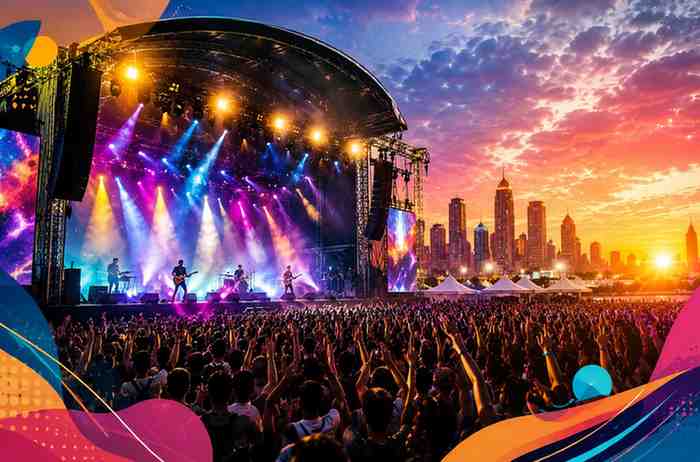
The Government of India has accelerated its efforts to transform the country’s live events industry into a globally competitive sector by introducing a series of reforms aimed at improving infrastructure, simplifying approvals and promoting investment. With an ambitious vision of making India a global hub for live events by 2030, the Centre has rolled out several initiatives that are expected to strengthen the ecosystem while creating new opportunities for employment, tourism and cultural promotion.
The Ministry of Information and Broadcasting has identified the live events industry as a key contributor to India’s economic growth. Recognising its potential to generate jobs, attract international events and enhance India’s cultural presence, the government established the Live Events Development Cell (LEDC) in July 2025 to coordinate policy reforms and improve the sector’s overall business environment.
LEDC Driving Sector-Wide Reforms
The Live Events Development Cell is chaired by the Secretary of the Ministry of Information and Broadcasting and includes representatives from various Central Ministries, State Governments, industry associations and other stakeholders. The body serves as a coordination platform for addressing challenges faced by the live events industry and recommending policy measures.
Since its formation, the LEDC has held four meetings on August 26, 2025, October 16, 2025, February 4, 2026, and April 30, 2026. During these meetings, multiple initiatives were finalised to strengthen regulatory systems, encourage investment and improve ease of doing business across the country.
Digital Single-Window System for Event Permissions
One of the most significant reforms introduced by the government is the launch of a comprehensive online permission system for live events through the India Cine Hub (ICH) portal.
The portal provides organisers with a single digital platform to submit applications, obtain approvals, coordinate with different departments, make payments and complete inspections. The system has been designed to ensure time-bound processing of applications while offering real-time tracking, digital payment facilities, automatic escalation of delays and transparent digital audit trails.
Officials believe this integrated system will significantly reduce procedural delays and simplify the process of organising large-scale concerts, festivals, exhibitions and entertainment events across the country.
States Join National Approval Framework
To strengthen coordination between the Centre and States, 29 States and Union Territories have already appointed dedicated Nodal Officers for processing live event permissions through the India Cine Hub portal.
The LEDC has also prepared the Model Executive Order for Streamlining Licensing and Permissions for Live Events in India, 2026, which was circulated to all States and Union Territories on March 13, 2026. So far, three States or Union Territories have implemented the model framework, with more expected to adopt it in the coming months.
The government expects greater uniformity in licensing procedures once more States implement the recommendations.
Heritage Venues and New Infrastructure Plans
To expand venue options for organisers, the Archaeological Survey of India has prepared a Standard Operating Procedure for hosting live events at protected monuments. Along with the SOP, the ASI has identified 224 heritage sites where such events can potentially be organised while ensuring protection of historical structures.
The LEDC has also circulated a concept note for a Greenfield Venue Development Policy to State Governments, sports authorities and industry stakeholders. The proposed policy aims to encourage development of modern event venues capable of hosting international concerts, exhibitions and cultural programmes.
The initiative is expected to improve India’s event infrastructure and attract global entertainment companies and event organisers.
Focus on Skill Development
Recognising the growing demand for trained professionals in the live events industry, the government has constituted a dedicated Skilling Committee.
The Indian Institute of Mass Communication (IIMC), working in collaboration with the Media and Entertainment Skills Council and the Event and Entertainment Management Association, has begun preparatory work for certificate programmes, short-term training courses and specialised elective modules related to live event management.
Also Read: Delhi Drops NEET Protest Cases, Tough Stand Against Criminal Offenders Remains
These programmes are expected to create a skilled workforce capable of supporting India’s expanding entertainment and event industry.
Addressing Industry Challenges
The LEDC has also identified several policy issues affecting the sector and has shared them with the relevant Ministries and Departments for further action.
Among the key issues highlighted are visa and Foreigners Regional Registration Office (FRRO) facilitation for international artists and technical crews, access to sports stadiums and heritage venues, simplification of music licensing procedures, permissions for events extending beyond 10 p.m., taxation concerns and improved access to finance for organisers.
The government is examining these issues to make the regulatory environment more business-friendly while supporting the long-term growth of the sector.
RBI Eases Financial Compliance
In another major development, the Reserve Bank of India has accepted a recommendation made by the LEDC regarding advance remittances for imported services.
Under the Foreign Exchange Management Regulations, 2026, notified on January 15, 2026, the RBI has removed the requirement for furnishing a bank guarantee for advance remittances of USD 500,000 and above for importing services. The revised regulation will come into effect from October 1, 2026.
The move is expected to reduce financial hurdles for organisers bringing international performers, technical experts and specialised services to India, making it easier to host large global events.
The information regarding these initiatives was shared by Minister of State for Information and Broadcasting and Parliamentary Affairs, Dr. L. Murugan, in a written reply to an Unstarred Question in the Lok Sabha. The government believes these reforms will strengthen India’s live events ecosystem and support its long-term vision of emerging as a preferred global destination for concerts, festivals, cultural programmes and international entertainment events.
Click here to join our WhatsApp Channel for real-time news updates and exclusive coverage.