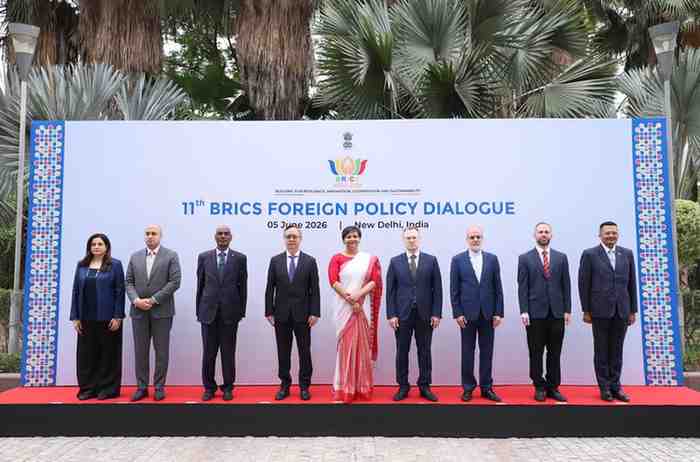
NEW DELHI: India witnessed an important diplomatic engagement with the successful convening of the 11th BRICS Foreign Policy Dialogue, where India reaffirmed its commitment to strengthening cooperation among emerging economies and amplifying the voice of the Global South. The dialogue brought together senior foreign policy officials from BRICS member nations to discuss key geopolitical, economic, and developmental challenges facing the world today.
The meeting was held at a time when the international community is grappling with multiple crises, including regional conflicts, economic uncertainty, climate challenges, food insecurity, and disruptions in global supply chains. Against this backdrop, India emphasized the importance of collective action, inclusive development, and a rules-based international order that reflects the aspirations of developing countries.
During the discussions, participating countries exchanged views on pressing global and regional issues. India stressed the need for reforming international institutions to make them more representative, democratic, and responsive to contemporary realities. Indian representatives highlighted that many global institutions were created in a different era and now require significant reforms to adequately address the concerns of emerging economies and developing nations.
The dialogue also focused on strengthening cooperation in areas such as trade, technology, innovation, sustainable development, energy security, and digital transformation. India underlined the role of technology as a powerful tool for social and economic empowerment and encouraged greater collaboration among BRICS countries in digital public infrastructure, artificial intelligence, fintech, and innovation-led growth.
Another major theme of the meeting was the promotion of multilateralism. India reiterated that dialogue, diplomacy, and cooperation remain the most effective means of resolving international disputes. Participants discussed ongoing global tensions and emphasized the importance of respecting sovereignty, territorial integrity, and international law while seeking peaceful solutions to conflicts.
Counter-terrorism cooperation also featured prominently in the discussions. India once again called for a united global approach against terrorism, stressing that there should be no double standards in combating the menace. New Delhi has consistently advocated stronger international mechanisms to address terrorism financing, radicalization, and cross-border terrorist activities.
The BRICS Foreign Policy Dialogue further explored opportunities for enhancing economic resilience among member states. Participants examined ways to strengthen trade relations, diversify supply chains, improve connectivity, and foster sustainable economic growth. There was broad recognition that closer cooperation among BRICS countries can contribute significantly to global stability and prosperity.
As India prepares to lead BRICS in 2026, the dialogue served as a platform to outline the country’s priorities for the grouping. India emphasized people-centric development, innovation-driven growth, environmental sustainability, and greater engagement with developing nations. The discussions reflected a shared commitment to building a more equitable and balanced international system.
PM Modi’s Vision for BRICS 2026
Prime Minister Narendra Modi has outlined an ambitious vision for India’s BRICS Presidency in 2026. The vision focuses on resilience, innovation, cooperation, and sustainability as key pillars for the future of the grouping. India aims to strengthen BRICS as a platform capable of addressing global challenges while promoting the interests of developing countries.
Under Prime Minister Modi’s leadership, India seeks to leverage BRICS cooperation in areas such as digital transformation, climate action, disaster resilience, healthcare, food security, and emerging technologies. The objective is to ensure that BRICS remains relevant and effective in shaping a more inclusive global order.
India’s approach also places significant emphasis on the aspirations of the Global South. By promoting greater participation of developing countries in international decision-making, New Delhi hopes to create a fairer and more representative system of global governance.
What is BRICS?
BRICS is a grouping of major emerging economies that originally consisted of Brazil, Russia, India, China, and South Africa. In recent years, the bloc has expanded to include new members such as Egypt, Ethiopia, Iran, Indonesia, and the United Arab Emirates, making it an even more influential force in global affairs.
Collectively, BRICS represents a significant share of the world’s population, economic output, and natural resources. The grouping serves as a platform for cooperation in trade, finance, development, technology, and global governance. It advocates a multipolar world order and seeks to ensure that developing countries have a stronger voice in international affairs.
The 11th BRICS Foreign Policy Dialogue highlighted the growing importance of the bloc in addressing global challenges. As India moves toward its 2026 presidency, the country is positioning itself as a key driver of cooperation, reform, and inclusive development within BRICS and beyond.