
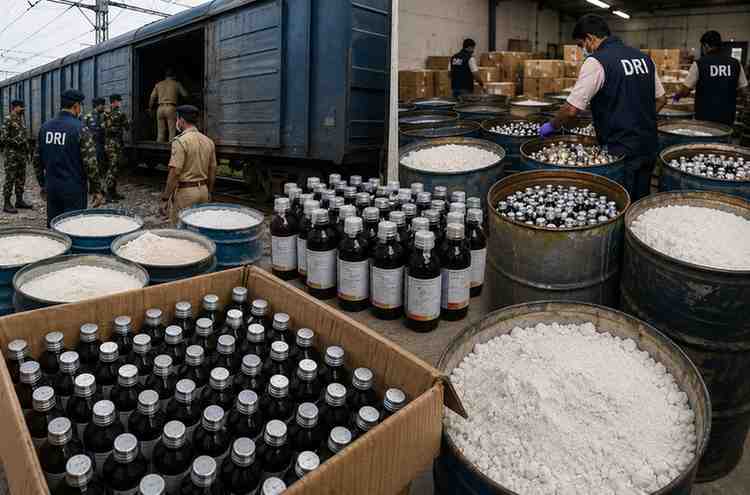
AGARTALA/KOLKATA: India’s fight against drug trafficking received a major boost after the Directorate of Revenue Intelligence (DRI) seized more than 1.11 lakh bottles of Codeine-based cough syrup in two intelligence-led operations conducted in Tripura and West Bengal. The seizures, made under the provisions of the Narcotic Drugs and Psychotropic Substances (NDPS) Act, 1985, underline the growing efforts of enforcement agencies to dismantle organised drug trafficking networks operating across the country.
The large-scale operations come just days before India hosts the BRICS Heads of Anti-Drug Agencies Meeting on July 6–7, 2026, in Guwahati, Assam, where senior anti-narcotics officials from all 11 BRICS member countries will discuss stronger international cooperation against evolving drug trafficking threats.
Also Read: Super Typhoon Bavi Roars Toward US Pacific Islands With 280 kmph Winds
Massive Seizure on Train Bound for Agartala
In the first operation, conducted on July 2, 2026, DRI officers intercepted a suspicious consignment travelling in the parcel van of a train heading to Agartala. During a detailed examination, officials discovered that the illegal cargo had been cleverly concealed inside 80 metallic drums.
The Codeine-based cough syrup bottles were hidden beneath a thick layer of powdery material intended to camouflage the consignment and avoid detection during transportation. After carefully opening the drums, officials recovered 55,626 bottles of the narcotic-containing cough syrup.
The operation was carried out with assistance from the Railway Protection Force (RPF) and Assam Rifles. Authorities also arrested one individual who allegedly arrived to receive the consignment.
The seized material has been confiscated under the NDPS Act, and further investigations are underway to identify others connected to the smuggling network.
Warehouse Raid in West Bengal Uncovers Another Huge Stockpile
Around the same period, DRI officers launched another operation at a warehouse in Dankuni, West Bengal.

During the search, officials found 104 sealed iron drums containing 56,225 bottles of Codeine-based cough syrup. Similar to the Tripura operation, the bottles had been concealed beneath a layer of china clay powder to evade law enforcement agencies.
The entire consignment was seized under the NDPS Act. Investigators are now tracing the origin, intended destination, and financial links associated with the shipment.
Combined Seizure Crosses 1.11 Lakh Bottles
Together, the two operations resulted in the seizure of nearly 1.11 lakh bottles of Codeine-based cough syrup and the arrest of one suspect.
Officials believe the concealment methods used in both cases indicate the involvement of organised trafficking syndicates that are increasingly adopting sophisticated techniques to move narcotic pharmaceutical products across states.
Why Codeine-Based Cough Syrups Are Frequently Misused
Codeine is an opioid derivative with legitimate medical applications when used in regulated pharmaceutical preparations to treat cough and pain.
However, when diverted into illegal markets, Codeine-based cough syrups are often abused because of their narcotic effects. Their misuse has become a growing concern for law enforcement agencies, particularly due to organised trafficking networks exploiting pharmaceutical supply chains.
Authorities say these latest seizures demonstrate how traffickers continue to devise innovative methods to conceal narcotic substances within seemingly ordinary commercial consignments.
BRICS Anti-Drug Meeting to Strengthen Global Cooperation
The DRI operations coincide with India’s preparations to host the BRICS Heads of Anti-Drug Agencies Meeting in Guwahati on July 6 and 7. Organised by the Narcotics Control Bureau (NCB) under the Ministry of Home Affairs, the conference will bring together anti-drug chiefs and senior officials from Brazil, China, Egypt, Ethiopia, India, Indonesia, Iran, Russia, Saudi Arabia, South Africa, and the United Arab Emirates.
The meeting aims to strengthen intelligence sharing, operational coordination, and institutional cooperation to combat increasingly sophisticated transnational drug trafficking networks.
India Focuses on Emerging Drug Threats
Under its 2026 BRICS Chairmanship, India is advocating practical cooperation rather than policy discussions alone. The conference will focus on combating synthetic drugs, preventing diversion of precursor chemicals, tackling darknet-enabled drug trafficking, monitoring cryptocurrency-linked financial networks, and enhancing intelligence exchange among member countries.
Delegates will also discuss New Psychoactive Substances (NPS), digital technologies for drug detection, demand reduction strategies, and capacity-building initiatives to strengthen enforcement capabilities.
India is expected to showcase its Vision Document on Narcotics Control (2026–2029), which seeks to modernise enforcement agencies, improve inter-agency coordination, and strengthen institutional mechanisms to combat narcotics trafficking.
DRI Reaffirms Commitment Against Drug Smuggling
The latest seizures reflect the continued vigilance of the Directorate of Revenue Intelligence and its coordinated efforts with other security agencies to identify and dismantle organised narcotics networks.
Officials maintain that intelligence-driven enforcement, combined with stronger international cooperation, remains essential as drug trafficking syndicates increasingly exploit technology, cross-border routes, and sophisticated concealment techniques.
As India prepares to lead crucial discussions on global anti-drug cooperation through the BRICS platform, the successful DRI operations send a strong message that enforcement agencies remain committed to disrupting illegal narcotics supply chains and protecting communities from the growing threat of drug trafficking.
Click here to join us on WhatsApp Channel and get all the latest news updates