
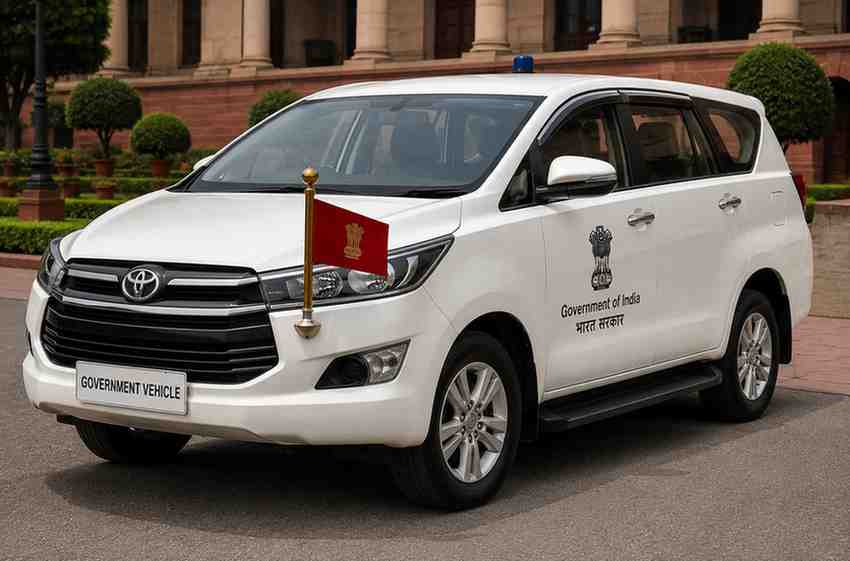
The Central Government has introduced a new policy restricting senior officers to just one official car, even if they are holding additional responsibilities in multiple ministries, departments, public sector undertakings (PSUs), or autonomous bodies. The decision is part of a wider effort to curb misuse of government vehicles, reduce unnecessary expenditure and promote better utilisation of public resources.
Issued through revised instructions by the Department of Expenditure under the Ministry of Finance, the policy directs all ministries and departments to strictly follow the principle of “One Entitled Officer, One Official Car.” The order makes it clear that officers already entitled to a government vehicle for their primary assignment will not receive another official car because of additional charges or temporary assignments.
Objective Is Better Resource Management
According to the government, the revised norms are intended to prevent duplication in the allocation of official vehicles while ensuring more responsible spending of taxpayer money.
The Centre believes that multiple vehicle allotments for the same officer have often resulted in inefficient use of government resources. By limiting vehicle allocation to a single official car, authorities expect better fleet management, reduced maintenance costs and greater administrative discipline.
Officials said the measure is part of broader reforms aimed at improving governance and ensuring public assets are used only for legitimate official purposes.
No Extra Vehicle For Additional Charge
One of the key changes under the revised policy is that officers entrusted with additional responsibilities will no longer be eligible for another government vehicle.

Earlier, officers handling multiple departments or organisations could sometimes have access to more than one official vehicle. The new rules remove this possibility by making the entitlement uniform regardless of the number of additional assignments.
The government has clarified that a single official vehicle should adequately serve all official duties assigned to an officer.
Restrictions On Using PSU And Autonomous Body Vehicles
The revised guidelines also prohibit Central Government officers from routinely using vehicles belonging to public sector undertakings, autonomous organisations or quasi-government institutions.
Such vehicles may only be used during officially approved visits, inspections or authorised tours. This provision is aimed at preventing unofficial or overlapping use of government transport resources across organisations.
Officials believe this will create greater accountability and eliminate ambiguity regarding vehicle allocation and usage.
Unused Vehicles To Be Kept In Safe Custody
Another important provision in the updated instructions concerns government vehicles that remain unused.
Read Also: History Can’t Rewrite Treaty: India Rejects Pakistan’s Indus Civilisation Claim
Instead of deploying idle vehicles without necessity, ministries have been instructed to keep them in safe custody until they are required. This is expected to minimise unnecessary operational expenses, reduce wear and tear and improve inventory management.
Departments have also been advised to periodically review vehicle utilisation to ensure that official transport assets are being used efficiently.
Focus On Transparency And Accountability
The government’s latest directive reflects a stronger emphasis on transparency in administrative functioning.
By introducing uniform norms across ministries, the Centre aims to reduce discretionary practices in vehicle allotment while promoting greater accountability among government departments.
Officials say the revised policy will simplify monitoring of official vehicles and help prevent instances where multiple cars remain assigned to a single officer despite limited operational need.
Part Of Wider Administrative Reforms
The new transport norms are being viewed as another step in the government’s continuing efforts to improve efficiency within the Central administration.
In recent years, the Centre has introduced several measures focused on digital governance, expenditure rationalisation and improved public resource management. The revised vehicle policy aligns with these objectives by encouraging responsible utilisation of government assets while reducing avoidable costs.
Administrative experts believe the move could also serve as a model for state governments and public institutions seeking to optimise operational expenditure without affecting official work.
What The New Rules Mean
Under the revised guidelines:
- Every entitled officer will be allotted only one official vehicle.
- Holding additional charge of another ministry, PSU or autonomous body will not qualify an officer for another government car.
- Vehicles belonging to PSUs and autonomous bodies cannot be used routinely by Central Government officers except for authorised official duties.
- Idle government vehicles must be kept safely instead of being unnecessarily deployed.
- Ministries have been instructed to ensure strict compliance with the revised transport norms.
The Centre expects the policy to improve financial discipline, eliminate duplication in vehicle allocation and ensure that government transport resources are used more efficiently across departments.
Click here to join our WhatsApp Channel for real-time news updates and exclusive coverage.