
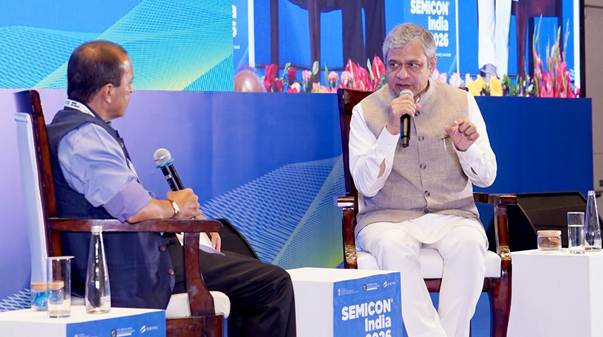
India is entering a new phase in its semiconductor journey, shifting from building basic capabilities to creating a globally competitive industry at scale, Union Minister for Electronics and Information Technology Ashwini Vaishnaw said at SEMICON India 2026.
Speaking during a fireside chat at the event, Vaishnaw outlined the next phase of the India Semiconductor Mission (ISM), saying ISM 2.0 will focus on establishing a complete semiconductor ecosystem spanning design, manufacturing, research, materials, equipment and skilled talent.
ISM 2.0 to Build Complete Semiconductor Ecosystem
According to Vaishnaw, ISM 1.0 was designed to establish the foundational ecosystem required for semiconductor manufacturing in India. The programme, initially planned for six years, has achieved its objectives in four years, he said.
The next phase, ISM 2.0, will concentrate on six major pillars: design; materials and machines; additional fabrication plants; more Assembly, Testing, Marking and Packaging (ATMP) units; research and development; and talent development.
The Minister expressed confidence that the second phase could also move faster than initially anticipated, citing increasing interest from investors and companies seeking opportunities in India’s sector.
Five Plants Begin Commercial Production
Vaishnaw said five manufacturing plants in India have already commenced commercial production. Chips produced at these facilities are serving domestic requirements as well as being exported to international markets.
He said the development demonstrates that Indian semiconductor manufacturing is increasingly capable of competing globally on two critical parameters — cost and quality.
Demand for products remains strong, according to the Minister, with several companies expanding their manufacturing capacity. He also highlighted the growing advance bookings for future production, noting that a semiconductor fabrication plant scheduled for commissioning in 2028 already has a substantial portion of its capacity booked.
Semiconductors and electronics operate through highly interconnected global supply chains, with components and finished products moving across international markets.
Chip Design Emerges as a Major Indian Strength
Design is expected to become one of the most important pillars of ISM 2.0. Vaishnaw said India’s established strength in information technology and global capability centres is increasingly extending into semiconductor design.
The government expects at least 200 chip-design companies to emerge under ISM 2.0, which the Minister described as potentially transformative for the development of indigenous semiconductor intellectual property.
Under ISM 1.0, government support helped startups overcome the high cost of Electronic Design Automation tools. More than 105 chip-design startups received access to advanced EDA tools, while 20 startups secured venture capital support.
The progress made by these startups, including the development of chips for commercial products, has encouraged the expansion of the programme and attracted greater participation from larger companies and Indian-origin engineers working overseas.
Precision Manufacturing and Applied R&D Get Fresh Focus
Vaishnaw also highlighted the role of India’s expanding electronics manufacturing sector in developing precision manufacturing capabilities.
MSMEs involved in this ecosystem are increasingly supporting industries ranging from electronics and mobile phones to aerospace, aviation, defence and semiconductors.
The next priority, he said, should be strengthening applied research and development directly within manufacturing facilities. Such research can help companies improve manufacturing processes, product quality and production efficiency.
Developing a workforce capable of handling advanced precision manufacturing will also be essential. The government is working on a multi-level training framework to create skilled personnel for the expanding manufacturing ecosystem.
India Trains 70,000 Semiconductor Design Engineers
India has also made significant progress in semiconductor-related skilling. Vaishnaw said the original objective was to train 85,000 design engineers over a decade.
Also Read — “Same Old Stalling”: India Slams Pakistan Over Naval Clash
However, approximately 70,000 design engineers have already been trained within four years.
Students from nearly 400 engineering colleges, including institutions located in smaller cities, have gained access to industry-grade EDA tools. The initiative also gives students opportunities to take their semiconductor designs through the tape-out stage and develop them into actual products.
Under ISM 2.0, the skilling programme will expand beyond chip design to include system design. The government also expects growing demand for cleanroom technicians and maintenance professionals.
Vaishnaw said the target of training one lakh technicians under ISM 2.0 may need to be increased as semiconductor manufacturing expands.
Electronics, AI and Semiconductors Growing Together
The Minister underlined the close relationship between electronics manufacturing, semiconductor production and artificial intelligence applications.
India is witnessing growing interest in manufacturing AI servers, with major global server manufacturers exploring opportunities to establish production capabilities in the country.
The emerging ecosystem is gradually bringing together semiconductor components, finished electronic products, laptops, servers and accessories. According to Vaishnaw, establishing these interconnected capabilities can provide a more stable foundation for sustained industrial growth.
Focus on Made-in-India and Designed-in-India Chips
Vaishnaw said India is moving systematically towards becoming a product-oriented economy, with semiconductor design and manufacturing playing a central role.
Some chips developed in India are already being deployed in strategic sectors, while Indian products are also reaching overseas markets.
The government expects the programme to result in a growing number of Made-in-India and designed-in-India chips, strengthening domestic intellectual property and manufacturing capabilities.
ATMP facilities in India are already exporting products to Japan, while chips are being integrated into products that are subsequently exported to markets including the United States and European countries such as Switzerland and Germany.
The developments highlighted at SEMICON India 2026 indicate that India’s strategy is increasingly moving beyond capacity creation towards building an integrated ecosystem covering design, manufacturing, research, talent and global supply chains.
Click here to join our WhatsApp Channel for real-time news updates and exclusive coverage.