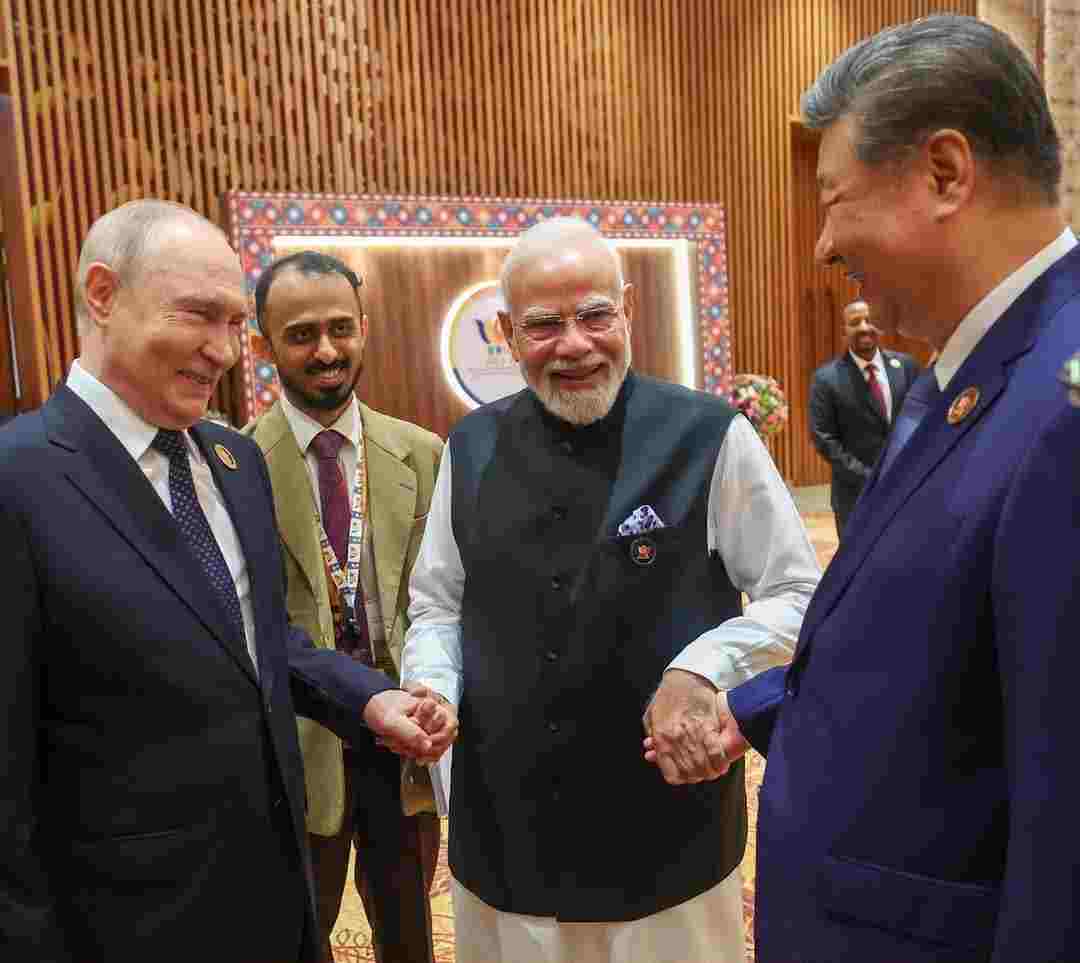
Prime Minister Narendra Modi, Russian President Vladimir Putin and Chinese President Xi Jinping shared a striking moment of camaraderie at the BRICS Summit in New Delhi on Saturday, as the three leaders were seen holding hands in a symbolic display of unity. The image quickly drew attention against the backdrop of major geopolitical tensions and the evolving relationship between India, China and Russia.
Modi, Putin And Xi Share Symbolic Moment
The three leaders were photographed together during the summit, with Modi, Putin and Xi holding hands. The unusual and highly visible gesture projected an image of cooperation among three influential BRICS powers and came as India hosted the grouping’s 18th summit in New Delhi.
The photograph was shared by Prime Minister Modi as part of a series of images from the BRICS gathering. The moment offered a powerful visual representation of engagement between countries that maintain significant strategic and economic relationships, despite differences on several international and regional issues.
BRICS Summit Takes Place Amid Global Turmoil
The gathering comes at a particularly important moment for the BRICS bloc. The organisation is seeking a greater role for emerging and developing economies in global affairs while its members face conflicts, economic uncertainty and growing geopolitical competition.
The New Delhi summit is being attended by leaders including Putin, Xi and Iranian President Masoud Pezeshkian, along with representatives from the other BRICS members. Discussions are focused on trade, investment, economic cooperation and major international challenges.
Prime Minister Modi has sought to position BRICS as a platform for strengthening cooperation among emerging economies rather than as an alliance directed against the West. India has also pushed for practical cooperation in areas such as technology, infrastructure, trade and global governance.
Xi’s India Visit Adds Greater Significance
Xi Jinping’s presence in New Delhi has added another layer of significance to the summit. The Chinese president’s visit marks his first trip to India in seven years and comes after a period of serious strain in India-China relations following the deadly 2020 Galwan Valley clash.
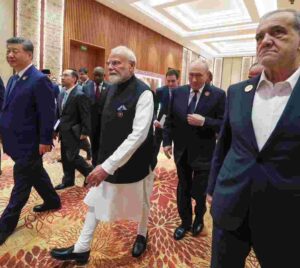
Relations between the two Asian powers have gradually shown signs of improvement. A 2024 disengagement agreement helped ease tensions along the disputed Himalayan border, while diplomatic and economic engagement has subsequently increased. However, significant differences remain, particularly over the border and broader strategic competition.
Against this background, Xi’s participation in the summit and his public interaction with Modi carry considerable diplomatic weight. The three-way image with Putin further highlights the complex strategic relationships connecting India, China and Russia.
India Balances Strategic Relationships
New Delhi continues to pursue a foreign policy based on strategic autonomy, maintaining important relationships with Russia while simultaneously strengthening engagement with the United States, European countries, Gulf nations and other partners.
Russia remains a major strategic partner for India, particularly in defence, energy and other sectors. Modi and Putin also held bilateral discussions in New Delhi ahead of the summit, focusing on areas including trade, mobility, fertilisers and critical minerals.
The India-Russia relationship has continued despite pressure created by the Ukraine conflict and wider changes in global geopolitics. Moscow, meanwhile, has promoted a stronger role for BRICS in shaping global economic cooperation outside traditional Western-led structures.
A Powerful Image From New Delhi
The photograph of Modi, Putin and Xi holding hands therefore carries significance beyond the gesture itself. It arrived at a summit where the future direction of BRICS, the changing global balance of power and the role of emerging economies are major subjects of discussion.
For India, the moment also reflects its position at the centre of an increasingly important multilateral grouping. New Delhi is attempting to use the BRICS platform to encourage cooperation while preserving its independent foreign-policy choices.
BRICS Summit 2026: PM Modi Proposes Seafarers Network, Says ‘Pyramid Of Privilege’ Must End
The symbolism of the three leaders standing together is particularly striking because India, China and Russia do not share identical strategic interests. Their cooperation is accompanied by differences on security, borders, trade and international conflicts.
With BRICS representing a substantial share of the world’s population and economic activity, the grouping is increasingly seeking influence over global governance, trade, finance and international institutions.
The New Delhi summit is consequently being watched closely for signs of whether the expanded grouping can convert its economic weight into greater political and diplomatic influence.
The Modi-Putin-Xi moment provided one of the summit’s most powerful images so far: three leaders from major Eurasian powers publicly demonstrating friendship and cooperation at a time when the global order is undergoing profound change.
The hand-holding image may last only seconds, but its diplomatic symbolism is likely to resonate well beyond the BRICS venue in New Delhi.
Click here to join our WhatsApp Channel for real-time news updates and exclusive coverage.