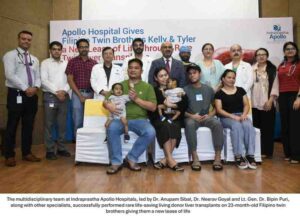
NEW DELHI: In a remarkable achievement for paediatric healthcare, Indraprastha Apollo Hospitals in New Delhi has successfully performed rare living donor liver transplants on 23-month-old Filipino twin brothers, offering them a new lease of life after both developed severe liver failure caused by a congenital biliary disorder.
The hospital described the procedures as a significant milestone in its paediatric transplant programme. Among the 645 paediatric liver transplants carried out at the institution, this is the first time that identical-aged twin siblings have undergone life-saving liver transplants within days of each other.
The highly complex surgeries were led by Dr. Anupam Sibal, Group Medical Director and Senior Paediatric Gastroenterologist, along with Dr. Neerav Goyal, Senior Consultant and Head of Liver Transplant Surgery. The operations involved extensive planning, multidisciplinary coordination and careful post-operative management.
Rare disorder led to liver failure in both children
The twin brothers, Tyler and Kelly, were born prematurely in the Philippines, weighing just 2 kg and 2.4 kg respectively. Although their birth brought joy to their family after the loss of another infant, their parents soon noticed alarming symptoms.
Within two weeks of birth, both babies developed persistent jaundice and pale-coloured stools. Medical investigations revealed that they were suffering from Choledochal Cyst Type IVA, a rare congenital condition in which the bile ducts become abnormally enlarged. If left untreated, the disorder can severely damage the liver and eventually lead to liver failure.
Despite receiving medical treatment over the following months, both children experienced repeated gastrointestinal bleeding, abdominal swelling caused by fluid accumulation, poor weight gain and frequent hospital admissions. As their condition deteriorated, doctors concluded that liver transplantation was the only option capable of saving their lives.
Finding two liver donors was another major challenge
The medical complexity extended beyond the surgeries themselves. Identifying suitable living liver donors for two siblings requiring transplants almost simultaneously is extremely uncommon.
The children’s mother volunteered to donate a portion of her liver to one of the twins. However, their father could not become a donor due to medical reasons. The family’s maternal uncle then stepped forward to donate part of his liver to the second child, making it possible for both operations to proceed successfully.
Throughout the treatment and recovery period, the father cared for his wife, brother-in-law and both children, providing vital support to the family during an emotionally and physically demanding journey.
Hospital highlights teamwork behind the success
Shivakumar Pattabhiraman, Managing Director of Indraprastha Apollo Hospitals, said the case reflected both medical excellence and the trust placed in the hospital by international patients.
He noted that the family had travelled from the Philippines seeking specialised treatment and said the successful outcome demonstrated the strength of Apollo’s multidisciplinary teams and its commitment to delivering advanced care for patients facing highly complex medical conditions.
Dr. Anupam Sibal said liver transplantation in twins is exceptionally rare, and the challenge becomes even greater when both children require surgery at nearly the same time.
He added that this was the first twin liver transplant among the hospital’s 645 paediatric liver transplant cases. The young age and small body size of both children further increased the surgical difficulty.
Dr. Sibal also highlighted Apollo’s long experience in liver transplantation, recalling that the hospital performed India’s first successful liver transplant in 1998. Since then, the institution has carried out several advanced procedures, including combined liver-kidney transplants, transplants in babies weighing as little as 3.5 kg, and ABO-incompatible liver transplants where donor and recipient blood groups do not match.
Long and complex surgeries completed successfully
According to Dr. Neerav Goyal, Tyler’s liver transplant lasted more than 15 hours, while Kelly’s procedure continued for over 13 hours.
Both surgeries involved intricate reconstruction of blood vessels and bile ducts before the donor liver segments could function properly. Despite the complexity, the operations were completed successfully.
Doctors confirmed that both children have recovered well, their transplanted livers are functioning normally and they continue to show encouraging progress during follow-up examinations.
Dr. Goyal said the successful outcome demonstrates the importance of early medical intervention, strong family support and coordinated multidisciplinary care in managing complex paediatric transplant cases.
India strengthens position in advanced transplant care
Lt. Gen. Dr. Bipin Puri, Director of Medical Services at Indraprastha Apollo Hospitals, said the case showcases how modern medicine, advanced surgical techniques and coordinated teamwork can transform lives.
He said the successful treatment of international patients with such rare and complicated conditions reflects India’s growing reputation as a global destination for advanced transplant care.
The surgeries were supported by a large multidisciplinary team comprising transplant surgeons, paediatric specialists, anaesthesiasts, intensivists, nurses and allied healthcare professionals, all working together to ensure the best possible outcome for both children.
Doctors also emphasised that persistent jaundice and pale stools in infants should never be ignored, as they may indicate serious congenital liver disorders. Early diagnosis and timely referral to specialised paediatric liver transplant centres can significantly improve survival rates and long-term quality of life for affected children.
Click here to join our WhatsApp Channel for real-time news updates and exclusive coverage.