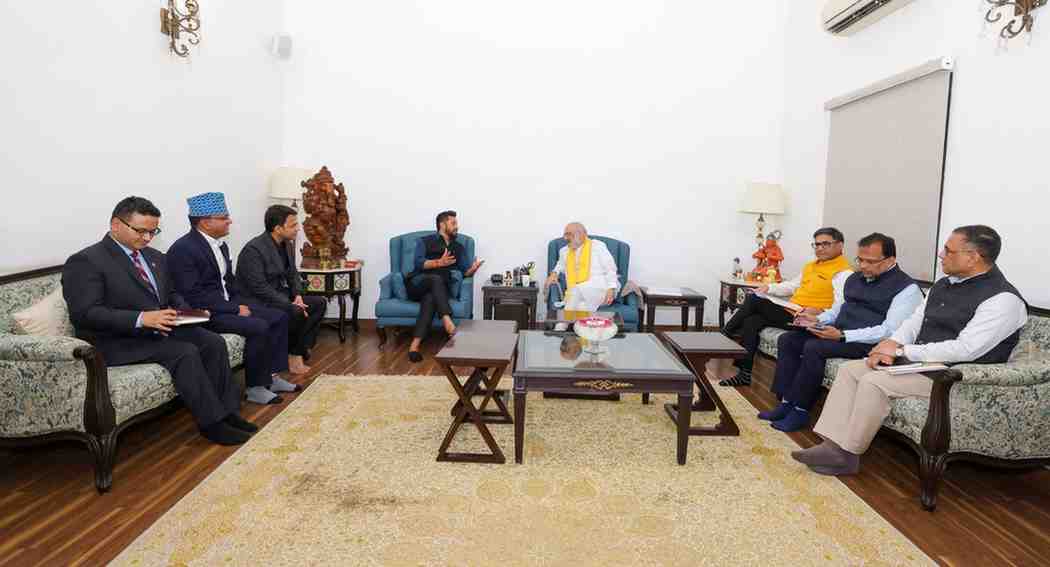
NEW DELHI: Union Home Minister and Minister of Cooperation Amit Shah on Tuesday held talks with a Nepalese delegation led by Rabi Lamichhane in New Delhi, underlining the importance of deepening the long-standing relationship between India and Nepal.
During the meeting, Shah congratulated Lamichhane on the electoral success of Nepal’s Rastriya Swatantra Party (RSP) and conveyed India’s best wishes for the success of the new government in Nepal. The discussions focused on strengthening bilateral cooperation and further enhancing the close people-to-people and cultural ties shared by the two neighbouring countries.
According to the Home Minister’s Office, both leaders reaffirmed their commitment to working together to strengthen the special partnership between India and Nepal. The meeting reflected the continued engagement between the two nations on matters of mutual interest and regional cooperation.
India and Nepal share deep historical, cultural and civilizational links, and the latest interaction is being viewed as another step toward expanding cooperation across multiple sectors. The two sides emphasized the need to maintain close dialogue and build upon the existing framework of friendship and collaboration.
The meeting comes at a time when both countries are seeking to further strengthen bilateral relations through political engagement, economic cooperation and people-centric initiatives. Officials indicated that the interaction highlighted the shared desire to advance ties and explore new avenues of partnership for the benefit of both nations.
Shah reiterated India’s support for Nepal’s development and prosperity, while both delegations expressed confidence that the relationship between the two countries would continue to grow stronger in the years ahead.
Today, India has also reiterated that all outstanding border-related issues with Nepal should be resolved through bilateral mechanisms, stressing that there is no role for any third party in addressing matters concerning the India-Nepal boundary. The Ministry of External Affairs (MEA) made the position clear while responding to recent remarks from Nepal Prime Minister Balen Shah regarding the long-standing border dispute.
According to the MEA, India and Nepal share a unique and close partnership rooted in history, culture and people-to-people ties. The ministry emphasized that both countries have established diplomatic channels and institutional mechanisms through which border-related concerns can be discussed and resolved amicably.
The statement comes amid renewed discussion over disputed areas such as Kalapani, Lipulekh and Limpiyadhura. These regions have remained points of contention due to differing interpretations of historical treaties and maps. India has consistently maintained that such issues should be addressed through direct dialogue between the two neighbouring countries.
Officials noted that India and Nepal continue to engage regularly on border management and security cooperation. Recent high-level meetings between the two countries reviewed issues including maintenance of boundary pillars, cross-border cooperation, infrastructure development and measures to strengthen coordination along the open border.
India has also underlined the importance of maintaining the spirit of friendship and mutual trust while dealing with sensitive matters. New Delhi believes that existing bilateral frameworks provide sufficient scope for both sides to discuss and settle outstanding concerns in a constructive manner.
The border issue gained fresh attention after Nepal Prime Minister Balen Shah suggested that countries such as the United Kingdom and China could play a role in helping resolve the dispute. Shah argued that since historical agreements dating back to the colonial era are linked to the boundary question, external stakeholders could contribute to finding a solution. His comments generated political debate in Nepal and prompted India’s response.
Despite periodic disagreements over specific territories, India and Nepal have continued to deepen cooperation across sectors including trade, connectivity, energy, security and development. Both governments have repeatedly expressed their commitment to maintaining strong bilateral relations and resolving differences through dialogue and mutual understanding.
India’s latest position reinforces its long-standing view that the boundary issue is strictly a bilateral matter and should be addressed directly by New Delhi and Kathmandu without outside involvement.