
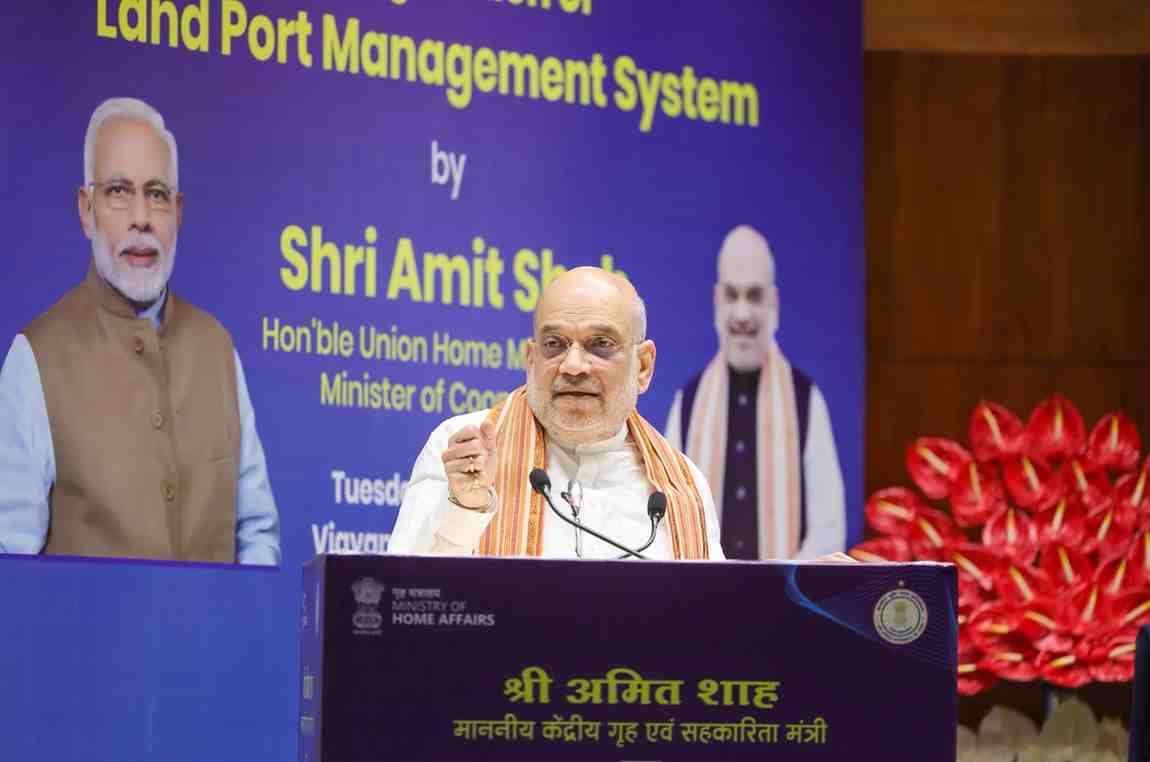
NEW DELHI: Union Home Minister Amit Shah on Tuesday emphasized that the newly launched Land Port Management System (LPMS) and the government’s Smart Border initiative will together transform India’s border management architecture into a modern, secure, and technology-driven framework. He asserted that the integration of digital systems and advanced surveillance technologies will help curb illegal activities while ensuring smoother trade and passenger movement across international borders.
Launching the LPMS platform, Shah said the initiative represents a significant step towards creating “smart borders” capable of addressing contemporary security challenges through technology and real-time coordination. According to the Ministry of Home Affairs, LPMS has been designed as a unified digital platform that integrates operations across India’s land ports, bringing them on par with the advanced digital systems used at airports and seaports.
Highlighting the importance of the initiative, Shah stated that LPMS and Smart Borders together will create a more secure and modern border management system. He noted that the combination of digital monitoring, seamless information sharing, and advanced surveillance mechanisms would help prevent illegal infiltration, smuggling, and other cross-border crimes while strengthening national security.
The LPMS platform introduces end-to-end digital workflows for both cargo and passenger processing. Facilities such as slot booking, online payments, cargo tracking, and single-window clearances are expected to significantly reduce delays and improve transparency. The system is also integrated with key national digital platforms, enabling secure and real-time exchange of logistics and regulatory information among multiple stakeholders.
Shah underlined that border infrastructure today serves a broader purpose than merely regulating movement. Land ports have become vital gateways for trade, connectivity, and people-to-people interaction with neighboring countries. Therefore, modernizing their operations is essential for both economic growth and national security.
The Home Minister has consistently advocated a technology-led approach to border security. Recently, he announced that the government is working towards establishing an “impregnable border security grid” through the Smart Border Project. The initiative will deploy drones, radars, modern cameras, sensors, and other advanced surveillance technologies to strengthen monitoring capabilities across India’s borders.
Shah had earlier observed that traditional methods alone are no longer sufficient to tackle emerging threats such as illegal infiltration, narcotics trafficking, counterfeit currency networks, organized crime, cyber threats, and drone-based smuggling operations. He stressed the need for a coordinated security framework involving central agencies, state police forces, intelligence agencies, and border guarding forces.
According to government officials, LPMS will function as a critical component of this broader Smart Border vision. By digitizing border processes and enabling interoperability among various agencies, the platform is expected to enhance operational efficiency while improving security oversight. The system will also facilitate better data analysis and monitoring, helping authorities identify suspicious activities more quickly and respond effectively.
The launch of LPMS reflects the government’s broader objective of leveraging technology to strengthen governance and security. Officials believe that the integration of digital platforms with advanced surveillance infrastructure will create a robust border management ecosystem capable of supporting economic development while safeguarding national interests.
As India continues to modernize its border infrastructure, the government views LPMS and the Smart Border Project as complementary initiatives that will improve transparency, efficiency, and security. Shah reiterated that technology-driven border management will play a crucial role in curbing illegal activities and ensuring that India’s borders remain secure, resilient, and prepared for future challenges.
HM Amit Shah also highlighted the transformative achievements of the past 12 years, stating that nearly 25 crore people have risen above the poverty line. He noted that 81 crore citizens receive free food grains every month, while over 58 crore Jan Dhan accounts have expanded financial inclusion across the country.
More than 44 crore Ayushman Bharat cards have provided health coverage of up to ₹5 lakh, and tap water connections have reached 16 crore households. Shah said that 13 crore farmers have benefited from PM-Kisan assistance, while 12.76 crore households received toilets and 10.55 crore families gained LPG connections.
Over 4 crore people have secured permanent housing, and more than 3 crore rural women have emerged as ‘Lakhpati Didis’ through 93 lakh Self-Help Groups. He added that India now leads the world in digital transactions, ranks second in mobile manufacturing, and third in the startup ecosystem, while its handling of the COVID-19 pandemic has earned global recognition.