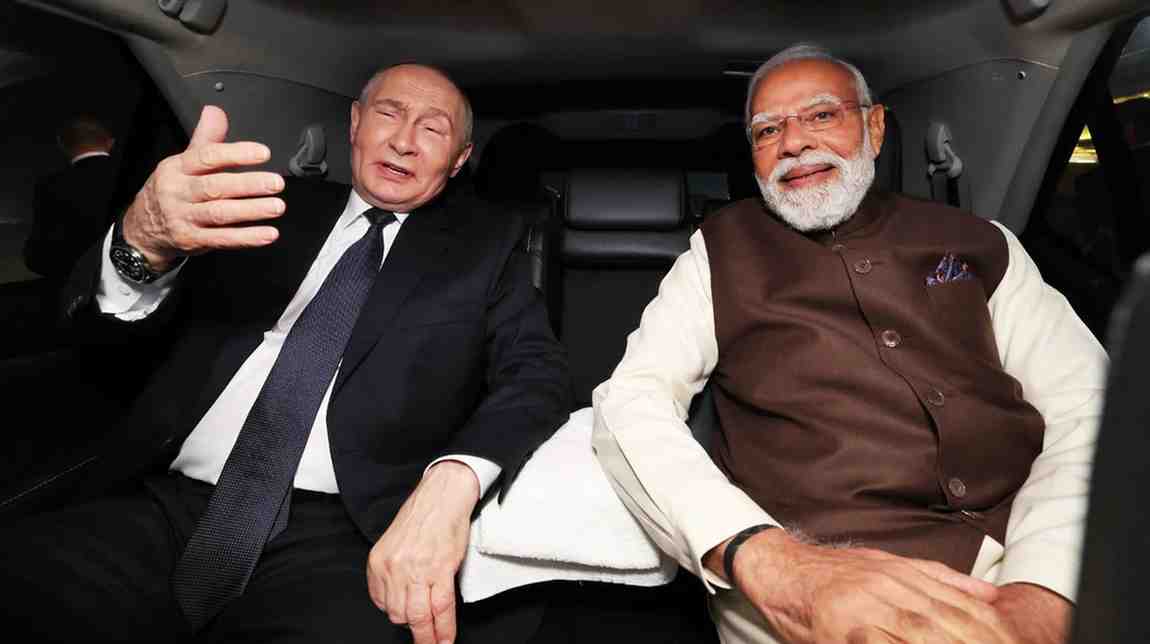
Prime Minister Narendra Modi is set to hold a crucial bilateral meeting with Russian President Vladimir Putin on the sidelines of the Shanghai Cooperation Organisation (SCO) summit in Bishkek, Kyrgyzstan, as India and Russia seek to deepen their longstanding strategic partnership amid major global uncertainties.
The meeting is scheduled during Modi’s upcoming visit to Uzbekistan and Kyrgyzstan from August 29 to September 1. According to the Ministry of External Affairs, the Prime Minister will first visit Uzbekistan from August 29 to 30 before travelling to Bishkek for the SCO summit from August 31 to September 1.
Modi-Putin meeting to focus on India-Russia ties
The proposed meeting between Modi and Putin is expected to provide an important opportunity for the two leaders to review the entire range of bilateral relations. MEA Secretary (West) Sibi George said India and Russia are working towards a bilateral meeting on the sidelines of the SCO summit, with both sides expected to discuss the broader relationship.
The talks come at a significant moment for India-Russia relations, with cooperation extending across energy, fertilisers, defence, nuclear power, technology, trade and transportation.
The two countries have maintained close diplomatic engagement despite major changes in the international strategic environment. Their continued high-level dialogue has also focused increasingly on expanding economic cooperation and addressing imbalances in bilateral trade.
Energy and fertiliser supplies remain key priorities
Energy cooperation is likely to feature prominently in the discussions. Russia has recently reaffirmed its commitment to supplying India with energy and fertilisers, particularly as disruptions linked to the West Asia conflict have created additional uncertainty in global supply chains.
During his recent meeting with External Affairs Minister S Jaishankar in Moscow, Putin assured India that Russia would continue increasing fertiliser supplies. The Russian president also highlighted the importance of the growing economic relationship between the two countries.
For India, maintaining reliable energy and fertiliser supplies remains strategically important because of their direct impact on the country’s economy, agriculture and energy security.
Trade imbalance could dominate economic discussions
Trade is another major issue likely to attract attention during the Modi-Putin meeting.
India-Russia goods trade has expanded dramatically in recent years. According to details shared during Jaishankar’s recent visit to Moscow, bilateral goods trade increased from around $13 billion in 2021-22 to nearly $60 billion in 2025-26.
However, the rapid expansion has also resulted in a significant trade imbalance. India has been seeking greater market access and stronger exports to Russia to make bilateral commerce more balanced.
The two governments have therefore been exploring ways to broaden economic cooperation beyond traditional areas and increase collaboration in sectors such as machinery, aviation, railways, space, nuclear energy and technology.
Modi’s Central Asia visit carries wider significance
Before travelling to Kyrgyzstan, Modi will visit Uzbekistan at the invitation of President Shavkat Mirziyoyev.
During his stay in Tashkent, Modi is expected to hold delegation-level discussions covering trade and investment, defence, digital connectivity, energy, education and people-to-people relations. The visit is also intended to strengthen India’s strategic partnership with Uzbekistan and deepen engagement with Central Asia.
The Uzbekistan leg will be followed by Modi’s participation in the 26th SCO Summit in Bishkek. The summit is expected to bring together leaders from SCO member countries to discuss security, economic cooperation, connectivity and regional challenges.
SCO summit comes amid changing global dynamics
The Bishkek summit is taking place against a rapidly changing international backdrop, with geopolitical tensions, conflicts, economic disruptions and questions surrounding global supply chains continuing to influence international diplomacy.
India’s participation is expected to underline its approach of engaging with multiple major powers while protecting its strategic autonomy.
Also Read — Nepal Flash Flood Horror: Death Toll Hits 270 As Over 1,200 Remain Missing
Modi is also expected to address SCO leaders during the summit and outline India’s priorities relating to security, connectivity and economic opportunities. India has been a full member of the SCO since 2017 after previously holding observer status.
The grouping is also marking 25 years since its establishment, adding further significance to this year’s summit.
Another Modi-Putin meeting may follow soon
The Bishkek meeting could also set the stage for another high-level interaction between Modi and Putin later this year.
Putin is expected to travel to New Delhi for the BRICS leaders’ summit in September, where another meeting with Modi could provide an opportunity to continue discussions initiated at the SCO summit. Jaishankar recently conveyed Modi’s hope that Putin would attend the BRICS gathering in the Indian capital.
With India and Russia seeking to expand cooperation across strategic and economic sectors, the upcoming Modi-Putin talks in Bishkek are likely to carry considerable diplomatic and economic weight.
The meeting will therefore be closely watched for indications of the future direction of India-Russia relations, particularly on energy security, trade, defence cooperation, technology and broader geopolitical coordination.
Click here to join our WhatsApp Channel for real-time news updates and exclusive coverage.