
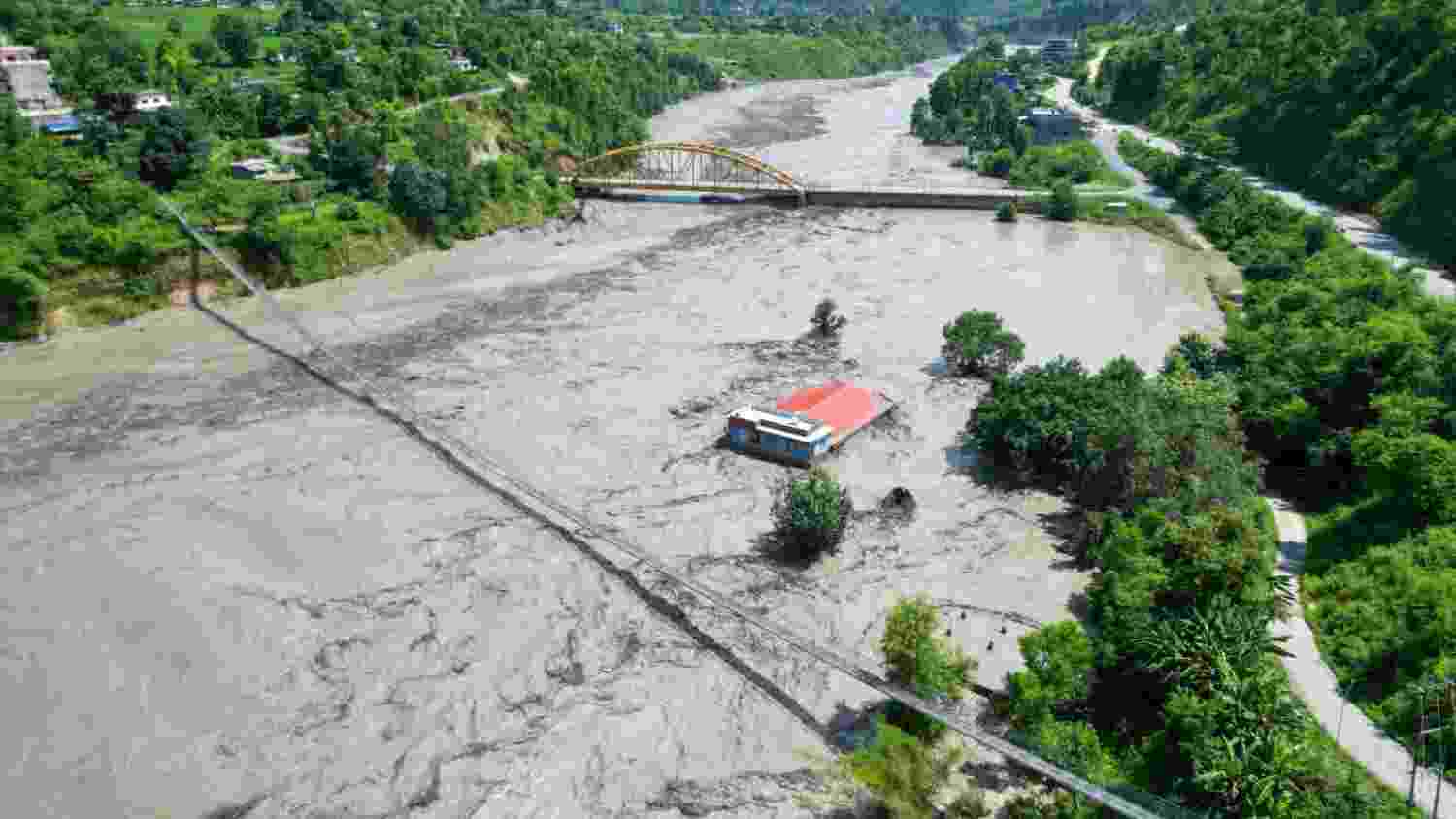
The devastating flash flood that struck Nepal on 26 August 2026 has once again exposed the extraordinary vulnerability of the Himalayan region—and raised uncomfortable questions about the growing strategic importance of Tibet’s rivers, glaciers, dams and water systems.
A massive flood originating in the Nepal–Tibet border region swept through Rasuwa and subsequently affected areas connected to the Bhote Koshi and Trishuli river systems. Roads, bridges, buildings and hydropower infrastructure were destroyed, while hundreds of people were reported missing. Indian nationals were also among those missing.
The immediate scientific explanation being reported is an earthquake followed by an ice-and-rock avalanche, which caused a sudden surge and blockage in the river system. India’s National Centre for Seismology recorded a magnitude 4.9 earthquake in Tibet at 08:22 IST, approximately 121 km northeast of Kathmandu.
But the larger strategic question deserves serious examination:
Could China’s control and development of the Tibetan Himalayan region increase the potential risk to downstream Nepal and India?
That question should not be dismissed.
Why Nepal is Particularly Vulnerable
Nepal’s major river systems originate in or are connected to the high Himalayas. When an upstream landslide, glacier collapse, glacial-lake outburst or sudden blockage occurs, enormous quantities of water can reach downstream settlements with very little warning.
The present disaster demonstrates exactly how quickly such an event can move from a remote Himalayan area into populated regions.
Nepal’s authorities have already warned that a remaining upstream blockage could create another flood wave and have urged people living near the Bhote Koshi and Trishuli rivers to remain alert.
This is therefore not simply a question of today’s disaster. It is a question of upstream control, information sharing, disaster warning systems and Himalayan water security.
Where Does China Enter the Strategic Equation?
Tibet is often described as the “Water Tower of Asia” because many major rivers of South and Southeast Asia originate in or pass through the Tibetan Plateau.
China controls Tibet and consequently has enormous influence over the upper reaches of several transboundary rivers.
That creates a fundamental strategic reality:
Whatever happens upstream can have consequences downstream.
This does not mean that every flood originating from Tibet is caused by China. It would be scientifically and politically irresponsible to make such a claim without evidence.
However, China’s infrastructure development, hydropower projects, reservoirs, roads, tunnels and other activities in the Himalayan region deserve continuous monitoring because changes to a fragile mountain environment can potentially alter downstream risks.
The India Connection
The danger does not stop at Nepal.
Nepal’s rivers ultimately feed into India’s river systems. The Trishuli, for example, becomes part of the Gandaki/Narayani system before entering India.
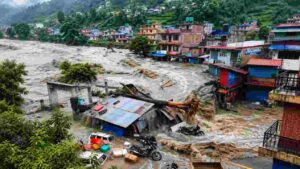
A major flood moving downstream can therefore affect India’s border states and the wider Ganga basin.
Reports today have already indicated flood alerts and concern in parts of northern India, particularly Bihar and Uttar Pradesh.
India therefore has three major concerns:
- Human Security:
Sudden floods can affect Indian pilgrims, tourists, workers and residents in Nepal, as today’s disaster tragically demonstrates. - Water Security:
Any major disruption in Himalayan river flows can affect downstream water management. - Strategic Security:
If upstream infrastructure and environmental changes are not transparently communicated, downstream countries can face serious uncertainty.
Could a Himalayan Flood Become a Strategic Weapon?
This is the most sensitive question.
A naturally occurring earthquake, landslide or glacier collapse should not automatically be labelled an act of aggression.
There is currently no publicly established evidence that China deliberately engineered today’s flood.
But strategic planners cannot afford to ignore the broader possibility that control over upstream water resources could, under different circumstances, create strategic leverage.
Water infrastructure can theoretically have consequences far beyond electricity generation or irrigation. Large reservoirs, river diversions and other projects can influence the timing and volume of downstream water.
That is why India and Nepal need to treat Himalayan water security as a national-security issue as well as an environmental issue.
The Question That Must Now Be Asked
The most important issue is not simply:
“Did China cause today’s flood?”
The more important question is:
“Does China possess sufficient control over the Tibetan Himalayan environment and upstream water infrastructure to create risks for Nepal and India, intentionally or unintentionally?”
Also Read: Nepal Thanks India For Swift Assistance As Deadly Floods Kill 98, Hundreds Missing
That question requires independent scientific investigation, satellite monitoring, hydrological data and complete transparency.
Nepal and India should demand timely upstream information concerning:
- Earthquakes;
- Glacier Movement;
- Glacial Lakes;
- Landslides;
- Artificial Reservoirs;
- River Blockages;
- Dam Operations;
- Sudden Changes in River Discharge; and
- Any Major Construction Affecting Transboundary Rivers.
China Must Answer the Transparency Question
Today’s catastrophe has demonstrated how little time downstream communities may have to react.
If a river originates in or passes through territory controlled by another country, early-warning information can mean the difference between life and death.
China has a responsibility—as an upstream power and major Himalayan infrastructure actor—to provide transparent and timely information to downstream countries whenever a potentially dangerous event occurs.
At the same time, Nepal and India must develop their own independent monitoring capabilities rather than relying entirely on information supplied by another country.
A Warning for India
India cannot look at this tragedy as merely a Nepalese disaster.
The Himalayas are one interconnected ecological and hydrological system.
What happens in Tibet can affect Nepal.
What happens in Nepal can affect India.
And what happens upstream today may become a downstream crisis tomorrow.
India should therefore strengthen satellite surveillance, seismic monitoring, glacier and glacial-lake mapping, river-level sensors and real-time communication systems along vulnerable Himalayan river corridors.
A dedicated India–Nepal Himalayan Disaster Early Warning Mechanism could save thousands of lives in future emergencies.
The China Angle Must Be Investigated—Not Assumed
There is a legitimate strategic concern about China’s expanding infrastructure and influence in the Himalayan region.
There is also a legitimate scientific explanation for today’s catastrophe involving an earthquake and ice-rock avalanche.
Both facts can exist simultaneously.
Therefore, instead of making an unsupported accusation, the responsible approach is to demand an independent international investigation into the complete chain of events—from the earthquake and mountain collapse to the river blockage, flood wave and downstream destruction.
If evidence ultimately establishes human interference, deliberate manipulation or negligence associated with upstream infrastructure, responsibility must be established without hesitation.
But until such evidence emerges, declaring China “100% responsible” would turn a serious investigation into an unsubstantiated allegation.
Conclusion: The Himalayas Cannot Become a Black Box
Today’s disaster should be a wake-up call for both Nepal and India.
The Himalayan region is no longer merely a geographical frontier. It is a critical zone of water security, environmental security, disaster security and strategic security.
China’s activities in Tibet must therefore receive continuous scientific and strategic scrutiny.
Nepal needs stronger disaster-warning mechanisms.
India needs stronger downstream monitoring.
And China needs greater transparency.
The central lesson is simple:
When the source of a river lies beyond your control, ignorance of what is happening upstream can become a national-security vulnerability downstream.
Today’s tragedy should therefore not end with rescue operations. It should begin a much larger conversation about China, Tibet, Himalayan water security and the future safety of Nepal and India.
Click here to join our WhatsApp Channel for real-time news updates and exclusive coverage.