
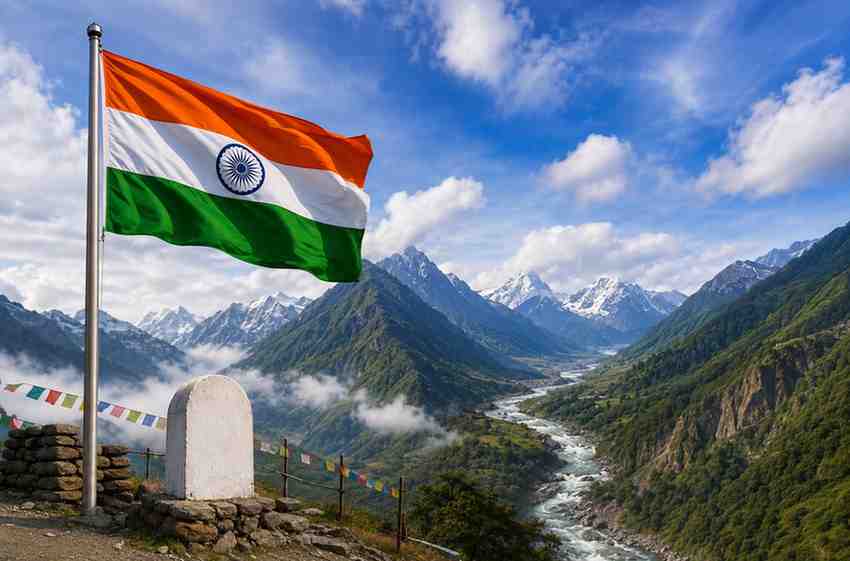
China on Wednesday said the situation along the India-China border is “generally stable at the moment”, even as reports of heightened Chinese military activity near Arunachal Pradesh have triggered renewed concerns over the sensitive frontier. Beijing stopped short of confirming reports circulating on Indian social media about increased military movements in disputed areas.
The latest development comes at a sensitive moment for India-China relations, with both countries attempting to stabilise ties after years of military confrontation and diplomatic strain. While Beijing has sought to project calm along the border, New Delhi has stressed that peace and tranquillity along the Line of Actual Control (LAC) remain critical to the broader relationship between the two Asian powers.
China Issues Fresh Statement on India-China Border
Chinese Foreign Ministry spokesperson Guo Jiakun made the remarks during a regular press briefing in Beijing. He was responding to questions regarding videos circulating on Indian social media that purportedly showed increased Chinese military activity along the border.
Rather than directly confirming or rejecting the reported military movements, Guo pointed to ongoing diplomatic and military communication between the two countries.
He said India and China had recently held the 36th meeting of the Working Mechanism for Consultation and Coordination on Border Affairs. According to Beijing, both sides agreed to maintain communication through diplomatic and military channels and jointly safeguard peace and tranquillity in the border areas.
The statement is significant because it comes amid renewed attention on the eastern sector of the India-China frontier, particularly Arunachal Pradesh, which remains one of the most sensitive points in the bilateral territorial dispute.
Arunachal Pradesh Tensions Raise Fresh Concerns
Reports of heightened Chinese military activity have emerged from Upper Subansiri in Arunachal Pradesh, adding to concerns about developments along the LAC.
The claims circulating online have not been independently verified. However, the reports have drawn attention because Arunachal Pradesh has long remained at the centre of competing territorial claims between India and China.
Beijing claims the Indian state as part of what it refers to as “South Tibet.” New Delhi has repeatedly rejected the Chinese claim and maintained that Arunachal Pradesh is an integral and inalienable part of India.
India has also strongly opposed Chinese objections to New Delhi’s recent formal identification and mapping of 27 locations and geographical features in Arunachal Pradesh using their standard Indian names.
The Ministry of External Affairs has made clear that such Chinese objections cannot change the territorial reality or India’s position on the state.
India Warns Border Situation Affects Bilateral Ties
While China described the border as generally stable, India has taken a firm position that developments along the frontier have wider consequences for bilateral relations.
The Ministry of External Affairs recently reiterated that maintaining peace and tranquillity along the LAC is of the utmost importance. New Delhi has also emphasised that the state of affairs along the border will have a direct bearing on the overall India-China relationship.
The message reflects India’s continued focus on preventing border tensions from undermining the gradual efforts to improve relations between the two countries.
The latest developments therefore present a contrasting picture: Beijing is stressing stability and dialogue, while India remains alert to reports of possible military activity and continues to underline the strategic importance of border peace.
India-China Relations Still Recovering From Galwan Crisis
Relations between India and China suffered a major setback following the 2020 Galwan Valley clashes, which resulted in casualties on both sides and triggered a prolonged military standoff along the LAC.
The confrontation led to a substantial military build-up in several areas and created one of the most serious crises in bilateral relations in decades.
Since then, both sides have pursued negotiations aimed at reducing tensions and restoring stability. In October 2024, India and China reached a disengagement arrangement covering the remaining friction points at Depsang and Demchok. Prime Minister Narendra Modi and Chinese President Xi Jinping subsequently met in Kazan, followed by further diplomatic engagement.
Despite these efforts, the unresolved boundary dispute continues to remain a major obstacle to a complete normalisation of relations.
Diplomatic Channels Remain Crucial
China’s latest statement highlights the importance both countries continue to attach to diplomatic and military communication.
The Working Mechanism for Consultation and Coordination on Border Affairs provides an important channel for discussing developments and preventing local incidents from escalating into larger confrontations.
Maintaining communication is particularly important along the LAC, where differing perceptions of the boundary can create the possibility of friction between troops.
For India, however, dialogue must be accompanied by respect for existing agreements and the maintenance of peace along the frontier. New Delhi has repeatedly maintained that normal relations with Beijing cannot be separated from the situation on the border.
Arunachal Pradesh Remains a Key Flashpoint
The latest India-China border developments underline why Arunachal Pradesh remains strategically significant.
India continues to strengthen infrastructure and security capabilities in its northeastern frontier, while China maintains its territorial claims over the region. The competing positions have made the eastern sector an important focus of India’s broader border-security strategy.
China’s description of the border as “generally stable” may help reduce immediate diplomatic pressure, but it does not resolve the fundamental territorial dispute.
For now, both countries appear committed to keeping communication channels open and preventing renewed escalation. However, reports of military activity, continuing territorial claims and India’s strong warning about the consequences of border instability show that the relationship remains fragile.
The immediate priority for both New Delhi and Beijing will be to ensure that developments along the LAC do not undermine the cautious progress made toward stabilising India-China relations.
Click here to join our WhatsApp Channel for real-time news updates and exclusive coverage.