
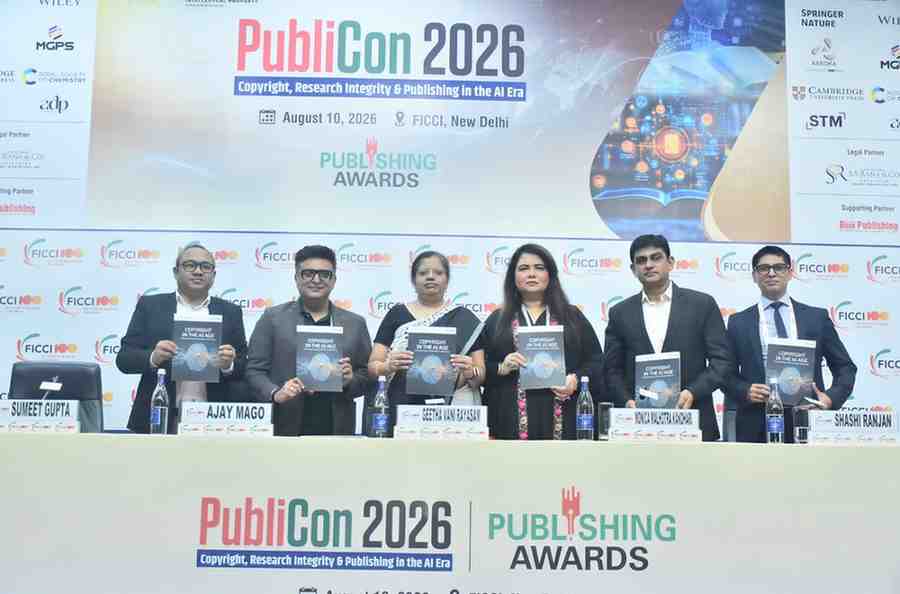
PubliCon 2026 highlighted how artificial intelligence is rapidly reshaping the publishing and research landscape, with experts stressing that technological advancement must not undermine human judgment, creativity, copyright protection or research integrity in New Delhi.
Organised by the Federation of Indian Chambers of Commerce and Industry (FICCI), the conference brought together publishers, researchers, academics, authors, policymakers and technology experts to discuss the challenges and opportunities created by AI. The event was held under the theme “Copyright, Research Integrity and Publishing in the AI Era.”
The discussions at PubliCon 2026 centred on a key message: AI should strengthen human capabilities rather than replace the people responsible for creating, verifying and communicating knowledge.
Human Responsibility Cannot Be Shifted to AI
At PubliCon 2026, Dr. Geetha Vani Rayasam, Director of CSIR-NIScPR, highlighted the growing importance of research ethics as AI tools become increasingly common in academic and publishing environments.
She stressed that using an AI system does not transfer responsibility from the human user to the technology. Authors and researchers remain accountable for the accuracy and reliability of material produced with AI assistance.
According to Rayasam, AI-generated content can contain fabricated references, inaccurate information, incorrect data or hallucinations. Such errors must therefore be identified and verified before information is used in research or published.
She also called for stronger training in research ethics, particularly for students and early-career researchers. Awareness about plagiarism, research misconduct and responsible research practices, she said, should become an integral part of academic and research programmes.
Rayasam further emphasised the importance of transparently disclosing AI use and independently checking AI-generated references, citations and data.
Publishing Industry Faces a New Trust Challenge
Caroline Sutton, CEO of the STM Association, said the publishing sector is confronting a critical intersection between artificial intelligence, trust and research integrity at PubliCon 2026.
She argued that validated knowledge must remain traceable and accountable, particularly at a time when people are increasingly finding it difficult to distinguish credible information from unreliable material.
Sutton said AI systems presenting scientific or academic information should provide greater transparency about their sources. Researchers and readers should be able to understand the origins of information, recognise the contributions of researchers and identify mistakes so that they can be corrected.
She warned that the issue goes beyond the future of academic publishing. At stake, she said, is the self-correcting knowledge system that forms the foundation of modern research communication.
WIPO Highlights Global Copyright Complexities
Sarah Nassar, Associate Program Officer at the World Intellectual Property Organization (WIPO), highlighted the increasingly complicated global legal landscape surrounding AI training and copyrighted material during PubliCon 2026.
She pointed out that countries are taking different approaches to whether copyrighted works can be used to train artificial intelligence systems without permission.
The European Union has established text-and-data-mining exceptions with opt-out mechanisms, while the United States generally addresses such issues through fair-use principles. Japan, meanwhile, has historically followed a broader approach to AI training.
For international publishers, this creates significant uncertainty because the same copyrighted work may face different legal treatment depending on the jurisdiction.
Nassar urged publishers to review their contracts, introduce AI-related disclosure provisions in submission procedures and carefully examine the terms of AI platforms before uploading unpublished or proprietary material.
She also recommended that AI licensing agreements clearly address scope, duration, compensation, attribution, integrity safeguards, output restrictions and audit and transparency rights.
FICCI Leaders Call for Responsible AI Adoption
Monica Malhotra Kandhari, Chair of the FICCI Publishing Committee and Managing Director of MBD Group, said AI has already become part of the publishing industry, a key focus of PubliCon 2026.

She noted that publishers are increasingly using AI for content creation, editing, production and dissemination. However, this technological shift has also raised critical questions about authorship, ownership, copyright and research integrity.
Ajay Mago, Co-Chair of the FICCI Publishing Committee and Publisher at OM Books International, described AI as one of the biggest technological changes to affect publishing since the era of Gutenberg.
He said the industry is no longer debating whether AI should be used, but rather how it can be adopted responsibly, what needs to be disclosed, what must be independently verified and which fundamental principles cannot be compromised.
Shashi Ranjan, Co-Chair of the FICCI Publishing Committee and CEO of Manipal Global Print Solutions, similarly stressed that technological progress must not weaken the core values of publishing at PubliCon 2026.
According to him, trust, integrity, creativity and respect for intellectual property must remain central even as AI changes how knowledge is produced and distributed.
AI Can Amplify Creativity, Not Replace Judgment
Arend Kuester, Country Manager of Springer Nature India, said publishing has survived centuries of technological disruption because it is fundamentally built around human curiosity, creativity and judgment.
He argued that AI can accelerate, streamline and broaden access to publishing, but cannot replace researchers’ intellectual curiosity, editorial judgment or authors’ creative vision.
The future, he said, should therefore be based on responsible collaboration between humans and AI, with technology used to amplify human potential while protecting the trust and integrity of scholarly communication.
Copyright Report and Publishing Awards Launched
PubliCon 2026 also witnessed the launch of the FICCI–SS Rana & Co. report, “Copyright in the AI Age.” The report examines emerging copyright challenges associated with artificial intelligence and underlines the need to balance technological innovation with the rights of creators and publishers.
The event also featured the FICCI Publishing Awards 2026, recognising publishers, authors and other contributors for their achievements and contributions to India’s publishing ecosystem.
The discussions at PubliCon 2026 ultimately underscored the need for stronger AI disclosure, independent verification and meaningful human oversight. Speakers called for publishers, researchers, creators, technology companies and policymakers to work together to establish responsible AI frameworks that encourage innovation without compromising copyright, creativity, research integrity and public trust.
Click here to join our WhatsApp Channel for real-time news updates and exclusive coverage.