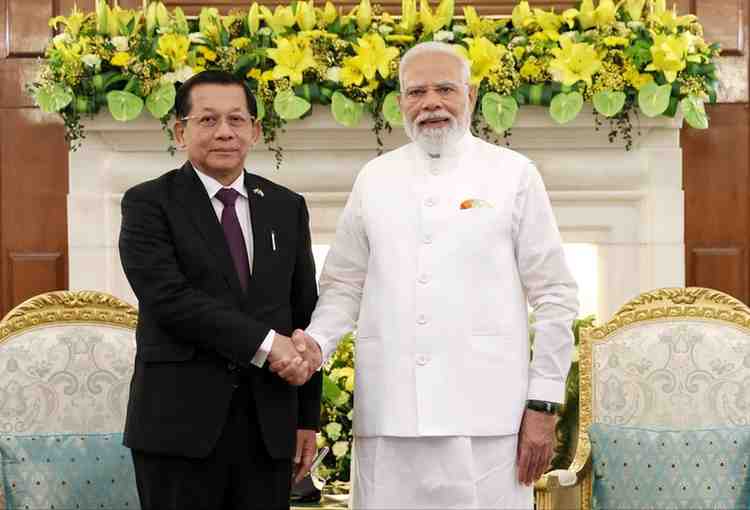
Indian Prime Minister Narendra Modi held extensive talks with Myanmar’s President U Min Aung Hlaing, reaffirming the importance of the India-Myanmar relationship and outlining a roadmap for deeper cooperation across multiple sectors. The discussions reflected both countries’ commitment to strengthening a partnership rooted in historical ties, cultural exchanges, and long-standing people-to-people connections.
During the meeting, the two leaders reviewed the current state of bilateral relations and explored opportunities to expand cooperation in trade, investment, connectivity, development initiatives, capacity building, border management, and security. Both sides emphasized that a stronger partnership would contribute not only to the prosperity of their respective nations but also to peace and stability across the wider region.
Prime Minister Modi reiterated India’s position as a trusted neighbor and dependable partner for Myanmar. He highlighted India’s role as a first responder during times of crisis and underscored New Delhi’s continued commitment to supporting Myanmar through humanitarian assistance, developmental cooperation, and diplomatic engagement.
The discussions were closely aligned with India’s broader regional strategies, including the “Neighbourhood First” policy, the “Act East” policy, and the MAHASAGAR vision, which seeks to promote regional cooperation, connectivity, and sustainable development. These frameworks place Myanmar in a strategically important position due to its geographical location as a bridge between South Asia and Southeast Asia.
Connectivity emerged as one of the central themes of the meeting. India and Myanmar have been working on several infrastructure and transport projects aimed at enhancing cross-border movement of goods and people. Improved connectivity is expected to boost trade, facilitate economic growth, and strengthen regional integration. The two leaders expressed support for accelerating ongoing projects and exploring new opportunities that could benefit communities on both sides of the border.
Security cooperation was another significant area of discussion. Given the shared border between the two countries, both leaders recognized the importance of coordinated efforts to tackle cross-border challenges, including illegal activities, insurgency, and transnational crime. Enhanced border management and intelligence-sharing mechanisms are expected to play a crucial role in maintaining stability and fostering mutual trust.
Prime Minister Modi also conveyed India’s willingness to support efforts aimed at promoting peace and dialogue within Myanmar. He reaffirmed that India remains committed to constructive engagement and stands ready to share its experiences in federal governance, democratic institutions, and economic development. Such cooperation, according to Indian officials, could help support long-term stability and inclusive growth.
Strategic Significance
The meeting carries substantial geopolitical significance at a time when regional dynamics in the Indo-Pacific continue to evolve. Myanmar occupies a critical strategic position, connecting India’s northeastern region with Southeast Asia. As competition for influence in the region intensifies, maintaining strong engagement with Myanmar remains a key element of India’s foreign policy.
For India, closer ties with Myanmar are essential not only for economic reasons but also for security and regional connectivity objectives. The relationship supports New Delhi’s ambition to strengthen links with ASEAN countries and expand trade routes extending beyond its eastern borders.
For Myanmar, engagement with India offers opportunities for infrastructure development, economic cooperation, capacity building, and diversified international partnerships. India’s emphasis on development-focused engagement and humanitarian support has contributed to the resilience of bilateral relations despite political complexities in the region.
Looking Ahead
The discussions between Prime Minister Narendra Modi and President Min Aung Hlaing signal a shared determination to deepen bilateral cooperation and address common challenges through dialogue and partnership. As both countries seek to advance trade, security, connectivity, and development goals, the India-Myanmar relationship is poised to remain an important pillar of regional stability.
The meeting reinforced a common vision of peace, progress, and prosperity, highlighting the enduring value of cooperation between two neighboring nations whose futures remain closely interconnected.