ChinaChina is reportedly developing a massive military infrastructure network in its northwestern desert that could significantly enhance the survivability of its nuclear arsenal in the event of a potential first strike by an adversary, according to a recent analysis of satellite imagery.
The development comes as concerns grow in Washington and among regional allies over the rapid expansion of China’s military capabilities. Speaking at a security forum on Saturday, US Defence Secretary Pete Hegseth urged Asian nations to increase defence spending, describing China’s military build-up as a source of “rightful alarm” for the region and beyond.
New satellite images reviewed by Reuters reveal extensive construction activity near China’s remote nuclear missile bases in eastern Xinjiang. The images show more than 80 sites that analysts believe could support mobile missile launchers, air-defence systems, communications infrastructure and command operations.
Security experts who examined the imagery said the scale and complexity of the project are unprecedented. Hans Kristensen, director of the Nuclear Information Project at the Federation of American Scientists, described the effort as extraordinary, noting that few comparable military developments have been observed in recent decades.
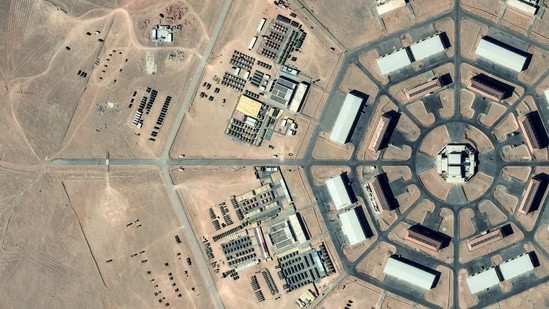
At the centre of the construction are two large octagon-shaped military complexes built over the past six years southwest of the Hami missile fields, which house some of China’s longest-range nuclear missiles. One facility is located about 140 kilometres from the missile fields, while the other lies approximately 230 kilometres away. A third similar complex near the Lop Nur nuclear testing area is still under development and appears to be functioning as a target range.
Satellite photographs show that the sites contain accommodation facilities, storage bunkers, airfields, rail connections and reinforced structures capable of supporting major military operations. Analysts believe the complexes are linked to an extensive network of roads, dirt tracks and underground conduits stretching across the desert landscape.
Several experts told Reuters that the concrete pads scattered around the region could be used to deploy mobile air-defence systems, electronic warfare equipment or road-mobile intercontinental ballistic missile launchers. Construction is also reportedly underway on a communications facility that may support satellite or microwave transmissions, with imagery showing satellite dishes and large communication towers.
The infrastructure expansion appears aimed at increasing the resilience of China’s land-based nuclear forces. By dispersing launch systems and strengthening command-and-control capabilities, Beijing could improve its ability to maintain a retaliatory strike capability even after an enemy attack.
China officially maintains a “no first use” nuclear policy, pledging not to be the first country to use nuclear weapons in a conflict. However, some Western diplomats and security analysts argue that Beijing could leverage its growing nuclear capabilities as a deterrent against foreign intervention in a potential crisis involving Taiwan.
Tensions over Taiwan remain one of the most sensitive issues in US-China relations. Earlier this month, Chinese President Xi Jinping reportedly warned US President Donald Trump that mishandling disputes related to Taiwan could lead both countries into dangerous territory. Beijing considers Taiwan part of its sovereign territory, while Taiwan’s democratically elected government rejects those claims.
While China’s military possesses nuclear-capable submarines and aircraft, experts note that the missile silo fields in Xinjiang and neighbouring Gansu province continue to form the backbone of the country’s strategic nuclear deterrent.
Although analysts agree that the new desert complexes are likely connected to China’s nuclear programme, important questions remain unanswered. It is still unclear what specific weapons systems will ultimately be deployed at the sites and whether the facilities will house ballistic missiles, nuclear warheads or a combination of military assets.
Nevertheless, the scale of construction underscores China’s continued investment in strengthening and modernising its strategic forces amid an increasingly competitive global security environment.