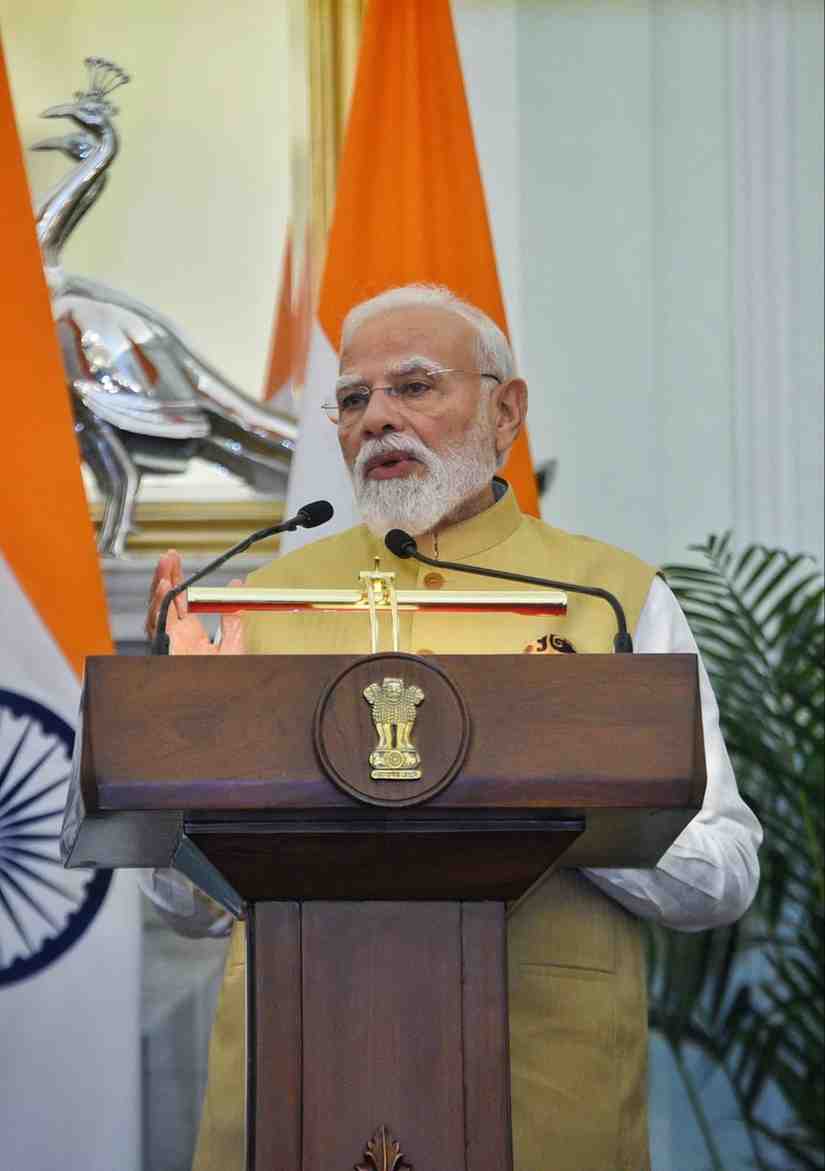
NEW DELHI: India and Japan elevated their Special Strategic and Global Partnership to a new level on Thursday as Prime Minister Narendra Modi and Japanese Prime Minister Sanae Takaichi announced a series of agreements spanning artificial intelligence (AI), defence, investment, energy security, advanced technologies and next-generation mobility.
Addressing a joint press statement after the India-Japan Annual Summit, Prime Minister Modi described mutual trust as the foundation of bilateral relations and said the two countries were entering “a new chapter” in their partnership.
Welcoming Prime Minister Takaichi on her first visit to India, Modi highlighted the historic and cultural links between the two nations, noting that she is Japan’s first woman Prime Minister and comes from Nara Prefecture, a region closely associated with the shared Buddhist heritage of India and Japan.
‘Mutual Trust Is Our Biggest Strategic Asset’
Prime Minister Modi said the India-Japan relationship has stood the test of time because it is rooted in trust and shared democratic values.
Referring to his remarks at the recent G7 Summit, Modi said, “In today’s atmosphere of global uncertainty, mutual trust is our biggest strategic asset. I am proud that the India-Japan partnership fully lives up to this standard.”
He noted that Japanese companies have played a crucial role in India’s economic transformation for decades, particularly in sectors such as automobiles and electronics, helping build a relationship based on confidence and long-term cooperation.
Modi said Prime Minister Takaichi’s visit marks the beginning of “a new chapter in our Special Strategic and Global Partnership.”
AI and Technology Become Key Focus Areas
Technology emerged as one of the central themes of the summit, with both leaders placing special emphasis on artificial intelligence and innovation.
Prime Minister Modi said, “Prime Minister Takaichi and I believe that technology partnership will become the strongest pillar of our cooperation.”
To strengthen collaboration, India and Japan issued a Joint Statement on Artificial Intelligence. Several leading Indian AI institutions also signed agreements with Japanese counterparts to promote research, innovation and technological development.
Modi said the combination of Japan’s precision engineering and India’s software capabilities has the potential to accelerate global AI development.
The two countries also agreed to expand cooperation in emerging technologies, including semiconductors, quantum technologies and advanced materials, recognising these sectors as critical for future economic growth and strategic resilience.
First Defence Co-Development Project Announced
In a significant milestone for bilateral defence cooperation, India and Japan signed an agreement for their first-ever defence co-development project.
The initiative will focus on the joint development of Naval Radio Antenna systems, marking a major step forward in defence technology collaboration.
Highlighting the importance of the agreement, Modi said the project would “open a new chapter in our defence technology partnership.”
He added that both countries would jointly develop advanced defence technologies aimed at strengthening regional peace, maritime security and a rules-based international order in the Indo-Pacific.
Healthcare Collaboration to Boost Global Health Security
The summit also produced agreements in pharmaceuticals, biotechnology and medical devices.
According to Modi, India’s manufacturing scale combined with Japan’s technological excellence can help deliver affordable, reliable and advanced healthcare solutions across the world.
He said these initiatives would also contribute significantly to strengthening global health security through collaborative research, production and innovation.
Investment Target Raised to 10 Trillion Yen
Economic cooperation remained a major focus of the summit, with both leaders reaffirming their commitment to expanding trade and investment.
Prime Minister Modi noted that more than 100 new business agreements had been signed over the past year, expected to bring over 10 billion US dollars in fresh Japanese investments into India.
A new agreement between the financial services agencies of both countries is expected to facilitate smoother capital flows and encourage greater investment.
Setting an ambitious long-term goal, Modi announced, “Our objective is clear—10 trillion yen of Japanese investment in India over the next ten years and doubling the number of Japanese companies operating in the country.”
He also underlined that India’s ongoing economic reforms and improved ease of doing business provide new opportunities for Japanese investors.
Economic and Energy Security Receive Major Push
Against the backdrop of growing global geopolitical uncertainties, India and Japan agreed to deepen cooperation in economic security.
The two countries unveiled a Joint Roadmap aimed at enhancing supply chain resilience in strategic sectors such as semiconductors, quantum computing and advanced materials.
Energy security also featured prominently during the discussions.
Among the key announcements was the launch of the India-Japan Bio-Gas Initiative, under which Japan will support the establishment of 1,000 bio-gas and organic fertiliser plants across India.
The initiative is expected to strengthen India’s GOBARdhan programme while promoting sustainability, rural prosperity and additional livelihood opportunities in villages.
The leaders also agreed to enhance cooperation in battery technologies, green hydrogen, nuclear energy and energy resilience to reduce vulnerabilities arising from global energy disruptions.
Modi said India and Japan view economic security as shared security and the energy transition as a shared opportunity, reaffirming their commitment to working together in these critical sectors.
Next-Generation Mobility and Infrastructure Cooperation
The two Prime Ministers also launched the India-Japan Next Generation Mobility Partnership Framework, aimed at expanding cooperation beyond the successful automotive sector.
The new framework will promote collaboration in shipbuilding, aviation and logistics, opening fresh avenues for industrial growth and technology transfer.
Read Here: Delhi Unveils Winter Pollution Plan; Construction Curbs To Take Effect From November 1
The initiative reflects the two countries’ broader vision of creating resilient manufacturing ecosystems while strengthening regional connectivity.
Strengthening People-to-People Ties
Beyond strategic and economic cooperation, both leaders stressed the importance of stronger people-to-people connections.
India and Japan agreed to expand opportunities for talent mobility, skill development, technical internship programmes, higher education partnerships, research collaboration and start-up ecosystems.
The two countries will also celebrate the 75th anniversary of India-Japan diplomatic relations next year, with special programmes planned in culture, tourism and the creative economy to further deepen public engagement.
A Partnership Built on Shared Values
Concluding his remarks, Prime Minister Modi said India and Japan’s partnership extends beyond economics and security.
He emphasised that the two nations are complementary economies with shared democratic values, cultural links and similar approaches towards technological progress and sustainable development.
“Above all, our relationship rests on unshakeable mutual trust,” Modi said, expressing confidence that the partnership would contribute not only to the vision of a developed India and a stronger Japan but also to global peace, stability and prosperity.
The summit reaffirmed that as geopolitical and economic challenges continue to reshape the international landscape, India and Japan remain committed to expanding cooperation across strategic sectors while working together to build a secure, resilient and prosperous Indo-Pacific.
Click here to join us on WhatsApp Channel and get all the latest news updates