
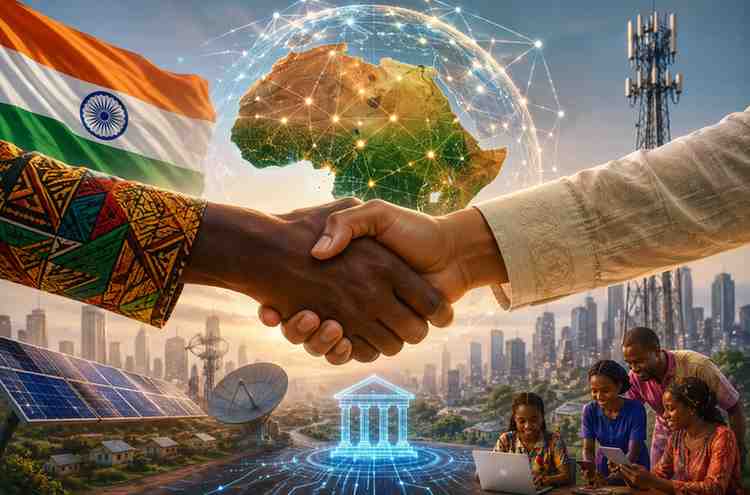
When Beijing’s Huawei powers nearly 70 per cent of Africa’s 4G infrastructure, and China’s Forum on China-Africa Cooperation (FOCAC) pledges $50.7 billion over three years against India’s $13 billion across fourteen years, the question is not whether Africa is a theatre of digital geopolitics, but which model prevails.
India acts as a strategic differentiator, providing open-source, interoperable, sovereignty-respecting Digital Public Infrastructure (DPI). The fourth India-Africa Forum Summit (IAFS-IV), the first in over a decade, was postponed after an Ebola outbreak in Africa; the digital dimension, nonetheless, remains central, a shift EAM S. Jaishankar underscored by naming “digital, fintech and innovation” as its new frontier.
A Blueprint for Collaboration
Over the last decade, India scaled its digital architecture to 970 million internet users, creating a replicable model for Africa to adapt.
India has signed MoUs on India Stack with seven African nations: Kenya, Sierra Leone, Tanzania, The Gambia, Ethiopia, Lesotho, and Seychelles. Namibia and Ghana are building UPI-style payment systems with NPCI International, while MOSIP now partners with 19 African countries on digital identity systems.
Also Read: PM Modi Receives Indonesia’s Top State Honour, Bintang Adipurna
Beyond payments and identity, India’s e-VidyaBharati and e-AarogyaBharati (e-VBAB) Network Project delivers free tele-education and telemedicine to all 54 African nations, linking Indian institutions to counterparts across the continent.
South-South or Strategic Rivalry?
India frames the partnership as South-South cooperation with no political conditionality, unlike China’s Digital Silk Road, whose scale has drawn scrutiny for surveillance-compatible systems and data-retention risks. India’s open-source DPI, by contrast, leaves African nations in control of their own ecosystems, an approach institutionalised at India’s G20 through the One Future Alliance, extending DPI capacity-building to nations wary of digital neo-colonialism.
Challenges in Collaboration
Yet structural limitations persist. Despite growth, only 38 per cent of Africans had internet access in 2024. India offers a sophisticated software stack, but China dominates the hardware, undersea cables, data centres, and handset markets. Without connectivity, even the most elegant DPI is inaccessible.
Skill gaps compound this. By 2030, 40 per cent of the world’s young people will be African, yet India’s ITEC programmes cannot currently skill a workforce that size.
New Delhi’s budgetary allocation for African countries is insufficient. The decade-long gap between IAFS-III and IAFS-IV, a summit due in 2020 that was delayed by five more years, is itself telling: a partnership historically richer in declarations than in delivery.
The Partnership Africa Needs
To succeed, our relationship must shift from exporting technology. In this regard, the India-Japan ‘Strategic Outlook for Expanding Japan-India Cooperation in Africa’ creates a win-win dynamic: India becomes a manufacturing powerhouse for Africa while helping to resolve the challenges.
In an era when the internet is itself a geopolitical contest, India’s DPI offers Africa a sovereign technology model that neither Washington nor Beijing has provided. Whether this yields durable infrastructure or diplomatic goodwill will determine if the partnership truly becomes a roadmap for the future.
Click here to join us on WhatsApp Channel and get all the latest news updates