India’s school education landscape is undergoing a major transformation under the Pradhan Mantri Schools for Rising India (PM SHRI) Scheme, with 13,092 schools selected across 36 States and Union Territories as of July 2026. The initiative, aligned with the National Education Policy (NEP) 2020, is designed to develop more than 14,500 existing schools into exemplar institutions focused on quality, inclusion, sustainability and 21st-century skills.
PM SHRI Targets 14,500 Exemplar Schools
Launched on September 7, 2022, PM SHRI is a Centrally Sponsored Scheme implemented by the Department of School Education and Literacy under the Ministry of Education. The programme has a total project cost of ₹27,360 crore for the five-year period from 2022–23 to 2026–27, including a Central share of ₹18,128 crore.
The government’s objective is not simply to improve school buildings or add facilities. PM SHRI schools are intended to demonstrate how the principles of NEP 2020 can be translated into effective classroom practices and holistic learning environments.
With 13,092 schools already selected, the programme has achieved around 90% of its envisaged target. The selected institutions are expected to directly benefit more than 20 lakh students.
From Infrastructure to Holistic Education
The PM SHRI initiative represents a shift from an infrastructure-centric approach towards a broader model of school development.
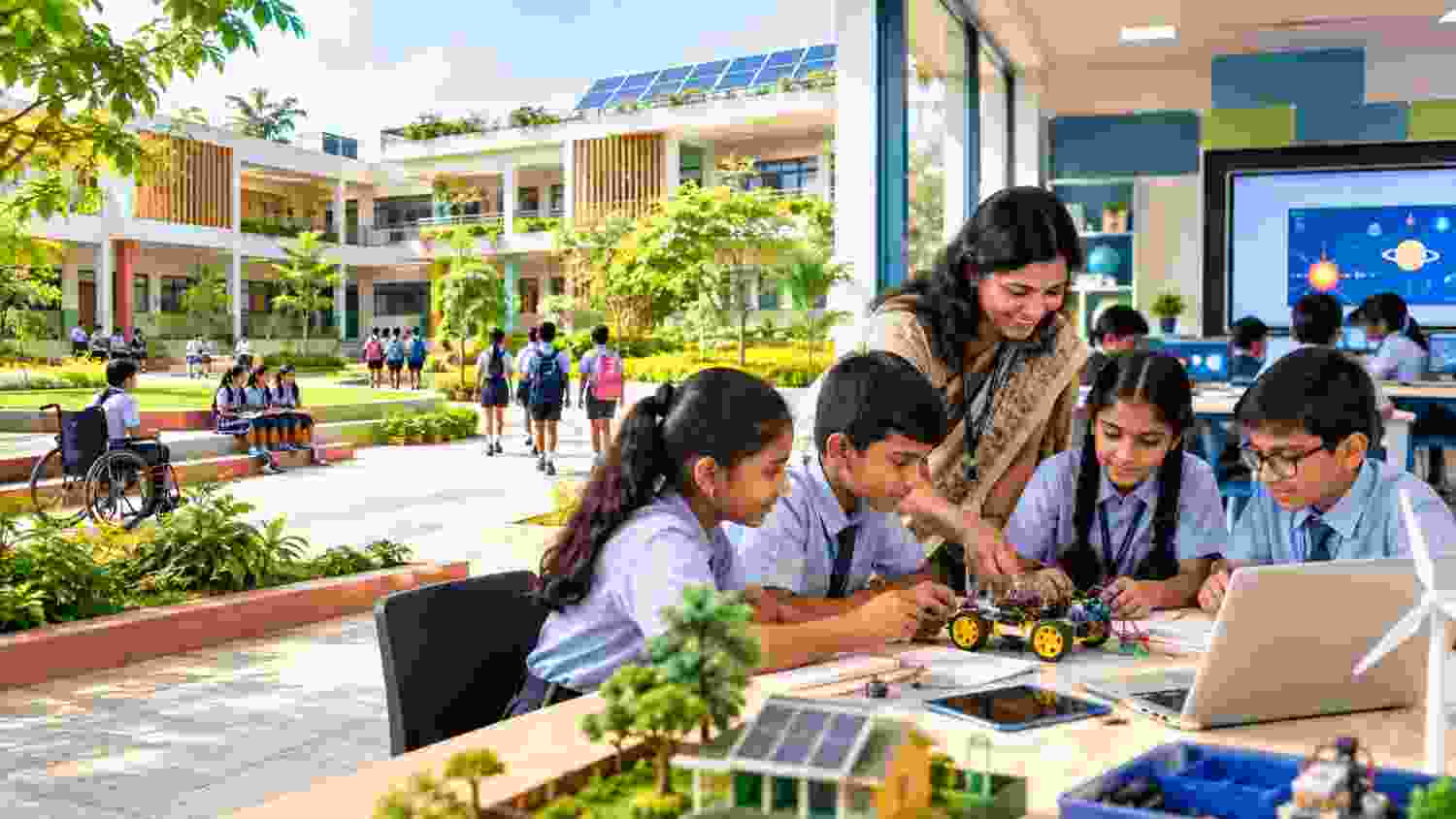
The programme seeks to create schools that are safe, welcoming and stimulating, while promoting competency-based education, experiential learning, technology-enabled teaching and sustainable practices.
The government has highlighted the need for students to develop the ability to learn, unlearn and relearn as they navigate a rapidly changing world. Alongside academic knowledge, the initiative therefore places emphasis on creativity, critical thinking, problem-solving and other future-ready capabilities.
The broader objective is to prepare engaged, productive and responsible citizens capable of contributing to an equitable, inclusive and plural society.
PM SHRI Network Spreads Across India
The selected PM SHRI schools have established a substantial national footprint, covering 725 districts and 8,340 blocks and urban local bodies.
The network includes schools at different levels of education. Of the 13,092 selected institutions, 1,305 are primary schools, 3,102 are upper primary schools, 3,141 are secondary schools and 5,544 are higher secondary schools.
The network also includes 80 Kasturba Gandhi Balika Vidyalayas, 913 Kendriya Vidyalaya Sangathan schools, 620 Navodaya Vidyalaya Samiti schools and four schools under the National Council of Educational Research and Training.
This wide geographical and institutional spread is intended to create a national ecosystem in which successful educational practices can be shared and replicated.
Schools to Become Mentors for Neighbouring Institutions
A key feature of PM SHRI is its emphasis on creating a ripple effect beyond the selected schools.
The institutions are envisioned as exemplar schools that can mentor and support neighbouring schools through handholding, collaboration, clustering and sharing of innovative practices.
Rather than functioning as isolated centres of excellence, PM SHRI schools are expected to demonstrate approaches that can eventually be adapted by other institutions. This model is aimed at supporting wider improvements in school education while building stronger local educational networks.
Focus on Inclusion, Green Practices and Skills
PM SHRI schools are expected to demonstrate several dimensions of quality and excellence.

Inclusive learning is a central component, with an emphasis on equitable and joyful education that responds to different backgrounds, languages and learning abilities.
The programme also promotes green schools, encouraging sustainable and environment-friendly practices. Experiential and learner-centred education is another major focus, including inquiry-based, integrated and play- and toy-based learning during the foundational years.
The initiative additionally connects schools with local entrepreneurial ecosystems and promotes exposure to 21st-century skills, helping students develop capabilities relevant to a changing economy and society.
The School Quality Assessment Framework (SQAF) provides a structured mechanism for assessing and monitoring the quality of PM SHRI schools.
Challenge Mode Builds Quality-Based Selection
PM SHRI schools are selected through a three-stage Challenge Mode, rather than through a purely administrative selection process.
Also Read — Tarique Rahman BRICS Row: India Reveals 2 Separate Invitations To Bangladesh PM
States and Union Territories first enter into a Memorandum of Understanding with the Centre, outlining their commitments to support participating schools.
Eligible schools are then identified using prescribed minimum benchmarks and indicators available through UDISE+ data. The assessment considers areas including infrastructure, learning outcomes, pedagogy, PM POSHAN, vocational education, green initiatives and stakeholder commitment.
This process is designed to ensure that selected schools have a foundation from which they can develop into exemplar institutions.
Rising Investment Signals Stronger Push
The financial allocation for the programme has also expanded significantly. The Central share of the approved Project Approval Board outlay increased from ₹2,520 crore in 2023–24 to ₹5,224 crore in 2026–27, representing an increase of around 107%.
India-US Defence Boost: 1,200 Troops Begin High-Intensity Military Exercises
The expansion reflects the growing scale of investment in upgrading schools and strengthening educational outcomes.
Overall, PM SHRI seeks to operationalise the vision of NEP 2020 at the school level by combining modern infrastructure, quality pedagogy, inclusion, sustainability and technology-enabled learning.
With more than 13,000 schools already selected, the initiative marks a significant step towards the government’s broader vision of creating future-ready, equitable and high-quality learning institutions across India.
Click here to join our WhatsApp Channel for real-time news updates and exclusive coverage.