
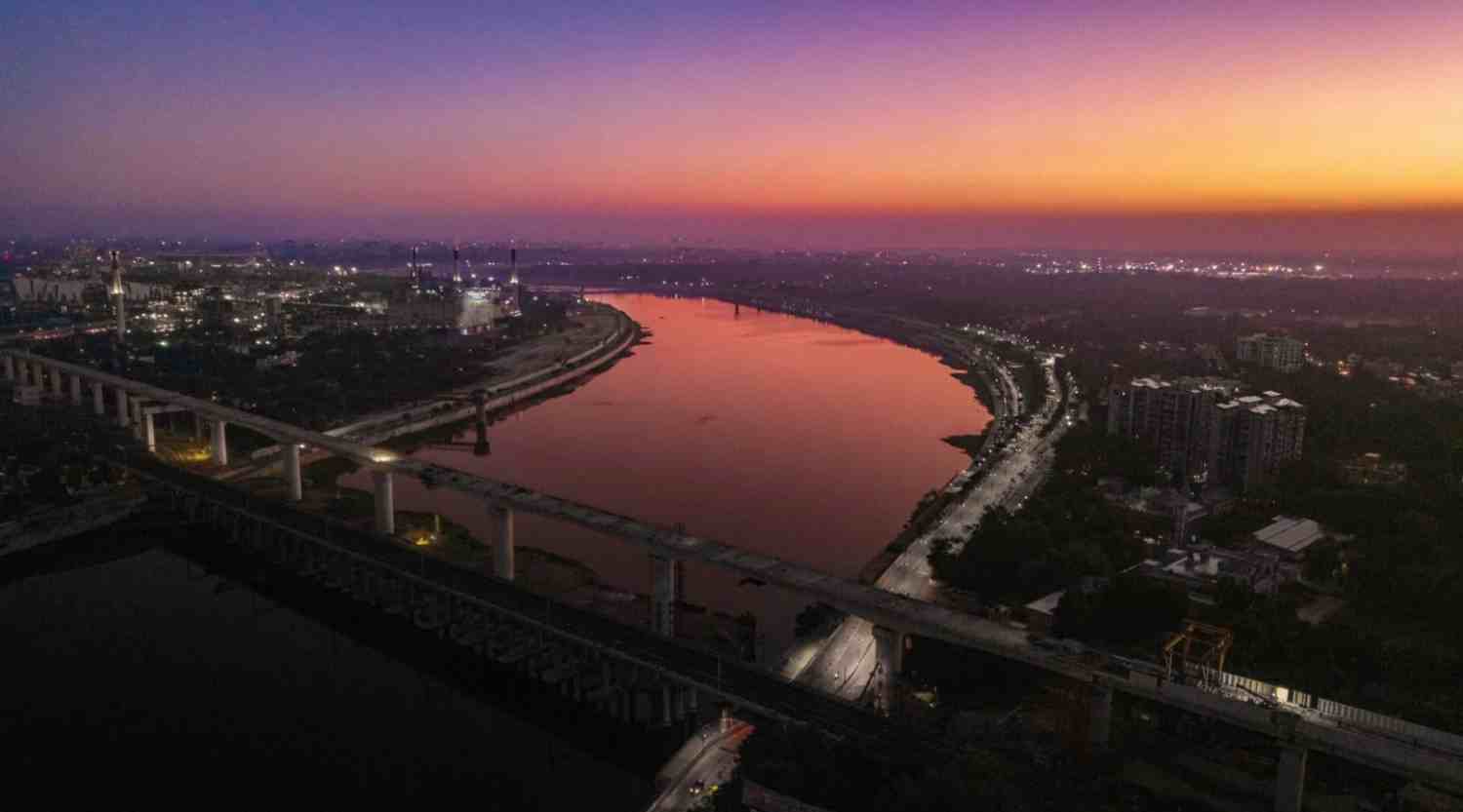
The completion of the 480-metre Sabarmati River bridge in Ahmedabad marks a major engineering milestone for India’s Mumbai-Ahmedabad High-Speed Rail Corridor, bringing the country’s bullet train project another step closer to reality.
The newly completed bridge stands nearly 36 metres above the ground, equivalent to the height of a 12-storey building or around 118 feet. It is located between the Sabarmati and Ahmedabad bullet train stations and forms an important structural component of the high-speed rail corridor in Ahmedabad.
The bridge is approximately 1 kilometre from Sabarmati station and around 4 kilometres from Ahmedabad station. It has also been constructed close to the existing Ahmedabad-Delhi railway line of Western Railway, which is situated about 14.8 metres above ground level.
High-Speed Rail Alignment Crosses Existing Infrastructure
The Mumbai-Ahmedabad High-Speed Rail Corridor passes through a densely developed infrastructure network in Ahmedabad. The alignment intersects or passes near several existing structures, including railway lines, flyovers, bridges and metro infrastructure.
Because the new high-speed rail structure had to maintain the required vertical clearance from these existing facilities, the piers supporting the Sabarmati bridge were designed with considerable height.
The bridge features eight circular piers, with diameters ranging from 6 to 6.5 metres. Four of the piers are positioned within the riverbed, while two are located on opposite riverbanks, with one on each side. The remaining two piers have been placed outside the riverbanks.
This carefully planned positioning reduces obstruction to the natural flow of water while providing the structural support required for the long bridge spans.
Longer Spans Reduce Piers in the River
A notable feature of the Sabarmati bridge is its longer span configuration. Most river bridges along the Mumbai-Ahmedabad bullet train corridor have spans of around 40 metres. In contrast, the Sabarmati structure uses spans ranging from 50 to 76 metres.

The longer spans have helped reduce the number of piers required inside the riverbed. This approach is particularly important for maintaining water flow and limiting the footprint of the bridge within the river.
The structure consists of five 76-metre spans and two 50-metre spans. Each span has 23 segments that were cast in situ at the construction site.
Precision Engineering Behind the Construction
Constructing the bridge required high levels of precision engineering, skilled manpower and rigorous quality checks at different stages.
The individual segments had to be produced and assembled with considerable accuracy to ensure that the completed superstructure met the required engineering specifications. The construction process also involved post-tensioning to provide the necessary strength and continuity to the bridge deck.
Balanced Cantilever Method Used
The Sabarmati River bridge was constructed using the Balanced Cantilever Method, a technique commonly suited to long-span bridges over rivers and deep waterways.
Also Read | Navpreet Singh Deported From Türkiye: India Scores Major Blow Against Global Drug Cartels
Under this method, the bridge superstructure can be constructed without installing conventional scaffolding underneath the deck. Segments are progressively constructed from the piers, extending outward on both sides.
The construction proceeds in a balanced manner from each pier, with the segments connected through post-tensioning. This creates a stable and continuous bridge deck while significantly reducing the need for temporary structures within the river.
The method is particularly useful where access to the area beneath the bridge is difficult or where placing extensive temporary supports could interfere with river flow.
25 River Bridges Planned Across the Corridor
The Mumbai-Ahmedabad High-Speed Rail Corridor includes a total of 25 river bridges. Of these, 21 are located in Gujarat and four are planned in Maharashtra.
Construction activity on the Gujarat portion has progressed significantly. Of the 21 river bridges planned in Gujarat, 18 have now been completed.
The completion of the Sabarmati River bridge therefore represents an important step in the wider construction programme, particularly because the structure has been designed to navigate a complex urban environment with multiple existing transport facilities.
Another Step Toward India’s High-Speed Rail Network
The Mumbai-Ahmedabad corridor is being developed as India’s first high-speed rail project. Its construction involves numerous complex structures, including tunnels, viaducts, bridges and elevated sections designed to integrate with existing infrastructure.
The completion of the Sabarmati bridge demonstrates the scale and engineering complexity involved in constructing the corridor through Ahmedabad. With major structural works continuing across Gujarat and Maharashtra, the project is steadily advancing toward the development of India’s high-speed rail network.
Click here to join our WhatsApp Channel for real-time news updates and exclusive coverage.