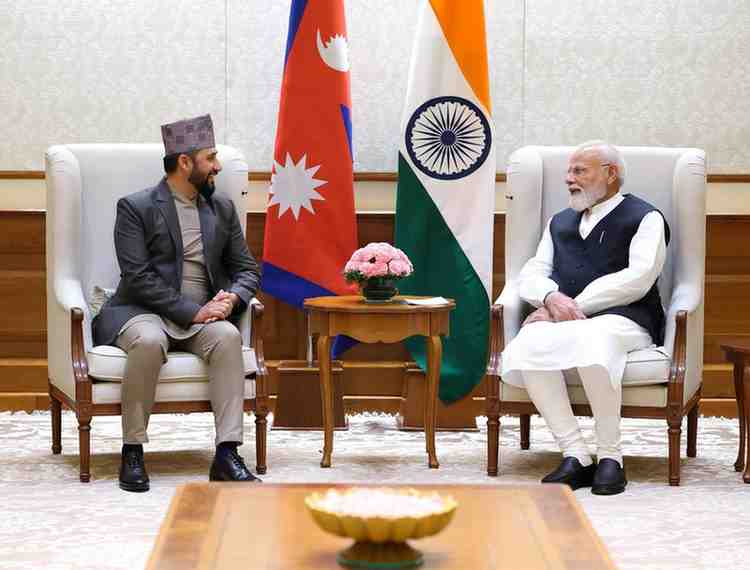
NEW DELHI: Prime Minister Narendra Modi on Wednesday underscored India’s commitment to deepening relations with Nepal following his meeting with Rabi Lamichhane, Chairman of Nepal’s Rastriya Swatantra Party (RSP). The meeting comes at a significant time as Nepal continues to navigate a changing political landscape with emerging political forces gaining prominence.
In a statement on a X post, PM Modi expressed his pleasure at meeting Lamichhane and welcomed his vision of closer cooperation between the two neighboring countries. The Prime Minister emphasized that Nepal remains a key partner in India’s foreign policy framework, particularly under the Neighbourhood First policy.
PM Modi stated that both nations share a common aspiration for prosperity and development and that India looks forward to working with Nepal’s leadership to further strengthen the longstanding relationship between the two countries.
India and Nepal share deep-rooted historical, cultural, religious, and economic ties. The open border between the two nations facilitates extensive people-to-people exchanges, trade, and cooperation. Over the years, India has remained one of Nepal’s largest development and trading partners.
The Prime Minister’s remarks reflect New Delhi’s intent to maintain close engagement with all major political stakeholders in Nepal. As political dynamics evolve in Kathmandu, India appears keen to ensure continuity in bilateral cooperation across sectors such as infrastructure, connectivity, energy, trade, and tourism.
The meeting also signals India’s willingness to engage with Nepal’s newer political actors. The Rastriya Swatantra Party has emerged as an influential force in Nepal’s politics, particularly among younger voters seeking governance reforms and greater transparency.
Both leaders reportedly discussed opportunities to expand cooperation and strengthen mutual understanding between the two neighboring nations. The interaction reinforces the shared objective of promoting stability, development, and regional cooperation in South Asia.
PM Modi’s statement carries both diplomatic and strategic significance. By publicly acknowledging Rabi Lamichhane and expressing support for closer cooperation, India is signaling that it is prepared to work constructively with Nepal’s emerging political leadership, regardless of political shifts within the country.
The reference to Nepal as a “priority partner” under the Neighbourhood First policy highlights India’s continued focus on maintaining strong ties with its immediate neighbors. This is particularly important given the increasing geopolitical competition in South Asia.
The statement also reflects India’s broader objective of ensuring stability and economic growth in the region through stronger connectivity, infrastructure development, energy partnerships, and cross-border cooperation.
For Nepal, closer engagement with India remains crucial due to extensive trade links, employment opportunities, tourism, and shared cultural connections. The meeting may help build confidence between India’s leadership and Nepal’s newer political forces, potentially paving the way for enhanced collaboration in the future.
Overall, the interaction suggests that both countries are interested in preserving their special relationship while adapting to changing political realities, with a focus on shared prosperity and regional stability.