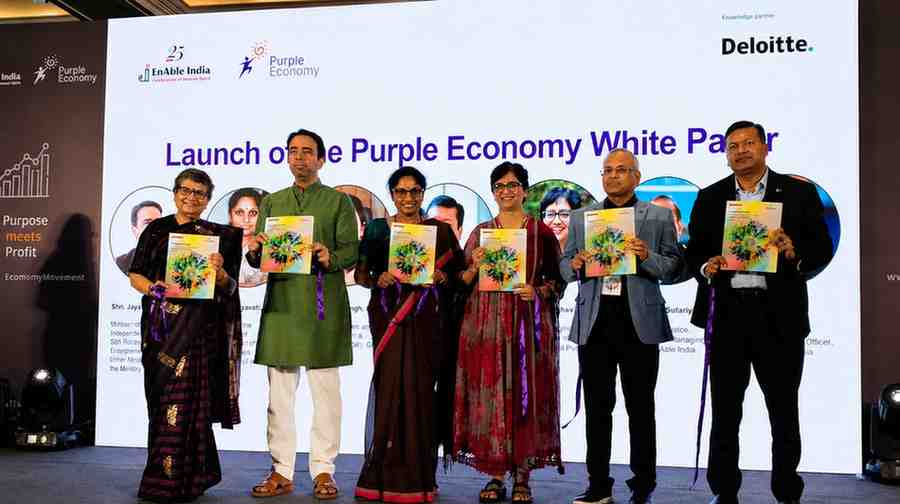
NEW DELHI: India’s economic growth story could receive a significant boost by embracing disability inclusion as a core development strategy, according to a new White Paper released jointly by Deloitte and EnAble India. Launched in New Delhi on July 14, the report estimates that India’s emerging Purple Economy has the potential to contribute nearly US$150 billion to the country’s economy by creating more inclusive markets, expanding workforce participation and encouraging innovation across sectors.
The report argues that disability inclusion should no longer be viewed merely as a matter of welfare, corporate social responsibility (CSR) or legal compliance. Instead, it should become a central pillar of economic planning that creates opportunities for businesses, governments and communities while supporting India’s vision of Viksit Bharat 2047.
What Is the Purple Economy?
The White Paper defines the Purple Economy as an economic framework that recognises persons with disabilities as active participants in the economy—not only as beneficiaries of support but also as consumers, employees, entrepreneurs, innovators, taxpayers and contributors to national growth.
According to the report, India has a vast untapped opportunity because workforce participation among persons with disabilities remains below 25 percent, significantly lower than the nearly 60 percent participation rate among people without disabilities. This gap represents a large pool of talent that remains underutilised.
Globally, the report estimates that persons with disabilities and their households account for an US$18 trillion consumer market, making them one of the world’s largest underserved consumer groups.
Disability Inclusion as an Economic Driver
Launching the report, Deloitte South Asia Chief Executive Officer Romal Shetty said disability inclusion should be viewed as a catalyst for long-term economic competitiveness rather than an additional business expense.
“India is at a decisive moment in its growth journey. The Purple Economy challenges us to see disability inclusion not as a cost, but as a catalyst for innovation, market expansion and long-term competitiveness. Businesses that design for inclusion will not only serve society better; they will build better products, stronger talent systems and more resilient markets.”
The launch event brought together senior government officials, policymakers, business leaders, investors, technology experts, civil society representatives and persons with disabilities. Union Minister of State (Independent Charge) for Skill Development and Entrepreneurship Jayant Chaudhary also attended the event, alongside senior government secretaries and industry stakeholders.
Creating Systems That Enable Participation
EnAble India Founder and Managing Trustee Shanti Raghavan, who has been one of the architects of the Purple Economy concept, said the approach is about creating systems that enable people with disabilities to participate throughout every stage of life.
She explained that just as healthcare systems help people recover and contribute productively, society must now develop similar enabling systems for persons with disabilities.
“Every unmet need is an innovation signal. When we design systems that improve daily participation for persons with disabilities, we create better quality of life not only for them, but for all citizens.”
The report notes that accessibility improvements benefit everyone, including senior citizens, parents with young children and people temporarily affected by injuries, thereby expanding the impact far beyond the disability community.
Moving Beyond Individual Success Stories
EnAble India Co-founder and Chairman Dipesh Sutariya said the Purple Economy represents the next stage in India’s disability inclusion journey after more than two decades of work in employment and livelihood generation.
According to him, the White Paper introduces concepts such as the Purple Delta, which measures the gap between current and potential participation, and the Purple Economy Flywheel, a framework illustrating how accessibility, innovation, employment and market demand can reinforce each other to create sustainable growth.
He said these models are intended to help governments, businesses and institutions build large-scale systems instead of isolated inclusion programmes.
Inclusive Growth Across Multiple Sectors
The report identifies several sectors where disability inclusion can generate substantial economic value.
These include:
- Banking and financial services
- Healthcare
- Education
- Mobility and transportation
- Retail
- Tourism
- Technology
- Skill development
- Public service delivery
According to the report, barriers experienced by persons with disabilities often reveal broader market gaps. Businesses that address these challenges through accessible products, services and infrastructure can unlock new customer segments while improving overall user experience.
National Growth Framework Proposed
The White Paper recommends a comprehensive national framework that integrates disability inclusion into India’s long-term development agenda.
Among its key proposals are:
- Expansion of Digital Public Infrastructure to improve accessibility.
- Development of Purple Economic Zones to promote inclusive entrepreneurship and employment.
- Greater collaboration between governments, businesses and civil society.
- Inclusive market design that considers accessibility from the planning stage.
- Cross-sector partnerships to scale innovative solutions.
The report argues that these initiatives can help transform disability inclusion into a mainstream economic growth strategy rather than a standalone social welfare programme.
Purple Economy Movement Gains Momentum
The report also highlights the growing Purple Economy Movement, initiated by EnAble India, which has expanded significantly over the past year.
Several initiatives are already underway, including:
- Purple Economy Dialogues involving policymakers and industry leaders.
- Purple Rides promoting accessible transportation.
- OPuN (Open Purple Network), a digital platform designed to improve discovery and participation.
- Early work on Purple Economic Zones.
- Collaborations in financial inclusion, tourism, mobility, education, technology and public service delivery.
- Corporate initiatives such as Prernaya, aimed at supporting women with disabilities through skills training, internships, mentorship and career opportunities.
EnAble India Head of Purple Economy Movement Neeraj Krishnan said the White Paper reflects an initiative that is already progressing across multiple sectors.
“The White Paper is not the beginning of the Purple Economy. It captures a movement already in motion. The next step is to convert these early signals into scalable models, sector playbooks and adoption pathways for India and the world.”
Towards an Inclusive Economic Future
Deloitte South Asia Chief Happiness Officer Saraswathi Kasturirangan said organisations that remove barriers to learning, employment and access ultimately become stronger and more resilient.
She emphasised that inclusion is not limited to workplace diversity but involves redesigning systems so that talent and innovation are never restricted by accessibility challenges.
The report concludes that disability inclusion should become part of India’s long-term economic imagination, bringing together policy, technology, markets, capital and communities to create sustainable and shared prosperity.
By reframing disability as an opportunity for innovation and market creation rather than a social burden, the Purple Economy seeks to position accessibility as a key driver of India’s next phase of economic growth. If implemented at scale, the framework could help unlock billions of dollars in economic value while ensuring greater participation and dignity for millions of persons with disabilities across the country.
Click here to join our WhatsApp Channel for real-time news updates and exclusive coverage.