The Government of Goa reinforced its commitment to sustainable development and heritage conservation by showcasing its long-term infrastructure vision at a prestigious national conference held in New Delhi. The event brought together leading policymakers, architects, urban planners, environmental experts, industry representatives and international delegates to discuss innovative solutions for building climate-resilient and environmentally responsible infrastructure.
Organised by the Goa State Infrastructure Development Corporation (GSIDC), the National Conference on Goan Architecture & Sustainability was hosted at The Leela Palace in Chanakyapuri. The conference served as a major platform for exchanging ideas on balancing modern development with the preservation of Goa’s unique architectural and cultural identity.
Top Leaders Inaugurate the Conference
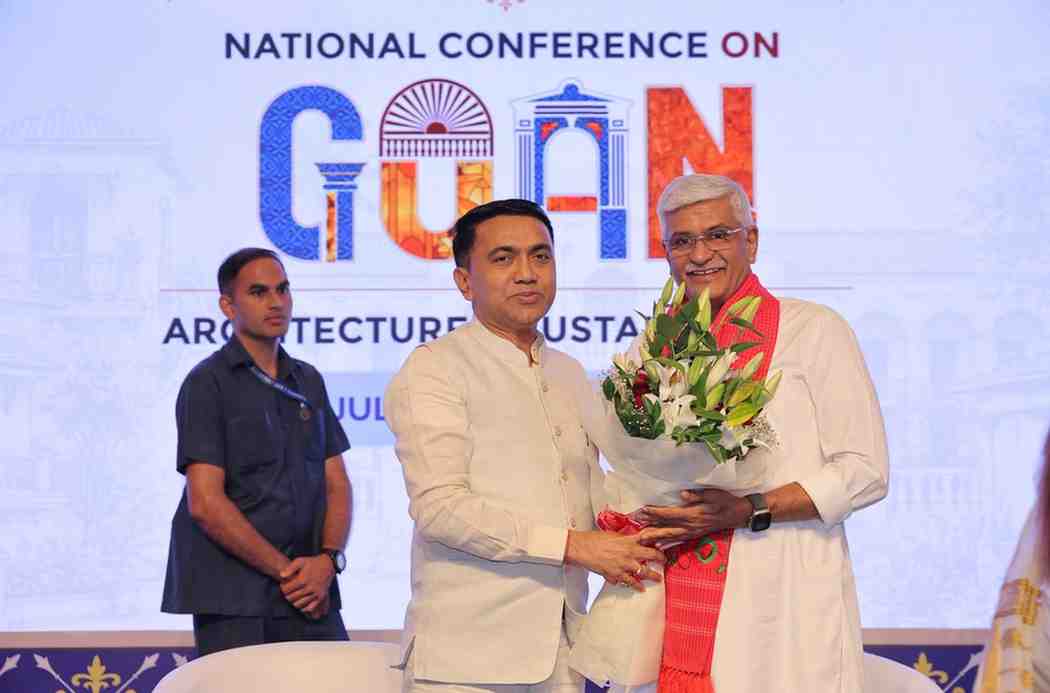
The conference was inaugurated by Goa Chief Minister Dr. Pramod Sawant along with Union Tourism and Culture Minister Gajendra Singh Shekhawat and Rajya Sabha Member of Parliament Sadanand Shet Tanavade. Several distinguished guests from India and abroad also attended the inaugural ceremony.
The event began with the traditional lighting of the ceremonial lamp, followed by keynote addresses focusing on sustainable infrastructure, environmental responsibility and the need for collaborative efforts to address future urban development challenges.
The dignitaries highlighted the importance of integrating innovation with heritage conservation while ensuring that infrastructure projects remain environmentally sustainable and socially inclusive.
Chief Minister Emphasises Heritage-Led Development
Addressing the gathering, Chief Minister Dr. Pramod Sawant underlined Goa’s determination to protect its architectural heritage while embracing modern infrastructure.

He stated that Goa’s rich architectural traditions continue to shape the state’s future and remain an essential part of its identity. According to him, the government is committed to creating resilient and world-class infrastructure that respects environmental values while preserving the state’s unique cultural character.
He stressed that development should strengthen rather than weaken Goa’s heritage and called for greater collaboration among architects, policymakers, planners and environmental experts to build climate-resilient cities.
The Chief Minister also noted that adopting green technologies and encouraging sustainable planning would ensure that future generations inherit a prosperous and environmentally responsible Goa.
Experts Discuss Sustainable Urban Planning
One of the major highlights of the conference was a series of four thematic panel discussions involving nationally and internationally recognised experts.
Also Read: Commercial LPG Prices Slashed Across India, Big Relief From August 1
The discussions covered important subjects including contextual architectural design inspired by Goa’s traditions, heritage conservation, sustainable habitats, energy-efficient construction, green building certification, climate-smart materials and environmentally friendly construction practices.
Experts exchanged ideas on reducing the environmental impact of infrastructure while improving urban resilience against climate-related challenges.
The sessions explored innovative construction technologies, policy reforms and sustainable planning strategies that can help cities achieve long-term environmental and economic sustainability.
International Participation Enriches Discussions
The conference witnessed participation from several globally respected institutions and organisations.
Representatives from TERI, the Charles Correa Foundation, INTACH, the GRIHA Council, the World Bank, the International Finance Corporation (IFC), the Centre for Science and Environment, Auroville Earth Institute, the European Union, the Royal Danish Embassy and the Embassy of the Kingdom of the Netherlands contributed their expertise.
Their participation added global perspectives on sustainable architecture, climate adaptation, green infrastructure financing and heritage conservation.
Experts shared international best practices that could be adapted to Indian conditions while promoting environmentally responsible urban growth.
Focus on Innovation and Local Entrepreneurship
Alongside the conference, a special exhibition featuring GoVAN products highlighted Goa’s innovation ecosystem and local craftsmanship.
Delegates had the opportunity to explore products developed by local entrepreneurs, reflecting the state’s commitment to promoting indigenous innovation and sustainable business practices.
The exhibition also demonstrated how local enterprises can contribute to economic development while supporting environmentally friendly production methods.
Collaboration Identified as the Key to Future Development
Throughout the conference, speakers repeatedly stressed that collaboration among governments, academic institutions, private industry and international organisations would be essential for achieving sustainable urban development.
Participants agreed that climate change, rapid urbanisation and resource management require integrated planning and knowledge sharing across sectors.
The conference encouraged stakeholders to adopt innovative technologies, sustainable construction methods and evidence-based policymaking to create resilient infrastructure capable of meeting future challenges.
Conference Ends with Vision for a Greener Future
The event concluded with a valedictory session where organisers summarised the key recommendations emerging from the panel discussions.
Participants reaffirmed the importance of preserving cultural heritage while adopting climate-smart infrastructure solutions that support economic growth and environmental protection.
The conference ended with a networking session that enabled government officials, architects, researchers, policymakers and industry leaders to exchange ideas and identify opportunities for future collaboration.
By hosting this national conference, Goa once again demonstrated its ambition to become a leading example of sustainable infrastructure, heritage conservation and climate-resilient urban development. The discussions and recommendations generated during the event are expected to contribute significantly to shaping future infrastructure policies that combine innovation, environmental responsibility and cultural preservation.
Click here to join our WhatsApp Channel for real-time news updates and exclusive coverage.