
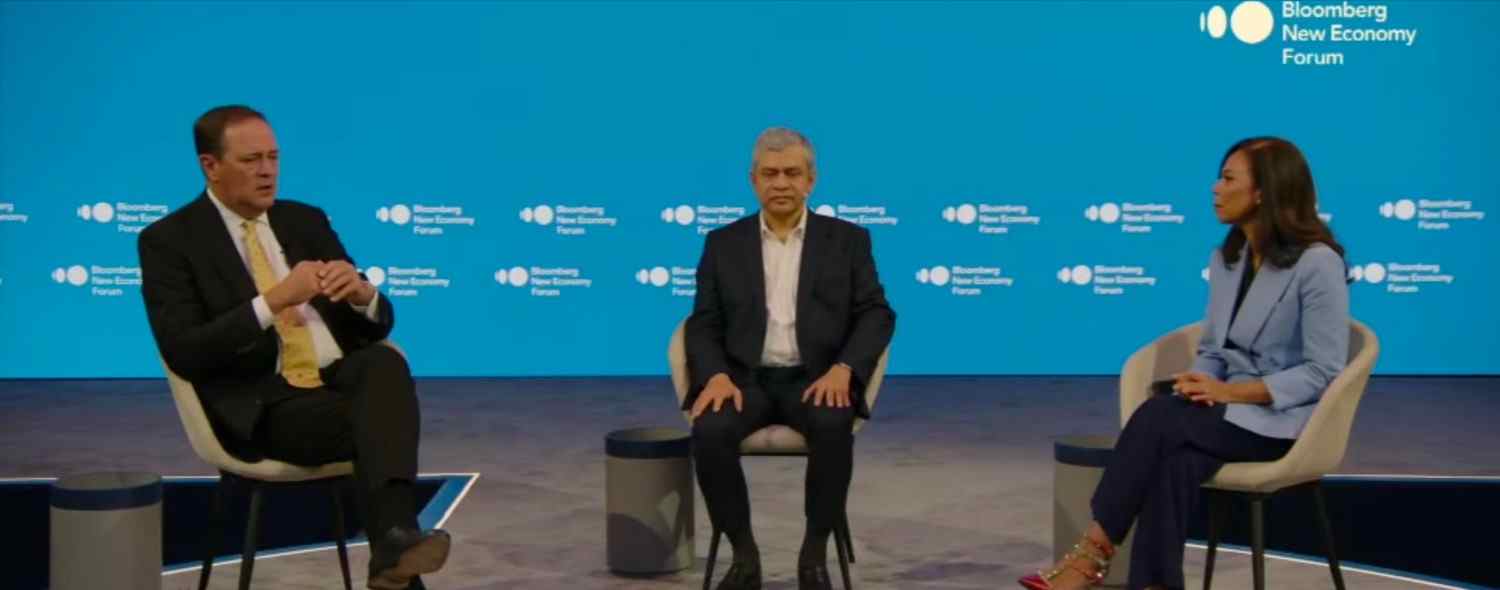
India must prepare for a more turbulent global economy by strengthening its technological capabilities, reducing strategic dependencies and building resilient supply chains, Union Minister Ashwini Vaishnaw said at the Bloomberg New Economy Forum 2026 in New Delhi on Wednesday.
Vaishnaw warned that artificial intelligence (AI), financial instability in advanced economies and changing geopolitical relationships could create significant challenges in the coming years. He stressed that India needs to identify vulnerabilities early and develop domestic capabilities in strategically important sectors to protect its economic growth.
Addressing global business leaders and policymakers, the minister outlined India’s long-term strategy for technological resilience, highlighting semiconductors, critical materials, chip design and advanced manufacturing as key priorities.
AI Disruption and Global Debt Pose Major Economic Risks
Vaishnaw said the international economic environment could become considerably more difficult as technological transformation coincides with financial and geopolitical uncertainty.
He pointed to two major sources of risk: disruption caused by AI, particularly in employment and the services sector, and the possibility that mounting debt in advanced economies could trigger wider financial instability.
AI is changing how businesses operate, potentially reshaping job roles, productivity and established service-sector models. According to the minister, these changes could coincide with financial shocks, creating additional pressure on economies and businesses worldwide.
He cautioned that India cannot assume its growth trajectory will remain unaffected by developments outside its borders. Although domestic economic fundamentals remain important, external disruptions could pose significant challenges.
Vaishnaw also emphasised that geopolitical relationships are not permanent. Countries that are currently close partners may adopt different positions as political priorities change, making it necessary for India to assess its international dependencies continuously.
The minister’s warning underlined the importance of preparing for future risks rather than responding only after a crisis has emerged.
India Sets a 25-Year Roadmap to Strengthen Economic Resilience
Vaishnaw said India is pursuing a phased development strategy with short-, medium- and long-term objectives. The plan covers three to five years in the short term, five to 15 years in the medium term, and 20 to 25 years in the long term.
The approach aims to identify areas where excessive dependence on foreign suppliers or government policies could threaten India’s production capacity and economic security.
Rather than seeking complete self-sufficiency, India wants to build strength in critical sectors while remaining closely connected to international supply chains. The objective is to ensure that the country can withstand external shocks without sacrificing opportunities for global cooperation.
The minister stressed that strategic independence requires careful decisions about which products should be designed and manufactured domestically and which can be sourced reliably from international partners.
This approach is particularly relevant as countries increasingly treat technology, manufacturing capacity and access to essential materials as strategic assets.
Semiconductor Mission 2.0 Targets Critical Supply Chain Gaps
Semiconductors emerged as a central part of Vaishnaw’s strategy for strengthening India’s technological position.
The minister said critical materials represent one of the biggest vulnerabilities in the country’s technology ecosystem. These include specialised gases, chemicals, substrates and other inputs essential for semiconductor production.
India’s initial semiconductor programme concentrated on establishing major manufacturing and assembly projects. According to Vaishnaw, the programme has expanded from supporting one major company to 12 projects, five of which were already producing chips at the time of his remarks.
The next stage aims to broaden domestic capabilities beyond individual factories and develop a more comprehensive supply chain.
Also Read | “Jailing Youth Is Act Of Cowardice”: Rahul Gandhi Backs CJP After Das, Ranka Sent to Jail
The government’s Semiconductor Mission 2.0 received Cabinet approval in July 2026 with a reported outlay of ₹1.27 lakh crore, compared with ₹76,000 crore under the first phase. Its expanded focus includes materials, equipment, research and other components needed to support the industry.
Vaishnaw stressed that building a complete semiconductor ecosystem requires sustained investment and coordination. Countries with established chip industries have spent decades developing specialised suppliers, manufacturing expertise and research capabilities.
India, however, faces pressure to accelerate this process as global competition intensifies. The government therefore wants to develop critical capabilities faster while maintaining international partnerships.
India Wants to Become a Trusted Global Technology Partner
Vaishnaw said India aims to establish itself as a dependable partner in global technology and manufacturing networks.
He noted that production of certain established semiconductor technologies, including chips manufactured using 28-nanometre to 90-nanometre processes, is concentrated in a limited number of locations. Such concentration can create supply risks when geopolitical tensions or policy changes disrupt trade.
Trust, cybersecurity and intellectual property protection are consequently becoming increasingly important considerations for international companies choosing manufacturing and technology partners.
The minister also highlighted India’s established role in advanced chip design. Engineers working in India contribute to the design of sophisticated processors for major international technology companies, including Nvidia, Qualcomm and AMD.
He argued that this expertise provides a foundation for India to expand its contribution across the semiconductor value chain.
The wider objective is not to withdraw from global trade but to ensure that India can supply valuable technologies and components while reducing exposure to critical external dependencies.
Domestic Manufacturing and Research Investment Remain Key Priorities
The minister also highlighted India’s experience in building an end-to-end 4G telecommunications technology stack through collaboration between government institutions and private-sector companies.
According to Vaishnaw, the system was developed in approximately three-and-a-half years and deployed across more than 100,000 telecom towers. He presented the achievement as an example of how domestic technological capabilities can be developed through coordinated efforts.
He also called attention to the need for greater investment in research and development, particularly applied research that can translate scientific advances into commercially useful products.
India’s broader manufacturing strategy aims to move beyond assembling imported components towards producing more modules, parts and sophisticated technologies domestically. Vaishnaw cited the mobile phone industry as an example of this gradual transition, noting that Indian manufacturers have increased local production and begun exporting certain components.
The approach could help strengthen domestic supplier networks, create new industrial opportunities and make manufacturing less vulnerable to overseas disruptions.
India Highlights Fiscal Strength Amid Global Uncertainty
Vaishnaw said India’s public debt-to-GDP ratio had declined from 61% to 55% over the preceding five years. He also described the country as approaching the $4 trillion economic mark, with annual growth running in the range of 6% to 8%.
However, he cautioned that international financial and economic developments could affect India’s future performance despite its domestic strengths.
The minister’s remarks reinforce the government’s emphasis on economic resilience, technological development and diversified supply chains. These priorities are becoming increasingly significant as governments worldwide respond to AI-driven changes, strategic competition and uncertainty in global trade.
For India, the challenge will be to accelerate domestic manufacturing, improve research capabilities and secure essential materials without losing the benefits of international investment and cooperation.
The message from the Bloomberg New Economy Forum was clear: India must prepare for a more uncertain global economy by strengthening the technologies, industries and supply chains that will shape its future growth.
Click here to join our WhatsApp Channel for real-time news updates and exclusive coverage.