
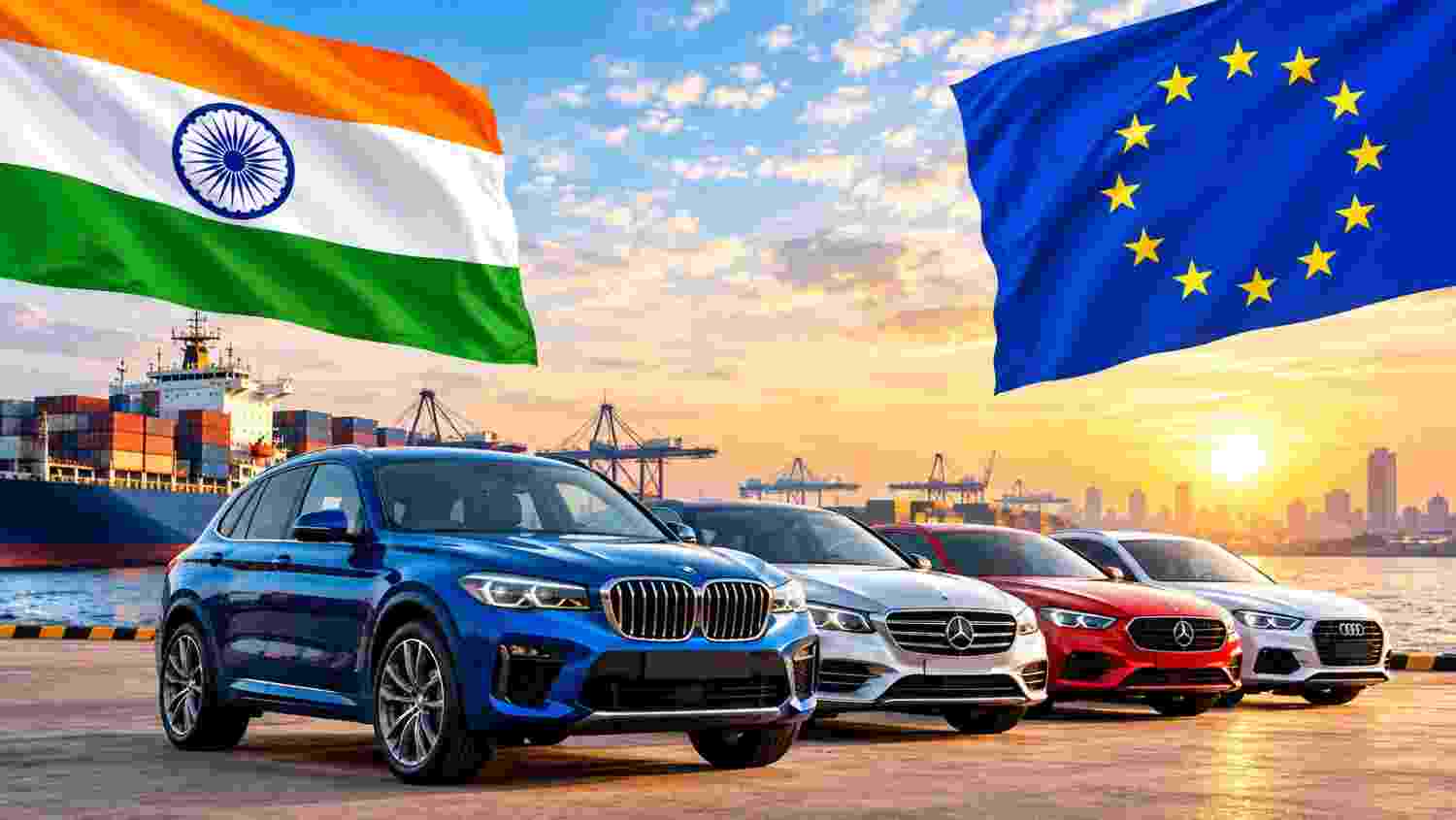
The India-European Union Free Trade Agreement (FTA) is set to create a major new opening for European automobile manufacturers in India, with the annual quota for eligible completely built-up internal-combustion engine and non-plug-in hybrid passenger cars starting at 100,000 units and increasing to 160,000 vehicles by the 10th year.
The provisions are contained in the agreement texts and annexures published on Friday. The arrangement represents a substantial change for Europe’s automobile industry, which has long faced India’s comparatively high import duties on passenger vehicles. Cars imported within the specified quota will qualify for significantly lower tariffs, subject to price thresholds and other conditions.
The tariff concessions are designed to be phased in rather than implemented immediately at their final levels, giving the Indian automobile market time to adjust while providing European manufacturers with greater access.
Major duty cuts for European passenger vehicles
For cars priced between €15,000 and €35,000, the applicable in-quota duty will fall from the existing 110% to 35% in the first year. From the fifth year, it will decline further to 10%.
For vehicles priced above €35,000, the duty will initially come down from 66% to 30%, before reaching 10% from the fifth year.
The agreement also establishes different quota allocations based on vehicle prices. From the fifth year, 43,000 vehicles priced above €50,000 will have a dedicated allocation. Cars costing less than €15,000 will not receive the preferential tariff treatment under the arrangement.
Also Read: China Signals Major Reset In India Ties As Xi Jinping Returns To New Delhi
The tariff reductions are not restricted only to vehicles imported within the quota. India will also gradually reduce duties on certain EU-made cars imported outside the quota. For vehicles priced between €15,000 and €50,000, the out-of-quota duty is scheduled to decline to 35% by the 10th year, while cars priced above €50,000 will face a duty of 30%.
Separate quota for CKD and hybrid vehicles
The FTA also establishes a separate framework for completely knocked-down, or CKD, internal-combustion and hybrid vehicles.
Under this provision, the annual quota will stand at 75,000 units during the first five years before declining progressively to 50,000 units from the 10th year. The in-quota duty for these vehicles will fall from 13.75% in the first year to 8.25% from the third year, compared with the existing 16.5% level.

The agreement additionally provides a pathway for battery-electric vehicles, plug-in hybrids and other eligible technologies. Concessions for these vehicles will begin from the fifth year.
The quota for completely built-up vehicles in these categories will start at 20,000 units in the fifth year, increase to 50,000 by the 10th year and eventually reach 90,000 units from the 14th year. The applicable in-quota duty will decline from 30% in the fifth year to 10% in the 10th year. Vehicles priced below €20,000 will remain outside this concession.
India balances market access
The tariff-rate quota structure allows India to widen access for European products while continuing to protect domestic manufacturers outside specified quantity, price and eligibility limits.
Modi-Putin Embrace: BRICS 2026 And New Logic Of Strategic Autonomy
The automobile provisions come alongside wider concessions covering several European products, highlighting the broad economic scope of the India-EU trade agreement.
The pact includes significant changes for European wines and alcoholic beverages. Wine priced below €2.50 per 750 ml will continue to attract the existing 150% base customs duty. For wine priced between €2.50 and €10, the duty will fall to 75% in the first year and eventually to 30% from the eighth year.
For wines valued at €10 or more per 750 ml, the duty will decline from 150% to 75% initially and then progressively reach 20% from the eighth year. The concessions cover several categories, including sparkling wine, bulk wine and flavoured wines.
Agricultural products also receive quota-based concessions
The agreement provides market access for selected European agricultural products through tariff-rate quotas.
India will permit 2,000 tonnes of EU pork annually at concessional tariffs, while the quota for apples priced at a minimum CIF value of Rs 80 per kg will begin at 50,000 tonnes and gradually increase to 100,000 tonnes from the 11th year.
The agreement also provides quotas for kiwifruit, pears and peaches, with preferential tariffs applying only within the specified limits and conditions.
The automobile provisions are among the most commercially significant elements of the FTA because they could reshape the competitive landscape for premium and European-branded vehicles in India. At the same time, the phased quota and price restrictions preserve safeguards for domestic producers while allowing European manufacturers progressively greater access to one of the world’s major automobile markets.
Click here to join our WhatsApp Channel for real-time news updates and exclusive coverage.