

US President Donald Trump has announced a sweeping new tariff escalation against Canada, declaring that Washington will no longer tolerate what he described as unfair trade practices and a persistent deficit with its northern neighbour.
In a statement, Trump said tariffs on Canadian cars, trucks, automotive parts and steel would rise sharply from January 1, 2027, marking a major escalation in his administration’s trade policy toward Canada.
Trump Says ‘We Don’t Need Canada, They Need Us’
Trump delivered an uncompromising message on the US-Canada trade relationship, arguing that the economic balance between the two countries has been heavily tilted in Canada’s favour.
“WE DON’T NEED CANADA, THEY NEED US!” Trump said, while accusing Canada of imposing excessively high tariffs on American farmers and agricultural products.
According to Trump, these trade barriers have placed significant pressure on US farmers and contributed to what he described as an unsustainable trade deficit of around $60 billion between the two countries.
The US President said his administration would no longer accept what he characterized as an unfair arrangement.
50% Tariffs on Cars, Trucks and Steel
Trump announced that beginning January 1, 2027, tariffs on a broad range of Canadian products would increase to 50%.
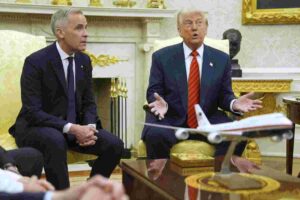
The proposed tariff increase would cover cars, trucks of various sizes, automotive parts and steel imported from Canada.
Trump simultaneously offered an incentive for manufacturers to shift production into the United States, stating that products built domestically would face zero tariffs.
The policy could put additional pressure on companies operating integrated manufacturing and supply chains across the US-Canada border, particularly in the automotive and steel industries.
Trump Targets Canadian Agricultural Tariffs
Agriculture was another major focus of Trump’s statement. He accused Canada of maintaining what he called “ridiculously high tariffs” on American farmers and farm products.
Trump argued that these measures have made it increasingly difficult for US agricultural producers to compete in the Canadian market.
His comments reflect a broader effort by his administration to use tariffs as leverage in trade negotiations and encourage greater domestic production.
The President presented the planned measures as a response to longstanding trade concerns rather than simply a new tariff decision.
‘Canada Will Be Treated Like a State No Longer’
Trump also declared that Canada would no longer receive what he portrayed as preferential treatment from Washington.
“Canada will be treated like a State no longer!” he said, linking the new tariff policy to broader concerns about trade and the relationship between the two neighbouring countries.
Trump further criticized Canada as one of the most difficult nations in the world for the United States to deal with on trade and other matters.
His statement signals a tougher approach toward Ottawa and could set the stage for renewed negotiations between the two governments before the proposed tariffs take effect.
Trump Points to Canada’s Dependence on US Trade
The President also highlighted Canada’s dependence on the US market.
Also Read: Putin Hails PM Modi In Meeting With Jaishankar As India-Russia Trade Ties Surge
Trump claimed that Canada conducts approximately 95% of its business with the United States, arguing that the imbalance gives Washington significant leverage in negotiations.
He contrasted this with his assertion that the United States does not have the same level of dependence on Canada.
The remarks reinforce Trump’s broader “America First” trade strategy, which seeks to use US market access as leverage to secure concessions from trading partners.
Major Implications for North American Trade
The proposed 50% tariffs could have significant consequences for North American manufacturing and cross-border commerce.
The automotive sector is particularly interconnected, with vehicles and components frequently crossing the US-Canada border multiple times during production. Higher tariffs could therefore increase costs for manufacturers, suppliers and potentially consumers.
Steel producers and agricultural exporters could also face changes in market conditions as both countries respond to the proposed measures.
The announcement is likely to intensify uncertainty for businesses planning investments and supply chains for 2027 and beyond.
A New Chapter in US-Canada Trade Relations
Trump’s announcement represents a sharp warning to Canada and underscores his determination to pursue aggressive trade policies.
By combining higher tariffs with zero tariffs for products manufactured in the United States, the President is seeking to encourage companies to expand domestic production while pressuring Canada to reconsider its trade policies.
The coming months could prove crucial as Washington and Ottawa assess the economic consequences of the proposed measures and determine whether negotiations can prevent or modify the planned tariff increases.
For now, Trump’s message is clear: his administration intends to put American industry, farmers and domestic manufacturing at the centre of its trade agenda—and he is prepared to use sweeping tariffs to achieve that goal.
Click here to join our WhatsApp Channel for real-time news updates and exclusive coverage.