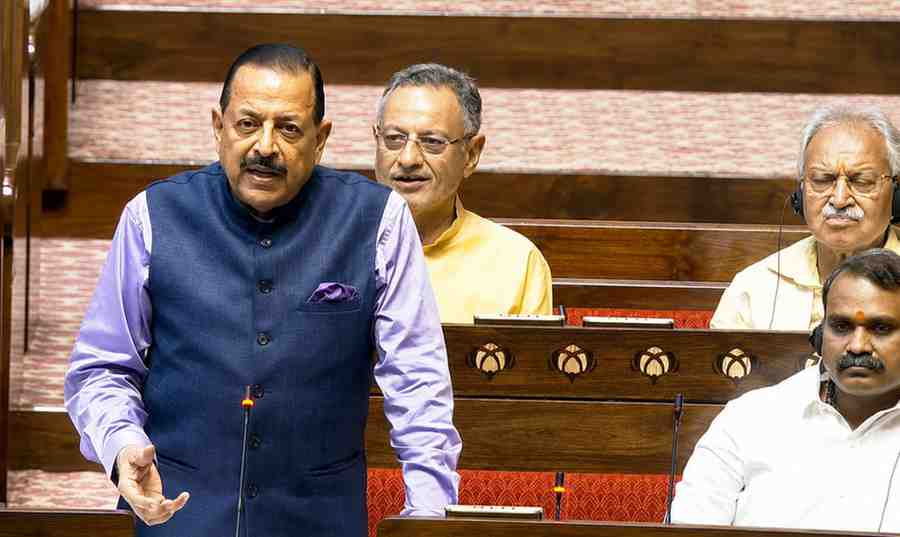
India is intensifying its efforts to tackle the growing threat of space debris as thousands of satellites and spacecraft increasingly populate Low Earth Orbit (LEO). Dr. Jitendra Singh has highlighted the risks posed by expanding satellite constellations and stressed the need for stronger monitoring, international cooperation and advanced technologies to keep Earth’s orbital environment safe and sustainable.
The Minister of State for Personnel, Public Grievances and Pensions and Prime Minister’s Office made the remarks in a written reply in the Rajya Sabha while outlining India’s approach to the rapidly evolving space debris challenge.
Growing Satellite Constellations Raise Collision Risks
The rapid expansion of satellite-based internet services has resulted in the deployment of large constellations containing thousands of spacecraft. While these systems are improving global connectivity, their increasing concentration in particular orbital regions is also creating new challenges for spaceflight safety.
Dr. Jitendra Singh said the large number of satellites operating around specific orbital shells can significantly increase the possibility of collisions. Although several major constellations have autonomous collision-avoidance systems, these safeguards cannot eliminate every risk.
Satellites can experience technical failures after reaching orbit. If a spacecraft loses its ability to manoeuvre, it may become an obstacle for other operational satellites sharing the same orbital environment.
Small Debris Creates a Major Threat
One of the most difficult aspects of the space debris problem is the presence of small and difficult-to-track objects. Such fragments can travel at extremely high speeds and may not always be detected early enough for spacecraft operators to take evasive action.
Dr. Jitendra Singh noted that these objects cannot always be avoided through existing collision-avoidance systems or adequately protected against through shielding.
A collision with even a small piece of debris can cause severe damage to a satellite, potentially ending its mission. More importantly, a major collision or accidental fragmentation can produce thousands of additional fragments, further increasing the danger to other spacecraft.
This creates the possibility of a continuing cycle in which debris-generating incidents make already crowded orbital regions increasingly hazardous.
ISRO’s Debris Free Space Mission
To address these challenges, the Indian Space Research Organisation (ISRO) is pursuing its Debris Free Space Mission, which is aimed at limiting the creation of additional debris and improving the long-term safety of space assets.
A key element of this initiative is Active Debris Removal (ADR). The technology involves removing selected inactive or hazardous objects from orbit before they can become a major threat.
According to Dr. Jitendra Singh, activities that can serve as precursors to active debris removal have already been initiated through demonstrations in orbit. These capabilities are expected to develop further as research and technological advances continue.
India Strengthens International Space Cooperation
India is also participating in several international mechanisms focused on monitoring and mitigating space debris.
The Inter-Agency Space Debris Coordination Committee (IADC), established in 1993, is among the major international bodies working on space debris monitoring and mitigation. ISRO has been a member of the committee since 1996.
India is also represented in United Nations forums dealing with the peaceful use of outer space, including discussions on long-term sustainability and Space Situational Awareness (SSA).
International organisations and working groups regularly review debris mitigation practices as the orbital environment changes. India also participates in other international platforms, including the IAA Space Debris Working Group and ISO Working Group 7.
Satellite Disposal After Missions
Managing satellites after they complete their missions is another important component of India’s space sustainability strategy.
The Indian Space Policy requires the adoption of internationally recognised space debris mitigation guidelines, including appropriate measures for the end-of-life disposal of satellites.
The Debris Free Space Mission is intended to support responsible satellite operations throughout the complete lifecycle of spacecraft, including measures to prevent inactive satellites from becoming long-term orbital hazards.
The Norms, Guidelines and Procedures issued by IN-SPACe in 2024 also encourage Indian space-sector entities to adopt suitable post-mission disposal measures. Space assets are encouraged to have limited orbital lifetimes wherever possible through natural orbital decay.
Space Situational Awareness Becomes Essential
Dr. Jitendra Singh identified Space Situational Awareness as one of the most important requirements for long-term sustainability in space.
SSA involves detecting, tracking and monitoring objects in orbit and assessing potential threats to operational spacecraft. Improved awareness can give satellite operators more time to respond to possible collision scenarios.
The government has also emphasised the importance of technical capabilities such as manoeuvrability and trackability. Satellite operators must also meet basic responsibilities, including registration and maintaining appropriate points of contact.
A robust regulatory framework is considered equally important for ensuring responsible behaviour across the expanding space sector.
India Focuses on Indigenous Capabilities
Alongside international cooperation, India is working to strengthen its domestic capabilities for monitoring space objects and addressing emerging orbital challenges.
Dr. Jitendra Singh stressed that international collaboration and data sharing are essential for achieving comprehensive Space Situational Awareness. However, India will simultaneously pursue self-reliance through indigenous technological development, research and innovation.
The government also aims to increase awareness among space-sector stakeholders about the vulnerability of usable orbital regions.
Protecting the Future of Space
The growing number of satellites is transforming the space economy, but it is also making orbital sustainability an urgent global priority. Effective debris mitigation, responsible satellite disposal, improved tracking and active removal of hazardous objects will be critical to protecting future missions.
India’s Debris Free Space Mission represents a proactive step toward addressing this challenge. With ISRO strengthening indigenous capabilities and India continuing its engagement with international organisations, the country is positioning itself to contribute to global efforts aimed at keeping Earth’s orbital environment safer, cleaner and sustainable for future generations.
Click here to join our WhatsApp Channel for real-time news updates and exclusive coverage.