
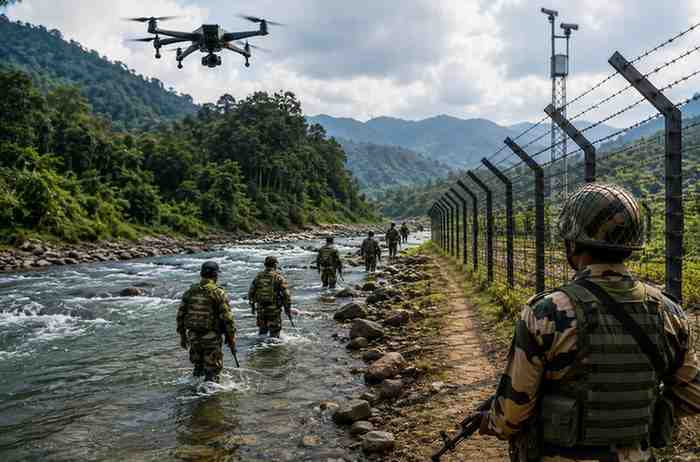
According to the Ministry of Home Affairs, India’s North-Eastern region continues to face significant challenges due to its proximity to the infamous “Golden Triangle” (also referred to in the release as the Death Triangle) and the porous Indo-Myanmar border. These geographical factors have made the region especially vulnerable to the trafficking of heroin and Amphetamine Type Stimulants (ATS) by organised transnational criminal networks.
Official figures reveal that between 2021 and 2025, enforcement agencies seized 4,626 kilograms of Amphetamine Type Stimulants (ATS) and 2,652 kilograms of heroin across the country. These seizures underline the scale of the narcotics trade and the growing presence of synthetic drugs in India’s illicit drug market.
Authorities noted that traffickers continue to exploit the Free Movement Regime (FMR) areas along the Indo-Myanmar border, making use of difficult terrain and loosely monitored crossings to transport illegal narcotics into India.
Government Launches Vision Document for 2026–2029
To address emerging challenges in narcotics control, the Centre released the Vision Document on Narcotics Control (2026–2029) on June 26, 2026. The document outlines a coordinated national roadmap involving central ministries, state governments, and enforcement agencies.
The strategy is built around four major pillars:
- Strengthening intelligence-based enforcement operations.
- Enhancing control over precursor chemicals and synthetic drugs.
- Expanding demand reduction and rehabilitation initiatives.
- Improving coordination and capacity building among enforcement agencies.
The government stated that every ministry and state authority has been assigned specific responsibilities and implementation timelines under the action plan to ensure coordinated execution.
NCORD Mechanism Strengthened Across the Country
One of the key pillars of India’s anti-drug framework remains the Narco-Coordination Centre (NCORD) mechanism, which functions through a four-tier system linking the Centre, states and districts.
At the national level, Apex and Executive Committee meetings are held regularly, while Chief Secretaries chair quarterly NCORD meetings in states. District Magistrates lead monthly district-level reviews to improve intelligence sharing, enforcement coordination and preventive action.
The Ministry has also established dedicated Anti-Narcotics Task Forces (ANTFs) in every State and Union Territory. These task forces function as the operational arms of NCORD, ensuring that decisions taken at various levels are implemented effectively.
Border Security Gets Major Technological Boost
Recognising that conventional policing alone cannot stop modern trafficking networks, the government has invested heavily in technology-driven border security.
Measures include:
- Deployment of advanced anti-drone systems in vulnerable border stretches.
- Installation of CCTV surveillance, PTZ cameras and night vision devices.
- Strengthening border fencing with upgraded infrastructure.
- Expansion of floodlighting along sensitive stretches.
The Narcotics Control Bureau (NCB) has also expanded its operational footprint by establishing zonal units in strategically important border locations including Srinagar, Siliguri, Agartala and Itanagar.
Also Read: Maharashtra Bans Junk Food Sales Within 50 Metres Of Schools
Additionally, the government has approved six new zonal offices, four of which will be located in North-Eastern states—Dimapur (Nagaland), Aizawl (Mizoram), Shillong (Meghalaya) and Gangtok (Sikkim)—to improve operational response and intelligence gathering.
Traffickers Shift Towards Synthetic Drugs
The Ministry observed a noticeable change in trafficking patterns over recent years.
While heroin continues to enter India from Myanmar, agencies have reported a sharp increase in the smuggling of methamphetamine, including crystal meth and YABA tablets, through Manipur, Mizoram and Nagaland.
Investigators have also detected illegal movement of precursor chemicals from different parts of India into Myanmar, where they are allegedly used in the manufacture of synthetic narcotics.
This shift reflects a broader trend in global narcotics trafficking, where synthetic drugs have become increasingly profitable and easier to manufacture than traditional narcotics.
Trafficking Networks Adopting Sophisticated Methods
The Ministry said organised criminal groups have continuously adapted their operating methods to evade law enforcement.
Drug syndicates now exploit forest routes, foot tracks and hilly terrain along the Indo-Myanmar border. Narcotics are increasingly concealed inside legitimate cargo, passenger vehicles and commercial goods carriers.
Authorities have also found growing use of courier services, parcel networks, encrypted communication platforms and social media applications to coordinate transportation and delivery of narcotics.
The Moreh–Tamu border crossing continues to remain one of the most significant transit points for heroin and methamphetamine entering India from Myanmar before being distributed to other parts of the country.
NCRB Data Highlights Scale of Enforcement
The Ministry also referred to the latest National Crime Records Bureau (NCRB) data covering the period from 2020 to 2024.
The data includes detailed state-wise information on narcotics seizures, arrests and convictions under anti-drug laws.
For 2024 alone, law enforcement agencies seized 942,571.125 kilograms of narcotic substances across India. States such as Rajasthan, Odisha, Madhya Pradesh, Punjab, Maharashtra, Uttar Pradesh and Assam recorded substantial quantities of seizures, reflecting both the scale of trafficking and intensified enforcement efforts.
The NCRB data also shows sustained enforcement action over recent years. Between 2020 and 2023, the number of persons arrested under narcotics-related offences increased from 83,719 in 2020 to 151,787 in 2023. Convictions during the same period rose from 16,117 to 56,743, indicating stronger prosecution and judicial outcomes alongside enforcement efforts.
Government Reaffirms Multi-Agency Approach
The Ministry emphasised that tackling narcotics trafficking requires close coordination among multiple agencies, including the Narcotics Control Bureau, Border Security Force, Indian Navy, Indian Coast Guard, state police forces and Anti-Narcotics Task Forces.
Regular Joint Coordination Committee meetings are held to facilitate intelligence sharing and joint investigations into major narcotics cases, while border surveillance and operational cooperation continue to be strengthened.
Written Reply in Rajya Sabha
The information was shared by Minister of State for Home Affairs Nityanand Rai in a written reply to a question in the Rajya Sabha. The government reiterated its commitment to adopting a comprehensive, technology-driven and intelligence-led strategy to curb cross-border narcotics trafficking and dismantle organised drug networks operating along India’s borders.
Click here to join our WhatsApp Channel for real-time news updates and exclusive coverage.