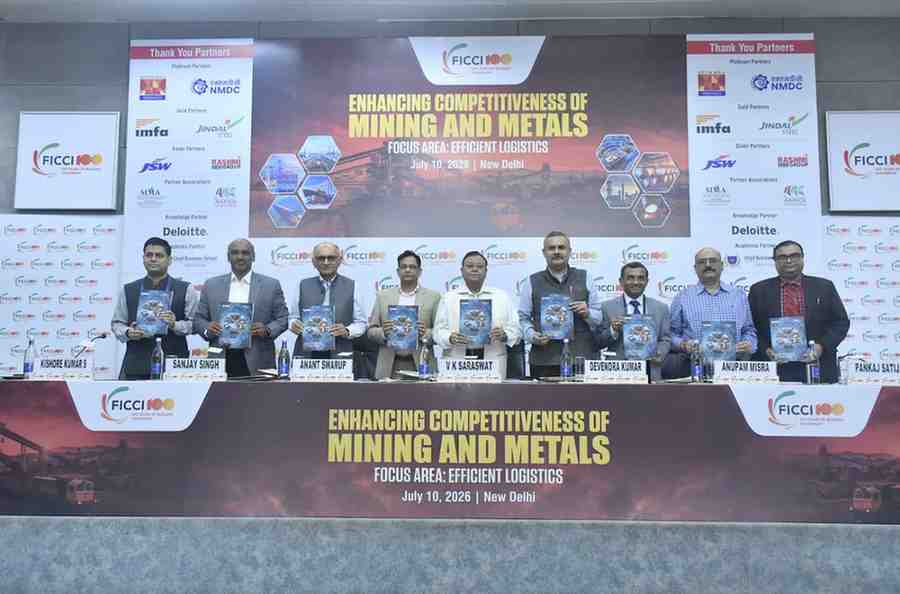
NEW DELHI: India’s mining and metals sector must treat logistics as a strategic pillar of competitiveness if it aims to meet the country’s long-term industrial growth ambitions, former NITI Aayog member Dr V K Saraswat said at the FICCI Conference on Enhancing Competitiveness of Mining and Metals held in New Delhi on Thursday.
Speaking at the conference, Dr Saraswat challenged the commonly quoted estimate that India’s logistics costs account for nearly 14 per cent of the country’s Gross Domestic Product (GDP). He noted that for the mining and metals sector, the actual figure may be closer to 8 per cent of GDP. However, he stressed that despite relatively competitive logistics costs, structural weaknesses continue to affect the efficiency of the industry.
Connectivity Gaps Continue to Challenge Sector
Dr Saraswat pointed out that inadequate first-mile and last-mile connectivity remains one of the biggest hurdles for the mining industry. Many mining locations are situated in remote, forested and mountainous regions where transport infrastructure is still underdeveloped.
He also highlighted the heavy dependence on road transport for moving minerals, saying that road haulage can cost two to three times more per tonne-kilometre than rail transport for bulk commodities. According to him, shifting a greater share of freight to rail and other efficient transport modes is essential for improving productivity and lowering operational costs.
To address these challenges, Dr Saraswat proposed a comprehensive ten-point national strategy aimed at strengthening India’s logistics ecosystem for mining and metals.
The recommendations include establishing dedicated mineral freight corridors with seamless connectivity, expanding conveyor systems and slurry pipelines, accelerating port mechanisation, rationalising logistics taxation, developing regional mineral logistics parks, strengthening railway connectivity to mining clusters and increasing digitalisation across the logistics value chain.
Emerging Technologies Can Transform Mining Logistics
Dr Saraswat also underlined the growing role of advanced technologies in modernising mining logistics. He identified six emerging technologies capable of significantly improving operational efficiency across the sector.
Also Read: Monsoon: MeT Alerts Himachal Over Flash Floods And Landslides
These include autonomous haul trucks and driverless freight trains, artificial intelligence-based dispatch optimisation systems, drone-assisted mine surveying, robotics for material handling, digital twin technology for real-time logistics simulation and decision-making, and satellite-enabled fleet monitoring integrated with 5G communication networks.
According to him, adopting these technologies will improve operational efficiency, reduce transportation delays and enhance supply chain visibility. He emphasised that logistics should no longer be viewed merely as a support function but as a strategic determinant of India’s mining and metals competitiveness.
Railways Expanding End-to-End Logistics Services
Addressing the conference, Devendra Kumar, Additional Member (Traffic), Railway Board, outlined the Indian Railways’ efforts to strengthen integrated freight transportation.
He said Container Corporation of India is already operating end-to-end container services between Delhi and Kolkata through Agra and Kanpur. Parcel train services are also running between Mumbai and Kolkata to improve freight movement.
He further revealed that Indian Railways has successfully conducted trials involving the coupling of two or three freight trains together. Such initiatives could pave the way for operating freight trains stretching up to two kilometres in length, similar to practices already adopted in several other countries.
Mr Kumar also stressed that government policies and industrial initiatives should remain citizen-centric, with success measured by improvements in economic opportunities and quality of life rather than merely by the amount of infrastructure created.
FICCI-Deloitte Report Highlights Logistics Bottlenecks
During the event, FICCI and Deloitte jointly released a report examining logistics competitiveness in India’s mining and metals industry.
The study concluded that India’s freight tariffs are broadly comparable with international benchmarks, making them globally competitive. However, fragmented multimodal logistics networks and excessive reliance on road transportation continue to reduce overall efficiency and increase operational complexity.
The report called for stronger integration between railways, ports, roads and other transport systems to unlock greater competitiveness across the mining value chain.
Industry Leaders Stress Infrastructure Development
Opening the conference, FICCI Secretary General Anant Swarup observed that commodities such as coal, iron ore, steel, fertiliser, cement and foodgrains account for a significant share of India’s freight movement, highlighting the importance of efficient logistics.
Kishore Kumar S, Chief Operating Officer of Hindustan Zinc, said India’s annual freight movement is expected to increase from around seven billion tonnes currently to nearly 20 billion tonnes by 2047 to support the country’s Viksit Bharat vision.
Former Steel Secretary and Director of Strategy & External Relations at Jindal Steel, Sanjay Singh, said logistics costs have steadily moved towards single-digit levels in recent years. However, he noted that sustained investment in logistics infrastructure remains critical for enhancing the competitiveness of mines and manufacturing plants.
Anupam Misra, Chairman and Managing Director of Hindustan Copper, highlighted that internal haulage operations account for nearly 40 to 60 per cent of mining operating costs. He said the company is working towards expanding its production capacity to 12.2 million tonnes by 2030, making efficient logistics increasingly important.
The conference concluded with a vote of thanks by Dr Pankaj Satija, Co-Chair of the FICCI Mining Committee and Executive Vice President of the JSW Group, who reiterated that efficient logistics will remain a key driver of competitiveness and sustainable growth for India’s mining and metals sector.
The event focused on freight structures, expansion of logistics infrastructure, improvement of first- and last-mile connectivity and greater use of metals in the development of ports, railway wagons and other transport infrastructure to support India’s future industrial growth.
Click here to join our WhatsApp Channel for real-time news updates and exclusive coverage.