
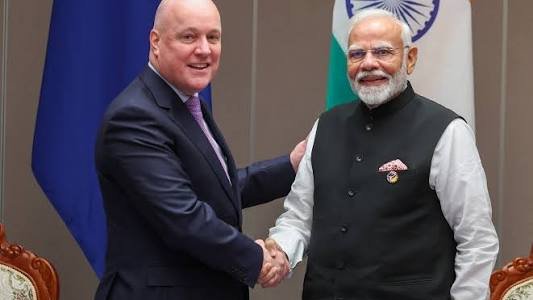
Prime Minister Christopher Luxon has said that 57% of New Zealand’s exports to India will become tariff-free immediately under the newly concluded India-New Zealand Free Trade Agreement (FTA), describing the pact as a major breakthrough that will strengthen economic ties between the two countries. His remarks come ahead of Prime Minister Narendra Modi’s official visit to New Zealand, which is expected to mark a significant milestone in bilateral relations.
The agreement is being viewed as one of the most ambitious trade deals between the two Indo-Pacific partners, with leaders from both nations expressing confidence that it will expand trade, attract investment, and create new opportunities for businesses and workers.
Luxon Highlights Immediate Tariff Benefits
Speaking ahead of Prime Minister Modi’s visit, Luxon said the agreement would allow more than half of New Zealand’s exports to enter the Indian market without tariffs from the first day of implementation. He added that tariff reductions would gradually expand, eventually covering around 95% of New Zealand’s exports.
The New Zealand Prime Minister said the deal represents a major opportunity for exporters, particularly those in agriculture and food production. Reduced import duties are expected to make New Zealand products more competitive in India’s rapidly growing consumer market.
Industries such as dairy, kiwifruit, apples, meat, forestry products, seafood, and wool are expected to benefit significantly from easier access to India, one of the world’s fastest-growing major economies.
Modi Visit Expected to Deepen Bilateral Relations
Prime Minister Narendra Modi’s upcoming visit is expected to provide fresh momentum to India-New Zealand relations. Apart from celebrating the conclusion of the FTA, both leaders are likely to hold extensive discussions on trade, investment, defence cooperation, education, technology, renewable energy, and regional security.
Read Also: India: Building A Gender-Inclusive Gig Economy For Sustainable Growth
Officials believe the visit will help broaden cooperation beyond commerce and encourage greater collaboration in innovation, digital technology, clean energy, agriculture, and higher education.
The two countries also share common interests in ensuring stability and prosperity across the Indo-Pacific region, making strategic cooperation an important element of the talks.
FTA Seen as Historic Milestone
The India-New Zealand Free Trade Agreement concludes years of negotiations aimed at improving market access and reducing trade barriers.

For New Zealand, India represents one of the largest untapped export markets due to its massive population, expanding middle class, and rising demand for high-quality imported products. Easier access to this market is expected to help New Zealand diversify its export destinations while reducing dependence on traditional trading partners.
For India, the agreement provides improved access to New Zealand’s market while strengthening supply chains and expanding opportunities for Indian businesses.
Trade experts believe the agreement could substantially increase bilateral trade over the next decade by encouraging new commercial partnerships and investments.
Indian Exporters Also Stand to Gain
While New Zealand exporters are expected to benefit from tariff reductions, Indian businesses are also likely to receive improved market access.
Products such as textiles, garments, pharmaceuticals, engineering goods, machinery, automotive components, gems and jewellery, leather products, and information technology services are expected to gain from lower trade barriers.
Indian companies are also likely to explore new investment opportunities in New Zealand across sectors including renewable energy, digital infrastructure, manufacturing, education, tourism, and agribusiness.
Industry leaders from both countries have welcomed the agreement, saying it will create a more predictable and business-friendly trading environment.
Boost for Agriculture and Food Trade
Agriculture remains one of New Zealand’s strongest export sectors, and the FTA is expected to provide significant benefits for farmers and food producers.
Products including fresh fruits, dairy ingredients, meat, seafood, honey, and forestry products could witness increased demand in India as import costs decline.
At the same time, Indian consumers are expected to benefit from a wider variety of imported food products, while Indian exporters will gain better access to the New Zealand market for processed foods, spices, tea, coffee, and manufactured goods.
Experts believe improved trade logistics and customs cooperation under the agreement will also reduce transaction costs for exporters.
Investment and Innovation to Receive Fresh Push
Beyond merchandise trade, the agreement is expected to strengthen investment flows between the two countries.
New Zealand companies are showing growing interest in India’s expanding infrastructure, renewable energy, food processing, digital economy, and technology sectors. Meanwhile, Indian firms are increasingly exploring opportunities in New Zealand’s education, tourism, information technology, healthcare, and innovation ecosystem.
The two governments are also expected to encourage greater collaboration between universities, research institutions, and technology startups.
Business delegations accompanying both leaders are likely to explore new partnerships during Prime Minister Modi’s visit.
Strategic Partnership Expands Beyond Trade
India and New Zealand have steadily expanded cooperation over the past several years across defence, maritime security, climate action, disaster management, and education.
Both nations support a free, open, and inclusive Indo-Pacific and continue to work together in regional and multilateral forums.
Prime Minister Modi’s visit is expected to reinforce these shared priorities while opening new avenues for cooperation in emerging technologies, cybersecurity, clean energy, artificial intelligence, and sustainable development.
People-to-people ties, driven by a vibrant Indian diaspora in New Zealand, are also expected to feature prominently during the discussions.
Business Community Welcomes Agreement
Industry groups in both countries have welcomed the Free Trade Agreement, saying it provides long-term certainty for businesses.
Exporters believe lower tariffs, simplified customs procedures, and stronger regulatory cooperation will reduce costs and improve competitiveness. Companies are also optimistic that the agreement will encourage joint ventures, technology transfers, and increased investment.
Trade analysts believe the FTA positions both economies to benefit from changing global supply chains while strengthening economic resilience.
Looking Ahead
Prime Minister Christopher Luxon’s announcement that 57% of New Zealand exports will receive immediate tariff-free access to India underscores the significance of the newly signed Free Trade Agreement. As Prime Minister Narendra Modi prepares for his visit to New Zealand, expectations are high that the two leaders will use the occasion to deepen economic, strategic, and cultural ties.
With expanding trade, growing investment, and stronger cooperation across multiple sectors, the agreement is expected to usher in a new chapter in India-New Zealand relations, benefiting businesses, workers, and consumers in both countries while reinforcing their partnership in the Indo-Pacific region.
Click here to join our WhatsApp Channel for real-time news updates and exclusive coverage