
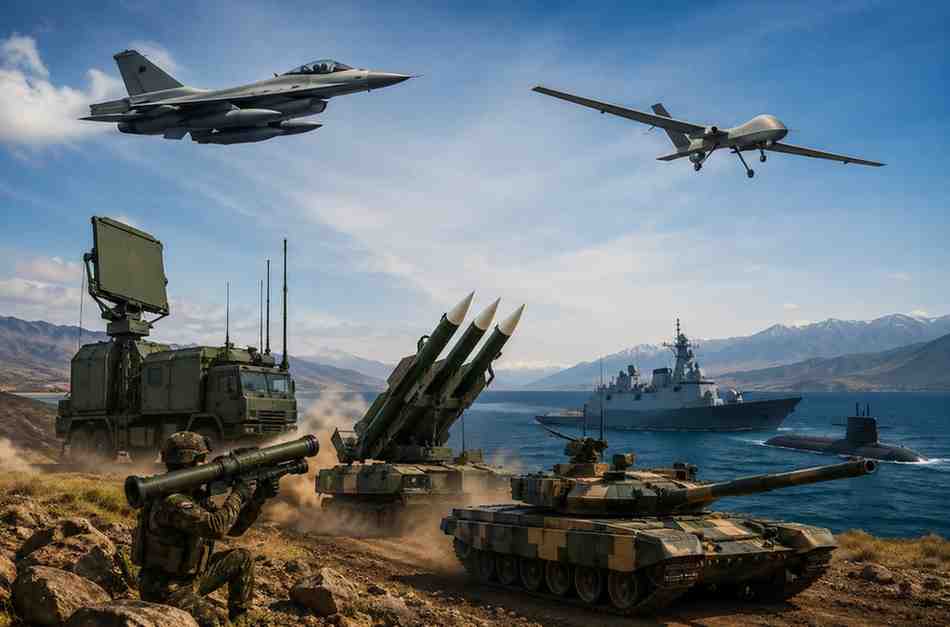
India’s Defence Modernisation Gets Major Push
The Defence Acquisition Council (DAC), chaired by Defence Minister Rajnath Singh, has approved a series of major defence procurement proposals worth nearly ₹52,000 crore, marking one of the most significant modernisation initiatives for the Indian Armed Forces in recent years. The approvals, granted under the Acceptance of Necessity (AoN) process, pave the way for the acquisition of advanced weapon systems, surveillance platforms and cutting-edge defence technologies for the Indian Army, Navy and Air Force.
The decisions reflect the government’s continued emphasis on strengthening national security while promoting indigenous defence manufacturing under the vision of self-reliance in defence production.
Indian Army to Receive Advanced Combat and Air Defence Systems
The Indian Army has emerged as the biggest beneficiary of the latest approvals, with several next-generation weapon systems set to enhance battlefield capabilities across multiple operational domains.
Among the key acquisitions is the AKASH TARANG Anti-Unmanned Aerial Vehicle Electronic Warfare System, designed to detect, jam and neutralise hostile drones. As unmanned aerial threats become increasingly common in modern warfare, this system will provide an effective protective shield for Indian Army formations deployed across sensitive borders.
The DAC has also approved the procurement of the Man Portable Anti-Tank Guided Missile (MPATGM) system, which will significantly improve the Army’s capability to destroy enemy armoured vehicles and tanks during combat operations. Lightweight and portable, the missile system will provide infantry units with greater operational flexibility.
Another major approval involves the Medium Range Surface-to-Air Missile (MRSAM) Weapon System. The system is designed to intercept a wide range of aerial threats, including aircraft, helicopters, drones and cruise missiles, strengthening India’s layered air defence network.
The Army will also receive the Very Short Range Air Defence System (V-SHORADS) featuring multi-spectral sensing technology. This advanced system is expected to improve resilience against electronic countermeasures while enhancing the effectiveness of low-altitude air defence operations.
To improve the survivability of armoured formations, the Council approved the acquisition of an Active Protection System (APS) for tanks. The technology can detect and destroy incoming anti-tank missiles before impact, significantly increasing battlefield protection for Indian armoured units.
Additionally, the procurement of Jet-Based Kamikaze Drone Systems will provide enhanced electronic warfare capabilities with greater precision, lethality and cost-effectiveness, allowing forces to engage high-value enemy targets with minimal risk to personnel.
Read Here: Centre Appoints IAS Lokhande Prashant Sitaram As CBSE Chairperson
Indian Navy to Strengthen Maritime Security
The Indian Navy will also benefit from several critical acquisitions aimed at improving maritime surveillance, underwater warfare and future naval propulsion technologies.
The DAC approved the procurement of Multi Influence Ground Mines (MIGM), which are designed to deny enemy naval vessels the freedom to manoeuvre in strategically important waters. These advanced mines will strengthen India’s sea-denial capabilities.
The Navy will also induct the Naval Shipborne Unmanned Aerial System (NSUAS) equipped with sophisticated sensors for intelligence gathering, surveillance and reconnaissance missions. These drones will improve situational awareness during maritime operations and enhance fleet effectiveness.
Another important approval is the establishment of a Land Based Testing Facility (LBTF) for Electric Propulsion Systems. The facility will support testing and validation of motors and propulsion technologies intended for future Indian naval platforms, contributing to long-term technological advancement.
Indian Air Force to Expand Strategic Surveillance
For the Indian Air Force, the Defence Acquisition Council approved the procurement of a Fixed-Wing High Altitude Pseudo Satellite (FW-HAPS) platform.
Operating at extremely high altitudes for extended durations, the system will perform persistent Intelligence, Surveillance and Reconnaissance (ISR) missions while supporting telecommunications and remote sensing operations. The platform is expected to provide continuous monitoring over large geographical areas without relying solely on satellites, thereby improving strategic awareness and operational planning.
Significance for India’s Defence Preparedness
The latest approvals represent a major milestone in India’s ongoing defence modernisation programme. By investing in advanced anti-drone systems, layered air defence, smart missiles, autonomous platforms and surveillance technologies, India is preparing its armed forces to meet the challenges of modern and future warfare.
The acquisitions are particularly significant given the evolving regional security environment, where drones, precision-guided weapons, electronic warfare and cyber-enabled operations are becoming increasingly important. The approved systems will enhance India’s ability to respond rapidly to both conventional and asymmetric threats across land, sea and air.
The emphasis on indigenous technologies and advanced defence manufacturing is also expected to strengthen India’s domestic defence industry, encourage innovation, create skilled employment opportunities and reduce dependence on foreign imports. This aligns with the government’s long-term objective of achieving greater self-reliance in defence production.
Overall, the ₹52,000 crore approvals are expected to substantially improve operational readiness, enhance force protection, strengthen deterrence and provide the Indian Armed Forces with modern capabilities required to safeguard national security in an increasingly complex strategic environment.
Click here to join us on WhatsApp Channel and get all the latest news updates